The deadliest thing of all isn't to do bad things, it's to do nothing at all. If you do wrong you can always learn from it and redirect yourself, but if you do nothing you won't ever get to that point. In this reality, you can either do things or not do things, and it's 100% up to you. And if you want to make it easier for yourself to do things, it seems to come down to two things:
- Doing what you intrinsically enjoy
- Having a greater purpose
What these two have in common is that they are what you have unlimited (almost...) energy for doing regardless of what happens outside of you. They're what you do when nobody sees you. Meaning that they have no connection to your need for confirmation and attention, your lust for fame, your social life, or your internal pressure and anxiety. That's why you have almost unlimited energy for them - because they don't have all that around-stuff that weighs it down. You could also give all this "around-stuff" another name: Results. Confirmation, attention, fame, social approval, money, these are all results you could or could not want, and your internal pressure and anxiety are the feelings worrying about if you'll get them or not. All this is pretty meaningless and takes unnecessary time and energy.
After all, you can't control the results, you can only control what you do. That's why doing something while thinking about the results takes so much energy and leaves you unsatisfied and exhausted, because you put energy on thoughts of wanting and needing something you can't control either way. If you just focus on what you do, you put focus on what you actually control.
If you intrinsically enjoy something, you do it not for the result but for the actual process of doing. Having a greater purpose in life on the other hand is about striving towards a goal, but it's all about creating results in the world outside of you. Having a real purpose that's greater than yourself somehow gets you back to the process and out of your unnecessary anxiety and worries. If someone in your family needed help you'd probably quickly understand what's a waste of time and what's important and easily make the right decision. You would have almost unlimited energy to both filter away unnecessary obstacles and to withstand necessary obstacles. When you intrinsically enjoy doing something you forget about obstacles, but when you're doing something for a greater cause it doesn't matter if the obstacles are there or not and if you forget about them or need to handle them, you do what you can anyway. Intrinsic enjoyment gets you energized, while working for a greater purpose may do the same, but it could also drain you completely, but it would somehow still be worth it to continue. How this works is unclear, but the body seems to be able to do almost anything if you give it a good enough reason.
To find these two forces, just wait and see what you do when you have time for yourself and no one sees you (no, not that thing). And also wait for your own thoughts and desires to slowly drift away. Stop thinking about the future and the past. Stop planning and deciding. What are you drawn towards naturally? I guess that between all those things you have to do (work etc), and all those things you believe you need to do, and all those things others want you to do, things just happened without any planning or forcing yourself. For me personally, those things are writing about ideas like this, creating things, and traveling to new places. I've never had a plan set out for doing those things, it has just happened naturally through all my life in between all other parts of life, and I don't really know how. That's probably where your intrinsic enjoyment lies, and maybe where your greater purpose lies too. If you enjoy something you'll do it a lot, which will make you better at it, and that's where great purpose can be found - where you can use your unique knowledge in a way others can't. That's where you're needed. Where what you like doing, what you care about, what you're good at and where you happen to be intersect. Since having this kind of drive and motivation lets you spend less energy on doing something, chances are you're already doing that thing automatically, because it's so easy for you. Just be honest with yourself and let go of all the "but's" ("but I need to do that other thing for financial reasons!", "but I want to like doing that other thing!", etc). Look for those things you can do how much you feel like, and how little you feel like, where neither procrastination nor pressure (which are two forms of the same thing) exist.
You can also train yourself to do things without results. Start doing things without looking at the reactions. Put something out there, and don't check for comments and likes. Say something nice to someone, and try to not be phased by the happiness or non-happiness of that person. Don't try to win anything for doing something. It's hard to get rid of this part of life, because we're taught to win and succeed. If you try to do something without caring about the reactions, but you still get angry and frustrated if you get the "wrong" reactions, maybe you weren't doing something you really enjoyed intrinsically. So then go back and try again with something else. If you truly enjoy something intrinsically you won't get angry with any results. And since you have almost unlimited energy to do what you enjoy intrinsically, why not spend all your time on such things? Following this logic, the results automatically become uninteresting. Because how fun is success compared to doing something that always feels easy and natural? Maybe that's what success actually is. However, be thankful if great results come, but don't long for them.
When using this method, I sometimes catch myself thinking like "Perfect, I've found a method for doing things without attachment to the results. This will definitely lead to great results!" And then I'm suddenly attached again. If you end up always going back to the results, the satisfaction, the reward, maybe you don't intrinsically enjoy it or feel a greater purpose, but are just trying to trick yourself. You shouldn't use your passion to get something in the end, the passion is the end goal. There is no way around it. Be ruthlessly honest with yourself: Do you enjoy it or not? Do you care about it or not? If you saw yourself from the outside, would you think the person you saw (=yourself) was true to their passions or tried to do something to get an advantage? I can't stress it enough: Be honest!
If you have a motivation based on the process instead of the results, it will be easier to handle negative emotions. Because the goal isn't to get positive reactions from other people or to feel good and do good things always. You'll be able to see other people's opinion as pure information and not get too emotionally affected by them, because your focus is on the process of learning and getting better, for the sake of it or to contribute something to the world, not on getting acceptance and liking. You won't cater to what people want from you, because the goal isn't to be accepted, and you won't be angry and give up when you get criticism, of the same reason. You'll be able to better see through your own self-criticism and take breaks to clear your mind, because meeting a deadline or meeting a quality bar isn't the goal. In fact, there is no goal, you're just doing the thing.
Western societies teach you to "win", and that to do that you have to fight against other people's reactions and criticism of you. But if you don't even try to win and let go of the idea that winning even is in your control, you don't even have to fight anything. When you don't need to win anything, no one can be against you.
Then: Take the first step. People often want to figure out how to do things before starting, but it's the other way around that actually works... So, just take the first step. Do as little as you can, as long as it's something, so it doesn't go the other way and you get overwhelmed. It doesn't matter what you do or how you do it, you should just do something. After that you'll know a little bit more about what to do next. With enough experience you'll eventually be able to plan ahead and see around the corner, prevent mistakes and take opportunities. You need to be realistic and practical to achieve what you want to achieve, but for that you need experience, and you'll get that from taking action and not from thinking about maybe doing something at some time.
If you're sitting around asking yourself what's the right thing to do, you're not taking action. You're probably putting more energy into not starting right now than you would do actually starting it. So let go of the resistance, don't be afraid, and see what happens. It's not hard to start as long as you stop overthinking and actually like what you do.
And if you don't know what you like or care about, just doing something lets you try new things out and eventually find your thing. When you just do anything, you'll suddenly find just what you were looking for. Even if you don't know what you were looking for. Sometimes after only a minute. It felt so difficult to get going, when you don't know what you want, but simply taking a step led you very far. At least it is like this for me. Doing just about anything is sometimes extremely effective, much more effective than trying to do something good or correct, because the latter takes time and could easily lead to nothing. As you see, doing is always better than not doing, which is the whole point of this text.
Experience will also in the end give you better judgement for the creative and intuitive parts of your process. This is also knowledge you can't get from others, because no one else knows how your thing should be done (after all, it's your thing!), and it's also hard to get this knowledge from just thinking things through before you've even done anything. Just take action in what you feel good about doing until you're good enough to have skills and intuition in your own domain. If you're bothered by your own pre-conceived notions or other people's advice on what you should or shouldn't do, actual experience from taking actual action is also the antidote. There are lots of ideas out in the world, that may have taken place in your mind, about what's reasonable and not to do. Peer pressure and social conformity. As soon as you start and learn from real experience you'll understand how the knowledge you get from actual experience means more than what other people are saying, and you'll be able to filter out which people know their thing and who are just talking nonetheless without knowing anything.
You sometimes need that first push to get out of your comfort zone, but if you have an intrinsic and purposeful motivation where you automatically fall back into that thing because it's just naturally for you to do so, you don't need much more habit or discipline. If you actually have the right motivation and don't do it for anyone else or for results, you'll probably continue with it. Maybe you need that push again now and then when you fall back into the comfort zone. But if you've REALLY found your thing, doing that thing _is_ the comfort zone. A lot of the productivity advice out there assumes that you don't really like what you're doing and therefore have to push through in some way. That's a lot of unnecessary energy spent on the act of forcing instead of on doing the actual thing. Forcing yourself is also unsustainable and will make you quit as soon as the discipline disappears.
I'm not naive and believe this post will change you. Change doesn't come from getting new information, it comes from an emotion inside of you. Even if I've laid out how you practically can find a better motivation for doing things, if you don't want to change you won't change. Kids do as their parents do and not as they say, so maybe I should instead hope that the amount of intrinsic and purposeful time I've laid on writing this post shines through and that it inspires you to feel like doing something yourself, regardless of if you've taken my message to heart or not. Maybe my work in the end will inspire you to stop thinking about doing and talking about doing, and instead just do.

In 2020 Poppy was the "weird Youtube art project pop singer" that just recently had turned into a genre-bending metal/pop act. And I really liked it. At that time I spent some time listening to her albums before that, to see her development. And now six years later, I want to look back on it all from today's perspective, and ask... What the heck happened?
Poppy.Computer (2017)


Video games are made of code (mostly), and code can easily become very complex. And since you need to understand what you're working on, both creatively and technologically, you must understand the code fully. For my last game I solved this by not letting it grow too complex so I could understand the whole code by just looking at it (it also helped that I had recently created almost all of it from scratch and had all the connections and systems fresh in memory...), and also by making the game very linear, meaning there's only one order you can play through the game's events in, which means much less possibility for parts of the code to interact weirdly with each other since everything is separated.
However, for a more sophisticated game like MANAGO (the game is either done or not done, depending on when you read this), I can't rely on understanding the code by simply looking at it. I can't keep the game small, simple and minimal, because I want to create more than that. More than I can keep in my head at one time, more code than can possibly be grasped by a short look of a human eye, or even a couple of long ones. And since the game's events, in a non-linear fashion, can occur in many different orders and affect each other in many different ways, trying to understand what actually happens in the game by looking at separate parts of the code won't really work.
Long story short, to understand a project like MANAGO, I have to resort to documentation...
As I said in the previous post of this series, I want the production capacity of a company but not the administration burden of it. So when starting to put more time on documentation, it's important to not become a company filled with administration and "around-work" that takes all time from the real work. So I have to document as little as possible and get as much out of it as possible. "Real" companies solve their complexity by creating systems to handle it, which in turn also grow so complex that they need to hire people to specifically handle those systems. That's what I don't want, especially not for programming related tasks, since the knowledge of the code as a whole then would be divided among multiple people. I believe that good and efficient code relies on one person knowing how all different parts work together, which is lost when different people are working on different parts.
My principles for documenting enough, but not more than that, are:
Don't document everything. Write more about the important parts, less about the less important parts, and leave out the least important parts.
When writing about something, don't hide details and don't assume the reader (you in the future) will know what you mean. Write briefly and concisely in clear human language, and involve technical concepts from the code when needed. By forcing yourself to write clearly and don't skip over details, you also force yourself to understand your project as a side-effect.
Mark with "IDEA:" when you come up with an idea for something to do, so you can come back to the document and quickly find tasks to do.
Mark with "-- WRITE MORE HERE --", where you're not done writing. So you can come back to the document later, even much later, and continue filling it up with information without wondering what's even left to add.
All this is to make the document easy to come back to and understand even if you forget about it for 6 months. It shouldn't be too long and boring, it shouldn't have the risk of becoming a "dead" document, it shouldn't be underexplained, and it shouldn't assume the reader knows any context or remember what they wrote last time. And besides coming back to read the document in the future, you should also be able come back and work more on the document in the future, and not rely on the sudden burst of inspiration at the start of doing something like this, because that fire will burn out and you still have things to do.
Bonus: Colorize for how much something matters, how much it affects other things, or how much that code is run. How important a part of the code is is hard to grasp from just looking at the code, but a color code for it gives us instant information. Things like how many times a piece of code runs every frame, or how a piece of code relates to other parts of the code, may be hidden "between the lines" or at least require looking at several vastly different parts of the code, which is hard to do in a large codebase. So right now I use color to show important structures you can't see in the code.
And remember that this type of clear documentation depends on the code not suddenly changing after a couple of month. Otherwise the documentation will stop being true, and all the common problems of being a company will start to occur. There's no coincidence that I came up with this system for my second project, where I both reuse old technology from my last game that's stable and proven to work well, and also have a hard time remembering how it worked...
Also, remember to throw away the document as soon as it doesn't help you anymore. Systems and documentation have no purpose in themselves.
This documentation, both the process of writing it and the document itself, can help with finding performance issues, potential bugs, unused or unnecessary code, inconsistent and badly written code, getting a clearer understanding of how the whole game system works, and also for more creative parts like showing what content is actually in the game, what needs to be added, where to put more focus, what thing to create in the game next, how to connect different parts of the story, which characters are used more or less, etc, etc... It's supposed to give you both information about the details and about the whole at the same time in a concise document, compared to the code itself where you either see the whole or a detail at a time and have a hard time seeing nuances and connections.

kbrecordzz can't, and shouldn't, be a real company, because I would need to spend too much time on really boring tasks that I don't want to spend time on. But I still want to create art & entertainment on the same level as a company could, just without the buildings, the staff, the internal bureacracy and the tax obligations. I want the production capacity of a company but not the administration burden of it. One reason is to surpass my hard limit of how many cool things I can come up with every day to create (they're not very many). There's no real limit to how many things I can make, but there seems to be a limit to how many GOOD things I can make, because the more I try the lower the average quality of them become.
Here's what I said in another post:
"I've made my tools work so well for me that the process of adding content into the game isn't what takes time anymore. That goes relatively fast, and now what takes time is thinking and coming up with all the ideas for what to add. To make sure I'm not just being productive and adding stuff without it being any good."
So technology, debugging and frustration aren't the bottleneck anymore, now it's the actual creative work. So let's tackle that bottleneck!
I think one solution is more inspiration, and most of all more diverse inspiration. To be a fan, not an artist, when enjoying other music, videos, games, movies, books, and so on, to find more new unpredicted things and not just the same favorites or that thing you were looking for. Find all the other stuff. Focus less on production and more on inspiration, that way you'll have more good and unique ideas to actually produce. This is just a good and fun way to not get the same ideas over and over again.
To take the idea of diverse inspiration further, another solution is collaborating (which I'm already utilizing; the story and characters for This Is (NOT!) A Car Club and the upcoming game MANAGO have been developed pretty much together with H. Von Asrik, known from the credits). When I don't have any more ideas, others have. But they have to be as good or better than mine, and fit into the projects I'm making, because someone could be brilliant but in a completely different way that doesn't fit with kbrecordzz and that wouldn't work (unfortunately, this is often the case with brilliant and unique people). This type of collaboration also can't be like work, it has to be fun time with friends, with no strings attached and no goals in sight. Because it never feels like work for me, and if I would start hiring people to come up with things for my games I know that the games would lose their fun factor. So I'm careful when it comes to collaborating for creative ideas, because picking the wrong person means more problems than solutions and then I've suddenly become a company...
But in the best of worlds I wouldn't come up with all areas, all nature, all buildings, all events, all objects & items, all UI and all around-work for a game on MANAGO's level by myself, and instead some of the things could get help from someone who is good in their field and understands the kbrecordzz style. Because I'm starting to run out of ideas for where to put flower pots and lamps inside of the MANAGO HQ building, and I'm sure someone out there is passionate about this in a way I couldn't even imagine.
Collaborating on the production side is easier. While it's hard to find people who can come up with kbrecordzz-like ideas, lots of people are better at art, music and sound design than me. It's much harder for me with my limited time to become a pro at both programming, design, making music, drawing graphics, creating sound effects, etc, compared to one person focusing on just one of those things. So I want to become good at making "mock-up" sketches for others to refine. For graphics, if I draw simple and quick sketches, and learn to communicate how I want the end-result to look, I can get much better graphics for my game without putting way too much time into it (Sachiko Mili, known from the credits of This Is (NOT!) A Car Club, has already started raising the level of MANAGO's visuals one step at a time). Lots of AI generated art from my previous game could also be replaced with more unique and lively art if someone talented drew them for "real".
When collaborating like this there's a risk that I become a company. I like creating things, not managing things, so I also want to become good at grouping material together in "batches" to not put all my time on communicating back and forth with people for every single thing I'm asking for (this is probably also beneficial for the other side of the communication). So I'll try to group similar ideas and sketches together to get much done at the same time. If I don't do it like this, I either won't get as much new cool graphics as I want, or I'll become a company filled with communication and administration instead of art and entertainment.
Let's see if I come up with anything more and make a #2 of this post "series" (who says a series can't consist of just one part? Break free of the mental chains that control you!).
1. The stress, worry and fear will always try to outsmart you. They always come in the disguise of something good. When you think "but this time it's not stress, worry or fear, this time it's for real!" it's definitely stress, worry and fear again. They will try to outsmart you one, two, three times, and so on, and you have to not believe in it every time. Yes, even the fourth time (yes, even the fifth time, and so on, and so on).
2. When in doubt, do one thing, not more and not less. Don't avoid doing the thing you're thinking about doing. Do more than 0 things, to avoid a vicious circle of inaction which leads to depression. Do less than 2 things, to not be overwhelmed and give up, but instead get on the right track first.
3. Never be indoors for a whole day (exception: when you're sick, but then you have to be really sick). Take at least one step outside the door every day. This is to make sure you're not alone with your thoughts for so long that you start to believe them too much, and for the general health benefit of being outdoors.
4. In general, physically work out every 2-3 days. This is because all aspects of life get a little bit better from it. If you can't work out, do something less intense like walking. If you can't walk, you can't.
5. Interact with humans in the real physical world now and then. This is to feel less alone, and to reduce the risk of becoming crazy from being alone with your own thoughts for too long.
6. Take a deep breath, until the stress, worry and fear disappear. Goes for all situations.
7. Take breaks. A bit more often and a bit more than you think you need.
8. Remember that you have free will, and therefore the possibility to decide by yourself what thoughts you think, what actions you take and what emotional reactions you get.
You have free will.
Therefore you have the ability to choose by yourself what thoughts you think, what actions you take and what emotional reactions you get.
Which means that you can wake up in the morning, and without putting anything more in you than water, live a life free from stress, worry and fear.
The serenity prayer goes like this:
"God, give me the serenity to accept the things I cannot change, the courage to change the things I can, and the wisdom to know the difference."
This is good advice, and you know that, but it's another thing to live by it in practice.
Accept that you can't change anything else than your thoughts with your thoughts. This is to stop thinking and stop trying to solve things with your thoughts.
There's only one thing to do: Find out what the best thing practically to do in your situation is, do that, and nothing more. After this the thinking is over.
The most usual scenario is that there is nothing to do to solve anything, because there is no problem, which means the thinking is over.
Less usual is that there actually is a problem to solve and that action has to be taken. Even really hard days often don't have a problem to solve, they're just really hard days with events outside of your control.
When you accept that you live in uncertainty, and stop trying to get rid of the uncertainty by "solving" it, the stress, worry and fear disappear. Wishing for things, including wishing for certain situations, leads to unhappiness in all moments except when you succeed. If you don't wish for anything you can't be unhappy, because you already have everything you need. If you have access to water you have everything you need as a human.
This goes for all situations, both the smallest and the biggest problems, death included. And it probably isn't death lurking around the corner this time either, because that's just what the stress, worry and fear try to convince you about every time.

MANAGO - the game that never gets finished (and that exists in some form, playable or not, at bankrupt.kbz.se) - was supposed to be done at the beginning of this year, but... I didn't finish it. And I don't have a strategy for how it can become finished either.
However, here are my thoughts on the state of the game in February 2026 and on how to take the game further. Not just to make it done, but to make it a good, interesting and impressive piece of art/entertainment:
- Making fun of corporate bureaucracy is fun, but the aesthetic of it is dry and boring (which is part of why we have to make fun of it!). So if the whole game is embodying corporate bureaucracy, the whole game will be dry and boring. The core still needs to consist of good and fun art of my own taste, not of a dry company's taste.
- Go back to the core: Characters, dialogues, events. Don't try to create a "game" game. Get influences from things that aren’t games.
- The whole will look and feel good when all its parts are made. So there's no purpose in tweaking and polishing what exists now, because it isn't done yet.
- Embrace the "Family Guy" style of writing. When there is a storyline, but you can also just lazily joke about whatever else in the world if you have another idea. Nothing gets thrown away because you can always do a "cutaway" of some sort. This is to not get stuck in structure and logic and "plot". The creators of South Park are going to hate MANAGO.
- It isn't a sequel to the last game, it's its own thing that is also better than the last. This requires new methods, new time spans and new ambitions. Making people gasp from seeing what type of game is possible to make in a web browser took 1.5 years, for people to gasp again they need to see something new and not just an improved iteration of the last thing. So it will take time. And I enjoy creating this game, so I will do it for as long as possible.
- Do it as if no one will ever see it. This isn't a game made for an audience, time, trend or culture.
Signed, kbrecordzz
(The cover image for this post is my latest draft of the game's official cover art. The drawing in the background and the two new characters to the left are drawn by Sachiko Mili.)

I thought I had already written about all my favorite "K-pop and J-pop girl groups that are good and also have a bit of quirk to them", but apparently I've never mentioned Orange Caramel on this site? When I wrote about which K-pop groups are/were timeless (and not) back in 2022, I mentioned Girls’ Generation, Red Velvet, f(x), 2NE1 and Crayon Pop, but I failed to bring up Orange Caramel who really, when you think about it, should also be joining that company of timeless K-pop artists. I guess I was in a different phase with a different taste in 2022, but now they've worked their way back to me.
Because they were like the kbrecordzz flavor of K-pop in the early 2010s. A bit of fun and a bit of good, lots of colors, and going against the grain and the standard in a fun way while still being part of the grain and the standard. If you're the type who likes colorful pop with quirky costumes and dances, they gave you double the amount. More of all the nice stuff, instead of keeping it balanced and tasteful.
I especially like the songs "Bangkok City" and "The Gangnam Avenue" and their respective music videos:


It's uptempo electropop, but with a streak of sadness in it, and the videos are colorful while also having pitch-black backgrounds. It looks simple, but in a good way (when you don't have a big budget, always go for a black background, it almost always looks good). The music reminds of 90s eurodance/bubblegum pop (and "nightcore"?) and 2010 "party music", and I'm just a big fan of those simple yet powerful styles of music. It's simple but comes with lots of emotions.
The rest of everything you could write about the group is already out there. Search Youtube for the ”hah!” compilations, the video essays about their stance as the weird group in K-pop, etc, and enjoy Lizzy's smile.

After a 2025 filled with discipline and ending with a big, empty, unclear "I didn't finish it" feeling, 2026 is lurking around the corner. Or wait, it's February already? Anyways, starting the year late feels right.
First of all, I'm tired of strategies, so 2026 will be as little strategy as possible. When doing creative things you need to be flexible more than you need to be planning, so I view kbrecordzz more like a constant "R&D" department than a company with goals, decisions and strategies. When producing products that will all look and function the same you can create clear and decided workflows for it, but a creative company is about making new things most of the time, and there's no trick for doing that except... doing that.
I will remove all deadlines. I don't need them to force myself to do things, because I always do things anyway. I'm past the "struggling with motivation" stage and don't need more dedication and discipline - I need less of it because it makes everything feel so serious and narrow. I want to come back to doing things for fun again. I have a bunch of different projects (like MANAGO and "the snowboard game") and I don't know when any of them will be finished. I just trust that by not caring about that I'll get the peace needed to actually finish them. I also want my work to be the best it can be, and it feels wrong to cut projects off before they've reached their full potential just because I want to be done.
Other than that, I won't change much from Streamlined production. Focusing work to certain weekends still works well, but I don't want any hard schedule and I won't focus on any specific project. Things will happen when they happen.
So there's no plan, no goal and nothing to be done at the end of the year, nothing like that. Short-sighted one-year ideas stand in the way of more impressive things that could be done over 10 years if I have more patience and more fun.
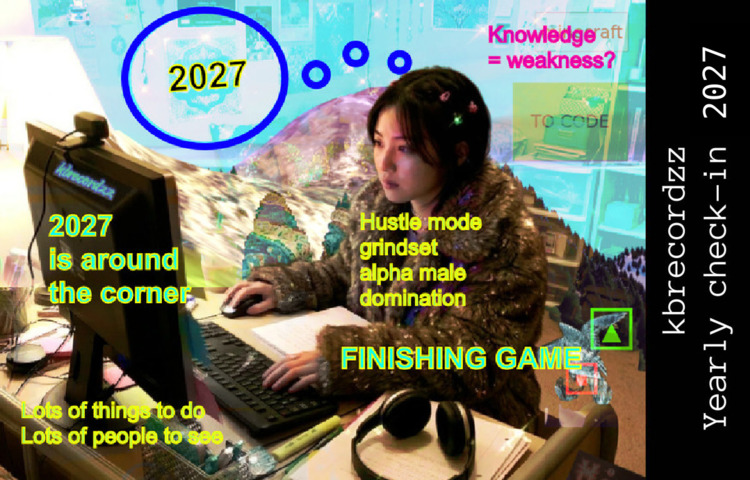
(The cover image girl representing an "80s K-pop" version of kbrecordzz contemplating the inevitability of 2026 in front of her computer, is AI generated by craiyon.com. They require me to credit them...)

Youtube pretty much has a monopoly on its kind of product. You can't really compete with them by having better functions, fewer ads or a nicer user interface, because the amount of videos and music they've have accumulated over 20 years, combined with Google's powerful datacenters that can stream video extremely fast and reliably (considering how many use the site every minute!) automatically makes the site superior for its purpose (= leveraging all the world's entertainment and information fast and reliably - my words, not Youtube's).
With this monopoly position, Youtube can now freely and easily be how bad they want at everything else besides the reliable video streaming and the large library of content without losing anything, because we need them and won't stop using the site regardless. For example the UI: Buttons and list items so big that they barely all fit in the video window on smaller screens, unnecessary circles and spacing around everything, and rounded corners that remove actual content from the video (last I checked, videos are naturally rectangular and not rectangular with CSS roundings at the corners...). With their position and status, making a UI like this is some kind of abuse of their users.
If you dislike a website or service I'd usually recommend using another alternative, or create your own alternative. Not only because it's a better path towards solving the problem than complaining about it is, but also because I think you shouldn't support things you don't like (for example, if you dislike ads you shouldn't use an adblocker to get around ads, you should go to other sites that don't support the ad business model and support them instead). But some sites and services are so big that they've reached a monopoly status where you can't easily compete with them, and Youtube is one of these, so here I see no better method than trying to make Youtube more usable, since abandoning the site isn't a realistic reaction.
That's why I've created a simple filter for the adblocker plugin "uBlock Origin" which hopefully makes the UI a bit more functional again. It's far from perfect and I have no idea how long it will work, but it's at least something: It makes the buttons a bit smaller, removes the unnecessary rounding around the videos, and also removes Youtube shorts at some places as a bonus to reduce your distractions. It only works if you have this specific adblocker, because it's the one I use. Here it is, you should hopefully be able to copy and paste this in "My filters" in the uBlock Origin dashboard:
youtube.com##body:style(border-radius: 0 !important)
youtube.com##[class^="ytp-heat-map-container"]:style(visibility: hidden !important)
youtube.com##[class^="ytp-heat-map-container"]:style(height: 0px !important)
!buttons in video player
youtube.com##[class^="ytp-chrome-bottom"]:style(transform: scaleY(0.7) !important)
youtube.com##[class^="ytp-chrome-controls"]:style(transform: translateY(20%) !important)
youtube.com##[class^="ytp-progress-bar-container"]:style(transform: translateY(250%) !important)
youtube.com##[class^="ytp-left-controls"]:style(transform: translateX(-1%) !important)
youtube.com##[class^="ytp-play-button"]:style(background-color: rgba(0,0,0,0) !important)
youtube.com##[class^="ytp-play-button"]:style(transform: scaleX(0.85))
youtube.com##[class^="ytp-prev-button"]:style(visibility: hidden !important)
youtube.com##[class^="ytp-prev-button"]:style(width: 0px !important)
youtube.com##[class^="ytp-next-button"]:style(visibility: hidden !important)
youtube.com##[class^="ytp-next-button"]:style(width: 0px !important)
youtube.com##[class^="ytp-volume-area"]:style(background-color: rgba(0,0,0,0) !important)
youtube.com##[class^="ytp-volume-area"]:style(transform: scaleX(0.85))
youtube.com##[class^="ytp-time-wrapper"]:style(background-color: rgba(0,0,0,0) !important)
youtube.com##[class^="ytp-time-wrapper"]:style(transform: scaleX(0.85))
youtube.com##[class^="ytp-right-controls"]:style(transform: scaleX(0.7))
youtube.com##[class^="ytp-right-controls"]:style(background-color: rgba(0,0,0,0) !important)
youtube.com##[class^="ytp-right-controls"]:style(transform: translateX(2%) !important)
youtube.com##ytd-player:style(border-radius: 0 !important)
!hide shorts in search results
youtube.com##grid-shelf-view-model:style(visibility: hidden !important)
youtube.com##grid-shelf-view-model:style(height: 0px !important)
!hide shorts in related section
youtube.com##ytd-reel-shelf-renderer:style(visibility: hidden !important)
youtube.com##ytd-reel-shelf-renderer:style(height: 0px !important)
youtube.com##yt-thumbnail-view-model:style(border-radius: 0 !important)

Here are some thoughts I've had while binge-watching Girls' Generation's music videos and live performances from 2009-2013 (mostly) during the last year. It's not primarily about their music this time, because now I instead want to talk about how the group performs, on stage and in general.
Elegance:
The members of Girls' Generation are definitely meant to look attractive on stage, but not necessarily "sexy". That would be a simple trick to get people to watch, but the way they appear is way more balanced and purposeful than that. Using simple tricks like that would ruin the elegant atmosphere around them. They're not there to make you drool, they're there to fulfill a higher ideal of beauty and elegance with their look, their clothes, the way they move and the way they behave. They stand up with a straight back, look into the camera with a reserved confidence and act like they're royalty. The viewer get what they want, but not too much of it. Other girl groups may have copied whatever was trendy at the time, or tried to act way too cute or way too shocking without having any interesting art underneath to back it up with. Those groups feel dated now, but we still watch Girls' Generation's performance of "The Boys" and think they look cool and elegant. It's a balanced aesthetics that never really goes out of style.
Charm:
Tiffany has undeniable charm (and eye smile) that is just hers and can't be manufactured, but charm can still be very manufactured, and we're very gullible when it comes to this. A confident smile and some good lighting and it feels like the members of the group are our friends. Then after having created this parasocial illusion, they're well-trained in not breaking the illusion. The girls always talk about their fans like we're their friends, and never say anything controversial that makes us doubt the illusion of them being those nice, friendly and unproblematic people who just as well could be your neighbours as world-famous pop stars. You rarely read headlines where the members are caught saying anything that breaks this kind of persona. In her book "Shine", Jessica Jung writes something like "Smile like the whole world is your best friend" about how they're trained to behave in front of a camera or an audience, and it isn't really more complicated than that. We see a smile that comes from the heart (even if it's also meticulously practiced) and we like that person. And it doesn't matter if we know that we don't really know that person in real life, because we feel like we do.
Stage presence:
When you don't think about how you look or what to do, and instead you're just present in the moment, that's what makes you look good on stage. Stage presence makes you fun to watch, because you believing in the performance makes the audience believe in it. I can't remember many vocal lines sung by Yuri, but I always like when she does something in a performance, because it looks believable and cool. That's because she has a great stage presence more than anything else. Stage presence is what makes a performance look good, even more than the technical ability to perform, which is a repetition of what I've said before.
Unique personal expression:
Even if it may feel like the members' personalities are washed down to fit a perfect ideal and to move together as a synchronized group, I still think it's the mix of this oiled machinery and the members' individual personalities that make Girls' Generation so good. They may wear the same costumes, but they all have their own unique charm. And when I say "unique", I don't mean some weird quirk that makes you stand out visually or anything superficial like that, I'm talking about that part of a personality you can't see, the part you can't manufacture. SM Entertainment can try their hardest to train the members to do everything right, but you can't turn someone who isn't Taeyeon into Taeyeon, because only she is herself. Some people have that look in their eye that no one else can copy. And here I think it all comes down to Lee Soo-man's personal intuition for finding charismatic and interesting people and seeing the potential in seemingly "normal" people (which is why it's such a shame he got kicked out of his own company... You can't replace Lee Soo-man's unique skills and vision even with 1000 smart people). He seems to be good at finding people who have something interesting about them that can't necessarily be put on paper and described with words. Girls' Generation differs from other girl groups in how every single member feels special in this way, and no one feels like a backup dancer or someone faking an interesting personality.
Singing voice:
The group's vocals are obviously meant to be listened to, but it's also something about being really good at singing which feels and looks cool in a performance. When I think about who are the "main" members of the group, I think of the ones who are the best at singing (Taeyeon, Jessica, Tiffany, but I may be biased here...), and I don't think that's a coincidence. Singing, especially really well, is a powerful human capability, even outside the musical purposes. Girls' Generation aren't a group with only perfect singers - their thing is more that they are all well-rounded in many different skills - but they have a special vocal sound and a special way to do melodies and harmonies, which combined with things like Taeyeon laying some nice adlibs during the last chorus of a song (and her vocal tone and delivery in general), is a big part of what makes their performances great.
Putting in the effort:
Girls' Generation feel like a more "definitive" group than other similar girl groups from the same time, but I can't point at any specific thing that makes it this way. All the early 2010s girl groups kind of did the same thing. Girls' Generation doesn't have a gimmick or "thing" (as in they're not the "vocal" group or anything like that), and they aren't really doing a specific genre. They're not the most extreme, the most interesting or the most innovative group (but probably the closest to this last one...). And when you can't put the finger on why something is really good, when you can't point to a specific attribute that makes it special, then no tricks have been used to make it appear good. It's good because real effort has been put in.
I think Girls' Generation's greatness comes from being just a bit more talented than the others, putting in a bit more effort into everything, having producers who are just a bit better and more daring with the sound, and so on, and so on... It's not one thing, it's all the things. They're really good at singing, and at performing, and they have interesting music, and their outfits are well thought-out and fashionable, and they look really good. They don't excel at one thing on the expense of something else, instead they try to make everything right. And they don't do anything in a sloppy way. When you see real all-around effort being put in like this, you immediately feel it's something special and you can't just wave them away like they're "just another group". This, combined with how Girls' Generation "came first" (you may also argue that they didn't) and defined the trend for the kind of girl group they are, is what makes them feel like that definitive K-pop girl group.
The power of many (9):
One thing about Girls' Generation is that it's just cool that they are so many. Like, the shock of seeing so many people at the same time on a stage. The weird formations they can do. How they're not just a group of individual people on a stage but a big organism moving in sync. Seeing 4-5 people do these kinds of things is cool, but when it's 9 of them it's a whole different thing.
Since they're a group, and not just individuals who happen to be on the same stage, you can't remove one member from the group and think the group will lose just 1/9 of its quality. Girls' Generation isn't just the sum of its members, it's also its own thing. It's the combination of the members, how they work together and how they sound together. If a big part of the group's sound was how Taeyeon's and Jessica's voices contrasted the others voices, removing Jessica from the group (which happened in 2014) doesn't remove only 1/9 of the group, it removes a third of the vocals and a big part of the overall group feeling, in some way. I can't explain it better right now than that Girls' Generation was a cultural moment, and it depended on them being those exact members, and now when they're not anymore it's like half of the group is lost (and it would be the same if any of the other members left as well).

Here's how I make my game development tools. They're optimized for me being a solo developer creating a relatively ambitious game on my spare time. Being alone means I have no time to waste on unnecessary stuff; on the other hand I have full control over the creative vision and can see how everything fits together easily. What the tools help with is letting me add much content to the game in little time, on the weekends after my dayjob when my brain is tired of thinking about complicated stuff and wants to be creative.
Creating the technology for the game and coming up with the idea for what the game should be are tasks that take lots of thinking and not so much doing, and these initial phases of development are meant to be surprising and unpredictable, so the tools I'm talking about work better at the later phases of development, where I have invented all the technology and decided on the game's general theme, and start adding lots of content (characters, houses, areas, events, dialogues, etc) to the game. This part of development can be systematized in a way that other parts often can't.
Part of what makes my tools work is that they're made for one person, and me specifically. This means you probably can't use the tools for your own project, but you can perhaps be inspired by the principles to create something that suits you. Both the tools and the principles won't probably work for bigger teams or even smaller ones, because they're not made for collaboration. Or who knows? I haven't tried.
To me, game development tools should be:
- Easy & fun to use
It's hard to get the right creative inspiration while struggling with frustrating technical problems. That's two parts of the mind that rarely work at the same time. So all technical stuff should be out of the way when creating, and nothing should feel like a slow time-consuming chore. You should see the result of what you do while you use the tool, and not program code or do any trial-and-error to make things work. There should be predefined categories for adding content so you don't have to think about the technical details behind how to add something. I have one function for adding a graphical detail at a position in the game world, and another function for adding a character that says a dialogue line when you talk to it. I can reuse these two functions over and over to create pretty much all fun content in the game, and having it this simple and predefined lets me focus on the fun stuff: the actual game world, characters, story and events.
The tools should not be slow or lag in any way, because that both gives me less time to create and makes it less inspirational to create.
- Simple
A simple system with few choices lets you create more efficiently. This is a similar idea to the last one, but is more directed towards being able to create more rather than having fun creating it. Instead of thinking about all possible details around how a house could look, a house in my game consists of 1x1x1 cubes organized in a grid, and then you choose one out of ten predefined textures to use and mix it with a color (a bit simplified description). So you only have to think about where the walls are and roughly how they look, not on what angles the walls should be, what decoration to add, how high the thresholds should be, how thick the walls should be, etc. Then if you want to change the look, you can change the wall's texture and/or color with a button click without having to rebuild any 3D model. It's faster to create a world in Minecraft or a Doom mod than an AAA game, because there are fewer things to think about, and the result doesn't necessarily become worse for that.
- Self-dependent
Instead of copying things between multiple different programs, like editing an image in an image editor and then exporting the result to a file and moving that file into the game, everything should be connected and all files should be in one place only. In my game development environment you can change size, rotation, color, etc of an image with one button click and it immediately changes inside the game. I also have a built-in image editor that lets me edit more advanced stuff without having to move the image back and forth between programs.
- Self-developed & self-hosted
You don't want to lay time on updating your tools or programs, or handling when they crash, or changing your workflow when an update changes how the program works. If you write the tools yourself, you're in control of what happens and the program won't ever change if you don't want it to. You don't need to be paranoid about your game development program potentially starting to go against their users who have invested years into the system, or anything like that.
- Specifically made for me
A program like Unity is made to suit a gigantic group of users and it has to provide functions and features to all of them. So all of the buttons in the program won't ever be used by one single person. If you instead create tools for your specific use case only, you get rid of all the unnecessary stuff that's in the way. You don't need a menu system anymore because all the buttons for the things you want to do now fit on the screen, and everything goes faster and is easier to find. The tools should also be made for what your specific use case is _right now_, so you can throw away stuff you don't need anymore. Now your tools won't grow bigger and more complex with the years, and you can always bring back old parts you threw away if you want to.
It's a challenge to come up with how your tools should work and then sit down and actually program them, but it's not way too time consuming, and as soon as you've used the tools for a while you quickly regain the time loss from having tools that let you create things more easily. I've made my tools work so well for me that the process of adding content into the game isn't what takes time anymore. That goes relatively fast, and now what takes time is thinking and coming up with all the ideas for what to add. To make sure I'm not just being productive and adding stuff without it being any good.

While hardware continues to get faster and faster, software seems to degrade. It's logical that we aren't as resourceful with the hardware today as we were in the 80s, because the hardware is so powerful today that we can afford to be lazy with our programming and still have our programs run smoothly. But the weird part is that software seems to degrade more than it should.
If computers have gotten 20 times faster the last 20 years (not an exact number, but you understand the principle), and your programs has become half as fast, the programs have somehow accomplished to get 40 times slower. That can't come from human laziness only. There must be some more powerful force working here. And it seems to be not just one root cause but a mish-mash of several ones that all do their own job as well as reinforce each other.
Short-term business goals
A pretty obvious one, but probably not the biggest cause, is software businesses not really caring about making their programs efficient. If they can make money from an inefficient program they'll do that instead. Not all companies do this, but short-term gains seems to often win over long-term quality when it comes to making money... Software companies don't sell efficient programs, they sell updates, new features, more features (which slowly makes the program bigger and slower) and fixing their own bugs. And if their program has a bug, they can always fix it in the next update... which gives an additional excuse to not make it good right now.
Culture, trends and chance
Still, I don't think most companies actually want their customers to be annoyed by slow programs. It's probably often a side-effect from just having the business focus somewhere else. But don't be afraid, software businesses have many other ways to get inefficient practices. Never doubt a company's ability to make bad decisions, and also never doubt their ability to hop on the latest trend when a new cool word arrives.
Some ideas just happen to appear at a certain time and change the trajectory of a whole space. The fact that the internet accelerated the programming space and all its ideas starting from the 90s and onwards is no coincidence, but the fact that Java and Javascript (slow and inefficient languages) were popular at the time instead of C (fast and efficient language) isn't a natural law. These languages have a certain look that may attract business people while C attracts technical people, but I still think trends happen pretty much randomly. And businesses love to cling onto trendy ideas and praise them just because... just because, I guess.
Pseudo-science and methodologies
The culture of software companies unfortunately caught on to a lot of pseudo-science:y stuff like "clean code" and other methodologies talking about code on such a high level that it starts to disconnect from the physical reality of the hardware it runs on, and ideas aiming to improve the developer's life and not the life of the program's end user. The hardware business hasn't caught on to such ideas, and I still think it's pretty random who ends up following magical lies and who ends up following facts.
These pseudo-science ideas aren't necessarily something only program managers force onto their employees of economical reasons. I say this because people online often talk about managers without technical knowledge being the root cause of inefficient business software, but this goes against the fact that LOTS of programmers - who should be the technically knowledgeable ones - also follow these ideas. Even hobby programmers who obviously have no business incentives for using them do.
"Clean code" and similar methodologies claims to create efficient programs, but really do the opposite. But it looks like the code is good!
Code complexity & organizational bureaucracy
Complexity and bureaucracy aren't unique to programming, but they're especially powerful forces here because of the nature of computers and their programs. A computer application is simply a more complicated tool than a spoon and probably even a car. And while we can laugh at the trendy ideas that businesses cling on to (which you can easily avoid with just some common sense), no one escapes code complexity without a fight.
Complexity comes from unnecessary communication between parts, from keeping backwards-compatibility while adding new features, from not knowing how your code works so that you don't dare to remove anything, etc, etc, etc. It grows naturally, and reinforces itself, and you have to manually and deliberately push back against it. That's why complexity tends to grow more often that it decreases. Complexity isn't the better route to take, but it's the easier one (at least in the short term).
And as soon as you work on a code with multiple people, you'll not only get complexity in your code but also in your organization. It grows in the same way there (people usually hire more people than they fire), and the complexity and inefficiency in an organization also seems to translate to complexity and inefficiency in the code (see Casey Muratori). And you don't have to be a commercial company to experience this, open source projects with many collaborators experience the same complexity, just because they are many people trying to collaborate.
And if you don't see how complexity leads to inefficient programs, just imagine a program that does a thing, then imagine a program that does the same thing but also consists of two parts which need to communicate with each other to make that thing happen. Which program is the most efficient? This is what complexity and bureaucracy do to software. Complexity and bureaucracy aren't new trends in the same way as the above mentioned things, but they certainly work together with all the new software trends to make them even more powerful and damaging.
The Internet
Despite all just mentioned, we have no one to thank more for inefficient software than the Internet. It has lowered the barrier to entry for programming. Before, only the really knowledgeable computer nerds could figure out how to start programming, but now it's easy. This is a good thing, but it has also flooded the online forums with information, opinions and ideas that are very inefficient. High-level languages and easy-to-use frameworks are obviously more popular among beginners than low-level languages, and there are naturally more beginners than advanced programmers, which is why there's so much more talk about this stuff online than about... all the other stuff. You have to wade through miles of high-level programming language forums to even get to the people who program in C and Assembly and actually know how computers work.
The Internet is so big and weird that it's impossible to understate its effect on pretty much all parts of the world, but it's also really hard to understand just how and how much it affects things. I don't think I'm doing a good job describing how the Internet leads to inefficient software, but I'm confident that it does. Because it hasn't just affected the culture of how people learn programming, it has also changed the software culture with quick rushed updates, and the field of web programming has influenced other areas in ways that don't always make sense. Animation systems that make sense on the web seem to have infiltrated themselves into Windows programs, which used to have native menus and buttons that worked like clockwork but which now require lots of power to draw, for some reason. And so on, and so on...
Summary
Summarized, you could say that inefficient software comes from unnecessary complexity. Some complexity is necessary and may even be good, but it tends to grow to excessive levels. And this unnecessary complexity (and some of the necessary as well) in turn comes from improved hardware allowing us to be inefficient and use more resources than necessary (which is often easier than doing the opposite), companies choosing profits over simplicity, organizational bureaucracy and the tendency for code to grow more and more complex, programmers choosing frameworks and quick easy solutions over doing it correctly from scratch, web programming trends, pseudo-science, and more. And complexity is an almost unstoppable force, which has led us to the situation we have today.
But it's culture, mostly on the Internet, with its low barrier to entry that lets amateurs take over, that spreads the problem by making us believe it isn't a problem and that we actually need the complexity. Something with the extreme amount of information and the speed of change on the internet seem to make our understanding of programming skewed. The true facts are buried underneath all the stuff people say. Misinformation isn't unique to programming, but the Internet has always contained unproportionally much content about computers and programming (logically), and I think that's why the misinformation is at such a level here. We have the power to understand complexity and keep it away, with a lot of effort, but when we're constantly overstimulated with ideas about how those objectively inefficient frameworks and programming languages are actually preferable, it's harder to take that step towards efficiency and simplicity.
It's no surprise that big companies catch on the obviously bad ideas, but when so many "normal" people do the same, there's a bigger problem. This is one of the reasons I wanted to write this post - partly to figure out the reason for all the bad software to be able to fix it - but also to show how it's not just business people that catch on to new "buzzwords" and get blinded by their own sight. Everyone follows bad ideas if that's what the culture is right now.
So, how do we solve this? An optimistic answer would be to try to spread a new better programming culture. But personally I'd rather not follow any culture at all. Because there isn't really some ancient unknown wisdom you have to discover to start creating efficient software. You just have to _not_ discover "clean code" and internet forums, and then go on and create things from your own mind, and gain your own knowledge while doing it, and repeat. And also deliberately fight against the natural complexity - learn how it works, when and why it appears and how to stop it, which is also something you learn by doing and not by following advice from people online. You'll have a greater chance at succeeding with this if you work alone, but it's an even more noble fight to tame complexity while working with others, maybe at one of those companies that believe all those weird ideas.

You can't learn how to be creative from anyone else. You do your own thing. But I still think there are some common traps people often fall into, and that if you avoid them you can get a better headspace for being creative. There are some patterns you see over and over again from people trying to start creative projects, especially big ones. There's the excitement at the start that quickly dies down, there's the usual procrastination and non-motivation... And when you actually succeed and things get "serious" you run into a whole new set of problems.
Beware that this is a snapshot from my mind in 2025 and no certain science at all (I usually don't want to give names to my theories because I start to believe them too much, but this time it felt worth it). Also beware that it may be biased by the fact that I've been producing games for the last 4 years, and some of the problems below may have nothing to do with for example musicians or writers because of this. This also isn't a list of solutions, it's more of a short bible (ambitious much?) to read through when you're stuck on a project and want to be reminded of what hurdle you might have created for yourself this time. The common problems are kind of categorized by where in a project's lifecycle they appear, but also a bit loosely. So, here are the states that people often seem to get trapped in, and that you probably want to get out of if you want to create something unique and make it the best it can be:

When people on the internet talk about how bad Toby Fox' programming for Undertale was, they often use the example of him - supposedly - using one single large switch-case statement for all dialogue in the game. These people think that's bad programming, either because it's inefficient or because it's just bad coding style. It's just that they are objectively wrong about so many things. Of course I'm not surprised about people on the internet collectively being wrong about something with confidence, but when Youtubers like JuniperDev spread this "Toby Fox being a bad programmer" rumour further to her 1.5 million (as of currently) viewers, it isn't just some random people being angry on a forum anymore, it's getting materialized as a truth.

1. Business to enable art, not art to enable business
- Don't forget why you do it (it's not to earn money, for example). And don't accept any excuses from your brain for getting around it. For example, if you start to believe you have to change your art into something you like less so it can make money, because you need money to be able to create what you want in the future, don't. That's your mind trying to trick you towards material rewards, don't listen to it.
2. Aim high
- Remind yourself of greatness by looking at great things people have done before, or you'll automatically think average. But don't idolize them too much, or you won't be able to surpass them. Then, define your own ambition. And remember that a lack of resources and contacts isn't the biggest obstacle, it may be an obstacle, but your way of believing things like this is the biggest obstacle of all and you need to tackle this first.
3. Art & entertainment, nothing else
- Don't divide your time between your main purpose (creating something great) and the more or less related side-things. Everything else will come if you put 100% of your time into creating something great.
4. Don't follow trends
- Just don't do it. Those who influence others create things from scratch out of their own ideas.
5. Don't react & comment, do & create
- None of the above, or anything else you say, matters if you don't put it into action.

Hey guys. *looking at you like a Youtuber* Here are some "hot takes" (or maybe just "takes"?) from me about video games:
1. The main appeal of video games specifically isn't playing a game (like rolling dice, solving puzzles, competing and stuff), it's the immersion. Talking about Super Mario 64 and chess in the same sentence is nuts to me.
2. Realism isn't the point of any art. 3D animated movies understand this, so they don't try to make their characters and environments look 99% photorealistic but instead make them look funny and likeable. They do what's functional for cartoon movies. Games don't understand this and that's why we graphically peaked in the Playstation 2 era. Video games should have doubled down on the "video game:y" style that looks wonky but is functional for interacting in fun ways with the game (like Minecraft, Doom, and late 90s / early 2000s console games).
3. Controller "rumble" is extremely overrated. Bumped slightly into something? Brrr. Brutally crashed with your car? Brrr. Got killed by a demon? Brrr. Made a menu choice? Brrr. It breaks immersion more than the opposite.
4. Remade versions of old games for newer consoles never look or feel even nearly as good as the original. The original game's idea was designed with the console and its hardware specifications/limitations in mind, and you can't just replace graphics and ideas here and there and think the game will keep its original feeling. All those quirks you polished away for the remake had a reason for being there, they were necessary at the time and the rest of the game was then built around those quirks. A newer remake may look "objectively better", but not actually better. It may have more pixels, polygons and polish but it won't have the summarized feeling and immersion as the original had.
Signed, kbrecordzz

I've spent around a year and a half working slowly (and not very steadily) on my upcoming game (MANAGO - the spiritual successor to This Is (NOT!) A Car Club), and if I continue in this tempo it will take years to finish. And that's not a reality I want to live in. So, to get it finished and ready for a release at the start of 2026, during the remaining months of 2025 I will:
- Work on it rarely but with focus. Every other weekend is probably enough. I need the time in between to think of ideas and reflect on what I've done (and who I've become...), and I need the singular focus to get things done. And, if I would do it more often I'd get tired of it, so this is how I can be productive without getting the backsides of it.
- Not do any side-work that just adds more work on top of the game without improving it. This mostly means marketing and other things (localization, porting to other platforms, putting out a soundtrack, writing documentation for the code, etc) where it feels like I'm working on the game but I'm actually just taking time away from the production.
- Only add content I know will work, and which I have a system and good efficient tools for adding. This is mostly:
*NPC characters with attached dialogue
*Dialogues in the linear story
*Graphical objects in the world, with or without attached dialogue
*Houses
*Terrain details in the "overworld"
This is what all the buttons in my in-game editor is for:
Because, if I want to add a whole new type of object or event, I have to program it from scratch, and programming that one thing would take the same amount of time as adding 100 NPCs, or 100 dialogue lines, or 100 house parts, etc (kind of), and that's not what I'll do in this phase. I have to be able to add content in a streamlined way by creating new variations of the same type of objects, without having to do too much context-switching.
The things I add should come from ideas I've thought about in my head for a while, and resonated back and forth whether they work technically, can be made in a reasonable time, don't affect other game parts too much, fit into the game's context, and are actually good. Trial-and-error:ing everything inside the game engine is tedious, so I avoid it as much as I can and try to do it in my head instead.
- Not do any big changes or remove anything. Because every change affects 5-15 other things in the game, which in turn affect multiple other things each, so changing even one single thing in a game system is fragile and too riskful for this phase. This means I have to think carefully before adding anything to the game (which ties back to the previous paragraph). Also, if I remove a concept from the game as soon as I don't like it anymore, I have to replace it with something else, and added up this means I'll kind of be producing several games during the project's lifetime, if you include all the content I create just to throw away. I want the content I made for the game 1,5 years ago to get used, which means I have to commit to all ideas I add and just make them work eventually, instead of giving up on them.
- Not get distracted by technical problems & design issues. I'll trust that they'll get fixed in the right time. Problems so big that production has to stop until they're fixed shouldn't appear at this stage anyway. Some day I'll wake up and think "today is the perfect day to fix all those small problems I've bumped into the last year" and fix them all in a couple of days, and I won't think or do much about them neither before or after.
This is because of several reasons: The programming brain doesn't go well together with the creative brain, and these problems appear at random times and are very distracting, which goes straight against the idea of working with focus. Problem-solving is better to do when you feel like it or when you get a sudden realization of the solution, rather than just when the problem arises and you aren't prepared for it and probably frustrated and confused. So, I just have to suppress my urge to fix problems, and learn to live with seeing all the weird inconsistensies and holes in the game every time I work on it.
- Not overanalyze things. Dreams, hopes and irrelevant worries took too much time during the last project. Instead of thinking about how cool it will be when the game is done, or about how impossible it seems to get it done, if I spend that time on producing instead the game could actually get done. (Writing this post is probably the most analyzing I'll do. I have to figure out how to produce in a streamlined way to actually do it, but then I also have to stop thinking about it.)
Summarized, I'll focus on streamlined production and leave all other distractions and roadblocks aside for ca 3 months, no matter how important or unimportant they are. I have all ideas, and now I need to get them together to a full thing. The main point here is that you can't really be a creative production company (or creative production person?) if you focus too much on irrelevant things, like technology or marketing, or on anticipating how your work will be received.

Before I read Aristotle (that is, before I read his works, not before I read _about_ him) I didn't know that you could, or were even allowed, to think as many thoughts as he did during his life. And that you could and were allowed to believe in your own conclusions from your own thoughts as much as he did. Even if he pretty much invented the scientific method of observing, measuring and analyzing the world empirically rather than come up with the principles intuitively in your head, his own thoughts are still what's most impressive about him.
Read his book "Ethics" (or another of them, they're so old that you can often find them for free), and then realize that he wrote books at the same level on almost all topics imaginable. With no prior science to build on top of. I can't explain how impressive what he did is in any other way than that, and the history books doesn't do it justice either. You have to experience his thought process yourself.
Today, nobody seems to think as much and as confidently as Aristotle did. Especially in the Western world, people sometimes believe in science and objectivity so much that they don't have any confidence in their own intuition and experience at all. We have such a good system for knowledge that we can afford to relax and not come up with our own knowledge.
Sometimes you need an example of an impressive person, like Aristotle, to realize that you can be one yourself. Because it's almost impossible to come up with that excellence of a mind by yourself. It only seems to be Aristotle who ever did it.
Det finns många saker som kan rycka i ens uppmärksamhet, framför allt när man är bland andra människor. Men man kan också bli distraherad av sig själv, t.ex. om man plötsligt blir sugen på chips och slutar tänka på det man tänkte på innan på grund av det. Man kanske tror att det är man själv som blir sugen på chips, men det är nästan som att det är någon annan. Om jag sitter och sköter mig själv i lugn och ro, och direkt vid synen av en chipspåse byter personlighet till en chipsgalning, då är det mer som att en chipsgalning inom mig har vaknat upp och tagit över mig, snarare än att jag själv tagit det rationella beslutet att sluta med det jag gör och istället gå och äta chips. Det är vad jag menar med att det känns som att det är någon annan.
Det finns sug av alla möjliga slag, både uppenbart negativa och sådana som verkar bättre. Men de som verkar bättre behöver inte vara bättre. Att bli besatt av produktivitet är ett slags sug, som man lätt kan intala sig är vad man själv vill. Men om man sitter kl 10 på kvällen och försöker vara produktiv, men inte riktigt orkar, är det verkligen något man vill göra då? Eller vill man bara vilja vara produktiv? Ibland vill man ha ett resultat, och intalar sig själv att man vill sitta igenom processen som krävs för att nå dit, men någon del inom en kan inte ljuga om sådant och det märks när man försöker göra något man tror man vill men bara blir trött av det. Det här "suget", både de här dragningarna man har till olika saker och de plötsliga infallen, är inte en själv, men de har en förmåga att lura en att de är en själv (hur det är möjligt att ha flera personer inom en på det här sättet lämnar jag till filosoferna och psykologerna att klura ut).
Att veta vad man verkligen vill göra är svårare. Det är inte alltid den starkaste känslan och det starkaste suget som motsvarar det man verkligen vill, utan det kanske snarare är det som varken har någon friktion i sig eller någon stark drivkraft i sig. Det är kanske mer det man gör helt naturligt utan att tänka på det.
För att veta vad jag verkligen vill göra, så behöver jag ha det tyst och stilla. Åtminstone i huvudet, vilket är lättast att uppnå om omgivningen också är tyst och stilla. Då försvinner till slut alla tankar om vad jag borde göra, vad jag tror jag vill göra, vad som känns så där extremt spännande och lockande att göra, vad andra kanske tycker att jag ska göra, vad andra kommer tycka om jag gör en viss sak, vad andra gör och hur långt efter jag hamnar om jag inte gör samma sak, osv. Om jag går i en stad och ser en fest där ett gäng unga människor har kul ihop, så börjar jag lätt fundera på varför jag inte har så kul själv? Varför går jag bara runt här helt ensam utan att göra något mer interessant med mitt liv? Varför passade jag inte på att ha så kul när jag var ung? Även om jag skulle ha kontroll på mina tankar i de här situationerna, vilket jag har om jag har något projekt att tänka på eller någon intressant plan för dagen, hur vet jag att de tankarna jag har är mina egna när jag har blivit bombarderad med intryck, åsikter och budskap hela dagen? Man kan definitivt bli van vid intrycken i en stad, så att man till slut inte märker de lika mycket, men man kan inte bli av med dem helt.
Sitter jag däremot hemma vid min sjö, och ser en svan åka förbi, som sedan kanske vänder och åker åt andra hållet igen, så finns ingen "FOMO". Om den här svanen som åker förbi och kanske gör några roliga ljud är det enda som händer inom mitt synfält just nu, så är det det enda jag behöver tänka på. Vad som händer i USA, eller i Göteborg, eller i andras liv, spelar ingen roll. Och det är inte bara att det känns som att det inte spelar någon roll, utan det spelar verkligen ingen roll. Om något sker på en annan plats än där jag är, så har det inget med mitt liv att göra. Allt annat är idéer som vi själva (eller nyhetsmedierna) har hittat på, och sådana idéer behöver man inte följa.
När jag är i en sådan miljö blir jag mer mig själv. Jag sitter inte där och tror på konstiga idéer om hur jag ska vara för att passa in. Jag tänker inte på mycket alls, men tänker jag något så är det mer ofiltrerat, mer naturligt, inte för att imponera på någon eller övertyga någon, inte för att tycka synd om mig själv eller rättfärdiga något med mig själv. Det blir mindre komplicerat, och utan en massa saker som drar i min uppmärksamhet kan jag fokusera på rätt sak. Jag kan fokusera på att bara göra det som är mest naturligt för mig att göra. Det jag alltid kommer tillbaka till efter olika mer intensiva perioder där jag lockats till annat i stunden, efter att jag gått på lite olika trender och hunnit tröttna på dem, efter att mina stora planer har gått i mål eller i sank, efter att olika kompisar och sociala sammanhang har kommit och gått. Det jag gillade att göra när jag var liten, och som jag fortfarande gillar att göra. De sakerna man fortfarande vill göra om man tänker bort grupptryck, ens drömmar och mål och plötsliga sockersug.
När alla programmerare flyttar till Silicon Valley, eller alla som jobbar med underhållning flyttar till Stockholm, eller alla aspirerande spelutvecklare flyttar till Skövde (ja, jag vet), så får man fördelen att vara med en massa andra likasinnade personer, men det blir också svårt att vara sig själv och veta vad man faktiskt vill göra, eftersom man ständigt blir bombarderad med åsikter och idéer om hur saker ska vara inom ens fält. Man blir en liten kopia av alla andra där, och det kan mycket väl vara ett effektivt sätt att lyckas (det mänskliga samhällets utveckling bygger ändå till stor del på många människor som gör samma sak ihop, snarare än att ett gäng genier sitter på sina egna hörn och är briljanta), men vad är poängen med att lyckas om man inte har någon själ kvar i det man gör? Om man inte gör det som verkligen passar en och det man verkligen vill?
En del av att flytta hem till lugnare områden kan vara för att "settle down" och t.ex. ge sina barn en lugn miljö att växa upp i, men för mig är det också för att ha en bra miljö att utgå ifrån för att faktiskt kunna göra mer saker. Inte för att sluta göra intressanta saker. Och framför allt göra saker på mitt sätt. Att inte bara bli en kopia av alla andra som gör liknande saker som jag. Och då behöver jag sitta och kolla på en svan vid min sjö.
kbrecordzz' tagline is "art & entertainment", and in my last post I described the "art" part and why it's my main focus over technology. But what about the "entertainment" part? Why add entertainment to the slogan if art is the thing that's so much more important than everything else?
Art and entertainment are two separate things, but there isn't really a clear divide between them. Entertainment can be art, and art can be entertaining. It's more the process that make them differ from each other. Why you do it, more than what you do. Art is done for the sake of itself, while entertainment is made for an audience, and this tends to make the products different in certain ways.
While art often turns out to be thought-provoking and about defying expectations, entertainment tends to be lighthearted and comfortable. It doesn't have to be about good feelings, because it's simply about entertaining people (true crime and horror movies can also entertain), but since entertainment is made with an audience in mind, it at least often appeals to the simpler sides of us. Because of this, entertainment is often easier to access and understand than art, and because of this it also often has a potential to reach a bigger and wider audience.
However, you can mix and combine these two ways of approaching creativity in both good and less good ways. You could water down art by appealing to the lowest common denominator and make it less interesting in a wish to make it more understandable to a wider audience. Or you could combine both your more complicated ideas with your simpler ideas, all while keeping the high quality, not compromising with the art but rather letting it be seen and more easily digested by a wider audience by making it both interesting and entertaining. Appealing to the common crowd can mean downgrading yourself to the stupidest ideas (not stupid as in funny, but stupid as in just stupid) that everyone understand, but it can also be to find those powerful emotions that are in all of us, to make us experience something cool instead of something dumbed-down.
I think companies like SM Entertainment and Nintendo are good at that last example. When I watch the music video for "The Boys" by Girls' Generation, or play The Legend of Zelda - Ocarina of Time, I both feel the unique and timeless art, and it also hits the weak parts of me that just want bright colors, pretty faces, jokes and to go around collecting rupees and killing enemies. And it doesn't feel like a compromise, it feels like a great mix.
And I know that because that music video and that game are both so easily accessible, the great unique art in them has been seen, and will be seen by many people, many who would miss great art otherwise. I believe this is a consequence of SM Entertainment and Nintendo believing in entertainment and broad appeal. They don't just want to make challenging art, they want people to enjoy it as well! And if art now is as important and everlasting as I argued for in my last post, why not make it easier for people to get to experience it? 1
Beyond making art more accessible to people (and at the same time making entertainment more artistically interesting) as a "good deed", I also sometimes feel like the greatest creative works of all are when they hit both the deep part of you and the shallow part of you like this. That it's not just about getting the best of art and the best of entertainment, but that they can become something even better when working together.
But that's just how I feel sometimes. Because don't we all at the same time have some artist we think is brilliant but others don't seem to get? That kind of artist-artist who doesn't care about doing it for an audience. Where it wouldn't be the same if everyone suddenly understood them, because part of what's great about them is that weirdness that's so hard to understand? When it's so good just because it hits you right in the heart in a way no mainstream artist could do?
I'm not really sure. Maybe it's always a compromise. Or maybe SM Entertainment and Nintendo actually have a magical way of combining the easy-going with the beautiful that makes them stand above everyone else 2. I still think it's an interesting challenge to make great art understandable to many people, without letting it lose its edge. It's difficult, which makes it interesting, and that challenge is probably also a part of why I'm so obsessed by the combination of art and entertainment.
But in the end, it mostly comes down to that I just like it. I like art, I like entertainment, and I especially like a really good combination of the two. Something about what SM Entertainment and Nintendo do sparks something inside me. I can argue for a bigger reason to do something (as I did in my last post), but that's still not why I do it. It may be a reason for why I sometimes choose to do it over something else, or for why it feels more purposeful when I do that compared to when I do other things. But I still make art & entertainment because it's what I enjoy doing in the moment. And if I don't, I'll do something else.
Footnotes:
1 I would also argue that even though many of the old classic artworks we still talk about today aren't the easiest ones to access (or digest), we probably know of them because they were published for an audience in some way. There are probably great works from back in the day that we don't remember today because no one ever really got to see them. So having a way to make great art more widely accessible feels like a good thing.
2 Or at least had. After Lee Soo-man left SM Entertainment in 2022 I suspect a slow creative death/downfall. And we should be happy we still have Shigeru Miyamoto alive and active in Nintendo. Even if he's not the one creating the games anymore, it's hard to understate how much one person can influence a whole company culture. Just as no one has even come close to replacing Steve Jobs during the last 14 years, no one will replace Shigeru Miyamoto.
A while ago I tried to describe kbrecordzz' tagline "art & entertainment", and in there I explained art as:
"Art is when you make something for the sake of itself. Art is similar to knowledge, curiosity and insight, in how you're never supposed to reach the end, find the definitive answer, create your masterpiece or become the best. You just continue exploring."
I want to update that description now, to explain why kbrecordzz is focusing on art and not on technology as a creator of games.
Art is a personal expression, coming from inside yourself with no commercial intent. Great art is when it has some kind of quality (obviously), which I don't really know how to define, except that I know you can't calculate what's great art, you can only feel it. Truly great art is those works that people never seem to stop talking about, when someone creates something impressive and beautiful that no one else could ever do again, like Shakespeare, Da Vinci, Mozart, and other immortal artists and works.
As a game creator, you usually have both an artistic and a technical side. Programming and handling hardware can be interesting, and sometimes even fun, but in the end these are just tools to reach something else. Technology in general is never the goal itself, it's a tool to reach another goal. Which could be comfort, entertainment or just anything that makes us feel good in the moment, or it could be to solve bigger problems, cure diseases and raise people's objective living standards. Even though the meaning of life may very well be to let as many people as possible live a good life, I can't get away from the fact that everything I've just mentioned eventually dies down and people forget about it.
The thing people seem to never forget about, the thing they continue to talk about forever, is truly great art and truly impressive people. Even knowledge, which is arguably a quest bigger than ourselves, kind of loses its edge once you understand a piece of it. When I try to understand the inner workings of a computer it gets more and more fascinating the closer I get to the lowest level, but as I get down to the 1s and 0s it suddenly stops being interesting. Because there's nothing more to understand. We're done! We obviously have lots left to understand about the world, but as soon as we understand something it loses its magic.
But a truly great piece of art is never "done". People are never done trying to understand it just to move on to something else. If that was the case, people wouldn't still talk about Shakespeare today. And maybe it's not just art. People are never done being impressed by nature either, or being captivated by geniuses like Einstein and Aristotle and iconic figures like Jesus. Maybe nature is art too, and maybe these exceptional scientists and people are artists as well... Or we need another word to describe these things that are bigger than ourselves and continue to captivate us (or maybe (god forbid!!) my theory has a plot hole). At least, it seems to be more about emotional experiences than about facts, opinions and bodily pleasures when it comes to the things that outlive ourselves.
This is why kbrecordzz' focus is on creating art and not on creating technology (but, we create technology as a tool for creating better art).
(Some day I may also try to explain the "entertainment" part of the tagline. But right now that part kind of contradicts what I've just said.)

I've had a plan for a long time to write shortly about what I've done to improve the graphics in my upcoming game (which can be found here in an either unfinished or finished state depending on when you read this!). And, here it is! Enjoy!
#1. In my last game (This Is (NOT!) A Car Club), all houses in an area had to have roughly the same appearance, or otherwise there would be too many "draw calls" (one for every house appearance) for the graphics processor (GPU) to draw the frames smoothly. The GPU doesn't like when you send multiple image files, because then it has to divide the job in an inefficient way. But it really loves when you send one single image file and then simply crop out the part of the image you want to use. So, that's what I did, and now I can have an infinite number of different-looking houses in an area and be much more creative with the environments, instead of being limited to 3 different types of houses for each area (which made the environments in This Is (NOT!) A Car Club look pretty same:y and repetitive). To pull this off, I had to go beyond the general-purpose 3D library "three.js" that I use, and create my own "shader". In this shader I also added the capability to blend these images together and change their colors.
(In the terminology I'm using here, a "house" is a small wall that you can build larger buildings of. The images below show the inside of these buildings, where you can see the walls being made of smaller repeating blocks. These blocks are what I call "houses", which is a historical leftover from This Is (NOT!) A Car Club where a house was just one of these blocks.)
Here's my image file containing multiple house wall images:
#2. The same is true for the flat 2D images that I use for objects inside the game world. Too many of them and the GPU starts to complain, and the solution is the same: Bake all objects into one big image and instead let the GPU crop out the one needed in the moment. I haven't created the shader for this yet, but I will eventually. And the result will be the same: I'll be able to be much more creative with the environments and add more varied details. Right now the areas in the screenshots look half-empty, but they will become more interesting as I add more furniture and other interior (apparently, being a game creator involves being a home furnisher).
#3. I've also started to minimize and simplify the 3D library I'm using (three.js), by removing lots of code from it. This is partly to reduce the file size to make the game faster to download, partly to learn more about 3D graphics, and partly also to some day turn it into my own 3D library, specialized for my own needs. Three.js is a very user-friendly library which is made to fit many use-cases at the same time, which means that most of the code in the library is never actually used by me. So, most of it can be removed. And through this process, I've found the shaders powering the basic rendering in three.js, and by modifying these I'm now able to change the appearance of the whole game on a level I couldn't achieve by using the predefined tools in three.js. By having more central control, I can achieve my own graphical style instead of looking like other three.js games because we use the same tool.
I'm not sure about these exact changes, but the changes I've made in the basic shaders so far are these: I've made the characters shine like gold, and I've made the whole world turn red and then blue, the further away an area is from the camera. It may look good, or it may just be the joy from doing something new that fills me up. Anyways, a game in neon-colors and gold feels right, in some way. Let's see how the actual end results turn out!
I have a few things to say about names. Names on products. And on things, etc.
I love Hazelight, and I loved their last game "It Takes Two", and if I'd play their upcoming game "Split Fiction" I would probably like it too. But... Hazelight's earlier games - "Brothers", "A Way Out" and "It Takes Two" - all had names that described what the games were about. But there was also something more in them, something that made them... good. You can't analyze what that is, but you feel it. There is soul in them, at least some of it.
In the same way, the name "Split Fiction" gives a good and clear description of what Hazelight's newest game is about and what you'll do in it. But it feels so practical. I don't feel the art and soul in it. It's like they most of all just wanted people to immediately get what the game is about. Like the game is a product only. Like a name is only for marketing. Like a video game, made with the care and artistic vision that few others than Hazelight have in this field, is to be treated on the same level as putting out a Youtube video or a social media post. When it's really much more than that. This game will live on for decades! It deserves a cool name, and not just a marketing description!
The point isn't to criticize Hazelight, but to make them, or probably more likely you, rethink how you go into naming things, presenting things, and making things at all. A great blog (https://entropicthoughts.com/) I follow changed their name a while ago from "Two Wrongs" to "Entropic Thoughts", to make the name better fit the content of the blog. Fair enough, but I always thought the cryptic name that had nothing to do with the content was cool for just that reason alone! Like the name lived its own life and wasn't just a practical description of the site.
I read the book "Mental efficiency" by Arnold Bennett, a really good book from 1911 which I first thought would be a technical description of the inner workings of the mind's energy consumption, but it wasn't, it was more of a loosely connected collection of essays where the first one was called "mental efficiency". So I thought I'd steal the title for this post instead and try to make that technical description I was looking for myself!
This knowledge comes from me being burnt-out and going through each day with extremely limited energy, where every large outtake of energy was felt clearly at the end of the day. I had to adapt and use the least energy possible to get anything done at all, which in the end has generated a mental map over how much energy various tasks take from my brain. So this is incredibly biased, but I still tried to pick out the things that felt more general and not just tied to my personality (doing things you like takes less energy than the opposite...). I also think it's interesting to show that we humans absolutely have a limited brain energy, in the same way we have limited muscle power, and that different things - in a very obvious way - take very different amounts of energy. Here are (some of) my findings:
• Morning vs evening:
It seems like you have more energy in the morning, or at least the first half of the day. I'm in a bad mood when I wake up and the opposite when I go to bed, but still my complex problem solving capabilities sink rapidly in the evening. Maybe it's only me. But I think it's you too.
• Creativity vs logic:
Creative thinking takes less energy than logical problem solving. Maybe because problem solving by definition puts a pressure on you, and forces you to think of certain specific things instead of thinking completely freely? Or because problems you haven't solved yet are probably pretty complicated and therefore requires you to take many things into consideration, which brings us to the next part...
• Focus vs multitasking:
Focusing on one thing for a long time takes less energy than doing many different things during that same time. You don't necessarily think about less things because you focus on less things simultaneously, but it takes less energy.
• Habit vs variation:
Doing things by habit is almost completely automatic and takes almost no energy at all. Doing something new takes more energy, of obvious reasons, but can also be much more fun and for that reason alone still be the better choice! Creating a habit takes much energy, because it is doing something new, but following that habit after it's been created doesn't.
• Thinking vs doing:
Stopping what you do to think and reflect, without trying to advance, progress, finish, develop or execute, takes less energy than doing all those mentioned things. Maybe because _not_ doing anything also actually _gives_ you energy by putting the body in resting mode, and because just wandering around with your thoughts conciously and unconciously ties up mental knots so that you have less problems, less plans and less to worry about after this period of thinking than you had before, even if you didn't really do anything? Reading and writing also seems to create this effect for me.
• Curiosity vs requirement:
It takes less energy to follow your curiosity, enjoyment and interest than to do something because you, or someone else, has decided that you should. Let the interest form, and then follow it. Focus on the process instead of the result.
Also: Worrying takes unreasonably much energy. Not sleeping enough takes unreasonably much energy. I couldn't put these two in any "vs" scenario like the ones above, so... just don't do them?
Don't use any of this as finite advice for how to go through life as efficiently as possible. These aren't ideas from a normal person's perspective, and I'll probably change my mind in a year or even in a few months about all of this. Also, many things that take energy from you also gives you energy, motivation and happiness back, so striving for as low energy consumption as possible probably isn't a good philosophy. Use the knowledge responsibly (if at all).
(Left out of this post: Silence vs noise, information & impressions. Meaning & progress vs forcing yourself with willpower. Calmness vs stress. Focusing on the process vs the results. And the usual pile of non-understandable notes.)

I was at a game jam, and I realized it's the perfect environment, structure and timeframe for finishing creative projects. After such a long time of trying to find the best possible way to plan and structure projects, the thought had never ocurred to me (until now) that you can also just remove the whole project thing, and just do!
At a game jam you're put into a fresh environment made just for being creative, together with a few other likeminded people, to start and finish a project in a few (usually) days. When you have so little time, you don't really have time for any prestige, judgement or structure. You focus on the creative, and the structure will have to follow. You just do whatever you have to be finished. The project's lifespan will look like any bigger project: You start with ambitions and lots of ideas, then you get productive for a while, and in the end you realize you don't have any time left and have to trash 90% of the ideas to get anything done at all. In the end, you have made something. It's far from perfect, but also much more than nothing. It's probably better than something half-done. And you had fun while doing it! Because you mostly focused on the fun parts, because you didn't have time for anything else. Game jams show what's most important in creative projects in a brutally honest way: Those who spend most of their time planning and arguing simply don't have a game at the end of the weekend.
Trying to finish something in such a short time can be stressful, but since it's also limited to a specific place and social environment, the pressure will stay at the game jam and not follow you into your "real" life. And, you'll soon realize that you won't be able to create something truly world-changing in this short time anyway, so there's not really that much at stake...
The change of environment is also an important part, which creates lots of new ideas and gets you out of your usual habits. You get the same feeling as travelling, where your whole day-to-day life forcefully gets exchanged to something new that you can't fully control (when you come home from experiencing something new in this wholehearted way, you've become a new person in tiny ways). And you don't have any excuses to not get on with your project, because that's the one and only reason you're here. And other people can't disturb you, because you're at an event.
So, onwards I will try to use the "game jam" concept, but for other projects, and also by myself, to finish various projects or parts of them (for example kbz.se, my snowboard game and the for now nameless sequel to This Is (NOT!) A Car Club), in a way where I also have a fun time doing it. Fun pressure during a short time to get some surprising results, instead of a slow, steady and silent pressure that slowly bores you and has a constant deadline hanging over your head. And hopefully it will be more productive than only doing things when you're "inspired" (how often does that really happen?).
(There's also the social aspect of a game jam, which gives you new perspectives, and maybe even new friends! But I think just the time pressure, environment change and focus on the fun goes a long way for solo projects too.)

To make big things, you must first get rid of everyone else that don’t believe people can make big things. That’s the first step towards getting rid of that same belief inside you, and the only way you can even get started. Then you start doing things, and continue, and find a way to not get tired of it. You remove all unnecessary energy spent on things that slows this process down, and narrow your focus so you don’t end up only spending time on administrating, planning and handling the biproducts of you making what you make. You learn by doing, and by learning, and by reconsidering what you've learned from doing and learning. Repeat this as many times as you want! This will give you real experience and knowledge. Then, when you've reached your full potential (if that's even possible?), you find other people who can help you go even further. People who align with your worldview and are willing to follow your direction, but who are good at something else than you. And you let them go through the same process as you did. Then you try to remove all unnecessary communication between you and your people, so you don’t end up spending all your time handling a company, when you really should be making things. With every new person, the communication will grow exponentially, and in the end you will have an organization that by itself has gotten its own will, needs and drive. Now, you either work actively and hard to keep this complexity (bureaucracy) down, or it becomes a monster that eats you up. If you succeed, you'll be able to continue making big things for a longer time. So now, continue with this for as long as you feel like.
This post was inspired by MrBeast and his quest to use as many cameras as possible (among other things). You can obviously make big things that are nothing else than just big, by just using many people and much time, but to make big things that are big as in ”interesting”, you'll need some more thoughts and intention behind your actions.

The This Is (NOT!) A Car Club universe has expanded, with two new characters! They will play important separate roles in an upcoming game, that yet has no name. So, let's get started!
(This segment had another name earlier, but since we at the kbrecordzz conglomerate are in the middle of an equality certification process, we have decided to give the segment a more fitting name. The diploma is on its way, so pretty soon we'll start relaxing again!)
Hey, Anna-Carin and Zamantha! Are you a Millenial or a Gen Z?
Anna-Carin: Hey!! I'm a Gen Z! :D
Zamantha: ... I'm Gen Z... *looks at her nails nonchalantly*
O'Malley: Hey, I'm O'Malley! You may remember me as the insecure badger from the last game, but now I'm back in a new shape: I'm the CEO and manager for the management managing company Manago. Hi!
Hi, O'Malley! You weren't invited to this interview, but I'm glad you stepped in!
Next question: What's your favorite kind of music?
Anna-Carin: Oh, I like all kinds of music! You could say I'm a "multi-enjoyer"! My favorite music is whatever is on the radio. :3
Zamantha: My Chemical Romance, The Cure, The Smiths, everything starting with "The", System of a Down, In Flames, Brokencyde, all emo bands in the entire world, ... Did I say Bruce Springsteen? No? Good, because he stinks *makes a fart sound with her mouth and then looks down on her phone*
O'Malley: That's an interesting question. On behalf of Manago, I would answer "it depends". We have a very varying taste inside this company.
What do you think about the world today?
Anna-Carin: I think it rocks! But of course all the sad stuff is pretty sad too. :/
Zamantha: Next question please *takes 20 selfies with her phone*
O'Malley: On behalf of Manago, I would say that we view the world in optimistic colors. Every new day is a time to shine and solve new interesting problems in creative ways.
Dark Gandalf: Hey guys. I think the world still has a long way to go until we reach utopia.
Adele: What's youtopia? Is it like Youtube?
Dark Gandalf: No, it's what we communists long for, and never stop longing for. It's our ideal society.
Adele: Ah, so it's a new idea for a society, I understand!
O'Malley: Hey! You guys can't answer in here! This is just for Anna-Carin and Zamantha!
Dark Gandalf: ... Okay then, bye. See you at the strip club later, Adele.
Adele: OH YEAH!!
Do you have any dark secret that you want to tell us?
Anna-Carin: Nope! :3
Zamantha: Yeah. It could have something to do with Hårass... and me... Yeah, we're a couple. Get over it! *ignores you*
O'Malley: If you have questions about our internal conflicts at Manago, you have to go through several layers of managers to even get a glimpse of an answer.
So, last question! When are you the happiest?
Anna-Carin: When I'm with friends. And, I like watching TV series. Oh, and playing games. And, MUSIC!
Zamantha: When Hårass does something. Hårass is such an interesting person. He's literally an artist. Just by the way he lives. He breathes art, night and day. Or, whatever *replies to a text from one of her therapists*
O'Malley: We at Manago are the happiest when we get to use our collaborative powers to problem solve! That's our biggest strength, and our biggest source of joy.
Dark Gandalf: O'Malley said that I couldn't answer in here, but this isn't an answer, this is a statement! Suck on a big one!
Thank you, Anna-Carin and Zamantha, for letting me interview you, and I wish you good luck in the upcoming game!

Congratulations!
My game This Is (NOT!) A Car Club just reached 100 000 views on Neocities! Or really, 99 351 views. I assumed it would have exceeded 100 000 by now, but... it didn't. And now I'm pressing SEND on this blogpost. Those 100 000 are probably inflated in some way that I don't fully understand, or at least they aren't 100 000 active participants in something, but it's still something! 100 000 people felt some kind of nothingness, or non-felt some feelings of experiencing emptiness while almost playing my game. That's something.
I'll end this post with a work-in-progress picture of Anna-Carin Johansson, a character from my next game, which was made by putting together some random images I found. She's a vicious character full of hatred. One of humanity's last enemies. One of the few creatures on Earth with no soul at all. Ha ha ha, I'm just kidding, she's super sweet:


Four years ago, in 2020, I had some hopes for a new Gwen album. Then I waited, and waited, and waited more. And today it finally came out!
No, it didn't turn out to be "a mix of the lightness of songs like Bubble Pop Electric and the authenticity of This is what the truth feels like, all sung on No Doubt music" as I hoped for. But maybe this country-pop sung from the heart is the right thing for 55 years old Gwen Stefani to do, after all? Pretending to be a quirky pop star or a punk singer maybe isn't the right thing for her in 2024, even if I WANT her to do that. So no, this album doesn't feel like any version of early or late No Doubt, or like the fun uptempo songs on L.A.M.B. or The Sweet Escape, but it kind of a bit feels like the slow and authentic songs on L.A.M.B. and The Sweet Escape, and they are pretty good!
And, a part of me thinks: You don't _have_ to make country music just because your boyfriend is Blake Shelton, Gwen! But I guess you're trapped in his world now and believe that "country album" and "music album" are the same thing, and have cheap access to his super flashy studio, and probably to his 32 tractors. "Bouquet" is still much better than the Gwen who didn't release any "non-Christmas, non-duet tracks" between 2016 and 2020, and it's also neither "pretending to be country" or Gwen singing on top of Blake Shelton's songs either. This is real Gwen Stefani. In some way.

In my previous post I wrote about the limitations web browsers put on your web program's or game's Javascript code. You want to use a device's full CPU and memory - especially if you make something advanced like a game - but you can't. But if you learn how web browsers work, you can make the best out of it.
The main point was that different web browsers behave pretty differently from each other, and there are only a few select things you can assume about how a web browser handles Javascript. Using some trick to make your program run faster in Chrome, may make it slower in Firefox. That's why I explained the subset of functionality you _can_ assume and therefore use to your advantage.
We can use this same idea for browser features too! Features go in and out of browsers all the time, but some are so classic that they worked in 2010, work now and will continue to work (like the HTML tag "font", which is the most supported feature for its cause even though it's "deprecated"). That's the subset we want to use. Everything becomes so much easier when you don't have to test your program across browsers because you use too many experimental features. And after all, you want to be better than the developers who say "Your browser isn't supported anymore, please upgrade" to their users when they've made their program too complex to handle, right?
For me, who makes 3D web games, there's no need or possibility to support web browsers before WebGL. WebGL came around 2011, and it went hand in hand with the development of 3D graphics on the web and GPUs in phones. There’s no coincidence that both devices and browsers from around 2011 started being able to support 3D, this was simply the time when technology became powerful enough for both PCs and phones to support 3D.
There's also another harder limit, not only for 3D graphics, but for all websites: The mass-adoption of HTTPS (with an "S" at the end). Or more specifically, the specific versions of HTTPS that use the security protocols TLS 1.2 and 1.3. TLS 1.2 started being supported by web browsers around 2012-2014, and it seems like the webmasters always want the most secure for their websites, so when a new standard comes they tend to upgrade their sites to use the new one and leave the old one behind. This means that while new browsers support old sites, new sites don't support old browsers. You _can_ make your site work with classic HTTP to serve the users of Internet Explorer 5 and the first version of Firefox, but if Google, Facebook, Youtube and 95% of all other sites won't work on that browser (because they don't support old SSL and TLS <1.2 anymore), who wants to use it? So the time around 2012-2014 is a good starting point for finding out what browsers to support, and then from that figuring out what features these browsers have in common.
So, if I want to target all web browsers from around 2012-2014 and onwards, I could use a site like caniuse.com to see if the HTML and Javascript features I use will work on all these browsers. But I can also get a decent picture by testing my program on a real browser from 2014. I won't catch all the differences between Safari and Chrome (which are annoyingly many), but I'll catch which features are timeless and not. If something works on a 2014 browser AND a 2024 browser, I'm pretty safe. I'll for example catch that Flash is too old (not surprising), and that WebGPU is too new (may be obvious, but no one says it in 2024). Solving backwards-compatibility solves forwards-compatibility as well, because we skip the old features that have disappeared, _and_ the new ones that risk meeting the same fate in a couple of years. The ones that are left are a stable and timeless subset to focus on.
And if I have this old browser on an equally old computer, I can test my program for hardware capability at the same time! If it works on an old weak device, it will probably work on most devices today and in the future, at least if we're talking hardware power and not specific features.
I know this may seem extreme. Who uses a web browser from 2014 today anyway? But it's a different thing to go head over heals and write complicated "polyfills" to make your program work everywhere, compared to cutting away features that aren't universally accepted and focusing on the ones that are. The latter is to me the most reasonable way to achieve great results _and_ making it easier for yourself. It's not only about supporting old browsers to be nice, it's also about leaving your program to function in the future without stressing about "maintaining" and updating it.
Here are some thoughts following "The bootstrap problem":
In order to create multiple web games without ending up with more and more to do because the games need to continue to function on a changing web, I made sure to use timeless HTML and Javascript features for This Is (NOT!) A Car Club so I won't need to update the game as new trendy features come and old trendy features disappear from the web browsers. I also made the game independent of all external things - the game is just a folder of files and nothing more. It just needs a web server to exist on, then it works. Now, a thing that differs web games from PC & console games is that they need to be constantly hosted on the web, or they will stop working. This is a task that requires active work, compared to creating a game on an "eternal" physical medium and releasing it to the wild. And this work will only grow with every game I eventually create.
Usually I'm dependent on myself, my own tools and my own "infrastructure" for tasks like this, but for hosting HTML files on the web both for today's usage and for tomorrow's archival, I trust Neocities more than myself. They (or he, Neocities is one person called "Kyle Drake") talk the talk and walk the walk when it comes to web archival. Neocities sites don't disappear if the site's creator gets tired of their site, which can't be said of my personal web server that goes down if my local electricity does, and then goes up again only if my mood allows for it. That's why This Is (NOT!) A Car Club is on Neocities: So I can be 1000% DONE with one project, and start on a next one without any baggage from the last one. No maintaining cost, no bugfixing, no security updates, no extra downloadable content, nothing. This way I can over time build up my library of great art & entertainment that serves it purpose, without creating an organization or tiring myself to handle it.

I just read something about the latest web programming trend "#nobuild", which means: Writing code in a normal way in order to make it run normally in a web browser. It never ceases to amaze me how people can believe something that has existed since the web started - no, something that is the foundation the web is built on - is something completely new. It's obvious they don't know how the web and web browsers work. So I decided to publish this draft, a text about going through the web browser as smoothly as possible to get the most hardware power for your web program, that's been lying around since August:
--------
Today, the web browser isn't just an app that shows documents on the internet, it's an operating system that you can make programs and games for. However, programming for the web is NOT a deterministic art like programming for an old game console where you know all the circumstances. No, the web browser is a result of 30 years of complexity that needs to be backwards-compatible with each other. Add to that all the different web browsers that try (and sometimes don't try) to show you the same thing, and different devices of a wide variety of power and possibilities. It's an uncertain art. However, we can take a couple of things for granted and expect them to be in all web browsers. If we know which these are, we can then assume nothing of all other variables.
To make programs and games for the web, we want to utilize the user's device's hardware through the web browser, mainly using the languages HTML and Javascript (and WebGL if we want 3D graphics, which I want). Games and programs are more Javascript-heavy than HTML-heavy, so I'll focus on Javascript here. Why do I prefer Javascript and WebGL over WebAssembly and WebGPU, which are newer and claim to be more performant? Because, in my opinion, while we want performance, the internet is even more about wide accessibility than about performance. Javascript has been around for 20 years and will continue to be around in the future. And if WebGL continues to be widely used for a few more years, it will become the same kind of eternal standard for 3D. This is the reality of what languages, code and formats work on the internet, regardless of what standards and people say should work. There's too much stuff out there for browsers to just break it all.
Let's start with the first important second of your Javascript program. The bottlenecks slowing down your program here is the download speed and the "parsing" and bytecode compiling of your Javascript code. If your files are smaller, they'll get downloaded more quickly (obviously). Parsing is then a step that converts your Javascript code into something more machine-fitting, and this is done by going through the code one step at a time. So how long this step takes depends partly on the code length and partly on how complex the code is (how many concepts there are). An example: The code "var x = 0.300+0.600;" is longer than "var x = 0.3+0.6" in number of characters, but "var x = 0.900" has fewer parts conceptually than both of them, because we removed an addition (it also happen to be shorter). Less code means less stuff for the parser to go through. And because everything in your code will be handled by the browser in some way, less complex code (fewer parts) means less things for the browser to do in general. Making less of everything can never have an unexpected downside, and that's why this is one of few things we can rely on in web programming. Everything else can change depending on the browser, so trying to hyper-optimize to make something work in a 2024 version of Google Chrome could, and will, backfire at some time.
The product of these steps is "bytecode". If the code is made of fewer parts it will also probably turn into fewer bytecode instructions, which generally will make the program faster to execute in the "bytecode interpreter": Javascript being a bytecode-ran language means that your program won't (or maybe it will, see later) run as machine code directly on the CPU. It's the web browser executable's machine code that runs on your CPU, which itself has a loop thats checks the current "bytecode" for your Javascript application and then runs the machine code corresponding to that bytecode. So, if you visualize the web browser's "bytecode interpreter loop" code being wrapped around your actual code, it's easy to see how you're never, or rarely, able to reach the device's full potential with your Javascript code. Knowing this, it may be smart to use built-in Javascript functions (like Math.abs() and similar) instead of writing your own code in some cases, because these often have predefined machine code which lets you skip these bytecode conversion and interpretation steps. Apart from built-in functions, writing your own code is almost always better than using a library, because libraries tend to be generalized for many purposes and therefore have much more code than you need for your specific purpose. And that's only talking about the library functions you actually use. All the functions you don't use will also get downloaded, and at least some computer power will have to get used to ignore them, no matter how efficient it's done.
If you make 3D graphics, you'll have real access to the GPU with WebGL in a way you don't have CPU access with Javascript. Here the browser isn't the biggest obstacle. The biggest bottlenecks here are sending the 3D coordinate data to the GPU (the fewer the "draw calls", the better), the number of rendered pixels, per-pixel effects like anti-aliasing, etc. The number of triangles/coordinates may also affect, but probably not as much as the per-pixel job and the data sending. Fabian Giesen has written well about this.
What I described so far about the web browser is mostly about how it works in the beginning, before it's kicked in its optimizing. You can read about "JIT compiling" on the web - this WILL let you utilize the device and run real machine code on it - but since I think it's more interesting to get good performance in the worst conditions (lag is annoying even if it almost never happens, and going easy on the hardware can, at least for phones, drain less battery from the device), I've focused on the web browser's simplest execution form. You might also be interested to read about "garbage collection". Also worth to know is that the web browser doesn't have true access to your device either, it's only one of many processes running on your operating system, which has more real access to the hardware. The slice left over for your web application isn't big!
--------
Note that I didn't talk about "optimization techniques" or anything else advanced here. When you know how web browsers work, making high-performance web programs and games doesn't require anything else than being resourceful with Javascript and WebGL code and using simple standard functions that have been around for a long time (read my next post in this "series" for more about such browser features). Going easy on all parts of the hardware instead of squeezing the last drop out of it. This also lets you remove cross-browser problems, backwards- and forwards-compatibility problems, and extensive device testing, because simple timeless code works everywhere without ever stopping. Your program will be so lightweight and purposeful that all those add-on libraries only seem to complicate things. And without those extra 500kb of libraries (of which you only use a few kilobytes anyway), the minifying, transpiling and bundling (I still don't know what these really mean) to optimize the code isn't needed anymore. That's what people have realized now with "#nobuild", but they realized that computers are now fast enough to handle their huge code sizes, not that computers always have handled small efficient code bases well.

In 2014, Jessica Jung left/was kicked out from the K-pop group Girls' Generation, after 7 years together. The group hasn't said one word about it since, and when they talk about their history they do it like Jessica Jung was never there. This smells like big company damage control, personal feelings and perhaps breaking of some cultural taboos, and it's not always easy to know who's telling the truth and when. There are some tweets from Jessica Jung and some official statements from SM Entertainment (the company behind Girls' Generation) that you can look up if you want to, and I've used those together with Jessica Jung's book "Bright" to try to figure out the truth. No big scoop here, I'm just concluding what parts of an already accepted story I'm the most sure about, the reasoning behind them and what happened after.
Here's what I believe: Jessica's tweet about her being forced out is her being genuine and telling exactly what happened. SM Entertainment's response is them trying to save their faces with a classic damage control "lie", where they don't deny Jessica's statement completely (because that would be too obvious), but still sprinkle some untrue statements on top of it that benefit themselves. The reasons leading up to all of this happening - according to the book: the members being upset with Jessica spending more time on her fashion brand instead of on her group, and therefore building a pact together to threat SM with something they would do or not do if Jessica doesn't leave the group - sound plausible, but could lack details or be exaggerated or could also be something completely else. Assuming that's what happened, the question is if she was actually bullied or if the members had a good reason for doing this. I rarely think one part (Jessica?) is completely innocent while the other part (the rest of Girls' Generation?) is evil, and of course Jessica would deny her own faults in the situation if she had any, just like any sane person would, but I actually believe Jessica's story is the most true. No overwhealming evidence of Jessica Jung being anything else than a good person has come to the surface in 10 years, which says something. I mean, almost everyone get these rumours if they're famous enough.
The way Jessica's book "Bright" described SM Entertainment's handling of the situation, where they first want to handle the 8 members' ultimatum gracefully and, in some compromising half-hearted way, please everyone by removing Jessica from the group but letting her stay under the company to do other endeavours, provided they all agree on playing it out nicely and keeping quite about all this drama, sounds very realistic. It checks too many boxes of my experience with how companies operate in the world to be completely fictional: You know, when they look good on the surface but are a completely different company behind closed doors, and have BIG incentives to keep those details behind those doors to maintain their image, and seem to be controlled mostly by a fear of losing business opportunities - that may not even objectively make sense but are rather created by a bureaucratic system that wants to preserve itself - more than they're being ruled by an evil CEO. The "evil CEO" sounds more intriguing, but it's probably closer to the truth to assume a boring bureaucratic company culture where every single person justs wants to save their face. Many other parts of the book are clearly constructed and made-up to make the story interesting, but this part doesn't have the typical dramaturgy where everything is black or white and good vs evil like in a fairytale. It's a bit too undramatic to be made-up. There may be some details missing, but if she were to completely make up a story - perhaps to make herself look more like the victim - would she really come up with this story where SM Entertainment actually looks a little _less_ shady than you could imagine, where they actually want to keep quiet and maintain a good relationship despite the situation?
And, following this, Jessica completely disregards SM Entertainments "let's keep it quiet and play it out nicely" demands, and releases her own public statement with her honest feelings about what truly happened. Which explains the "blacklisting" part - where Jessica Jung is seemingly banned from all Korean music & entertainment shows, and effectively from the Korean music industry, since this happened. This confused me at first, because a lot of members have left a lot of k-pop groups without making that kind of thing of it. You know where they actually can and do talk about it. So how could Jessica become "blacklisted" if she only left/was kicked out of Girls' Generation due to conflict of interest when she started to focus more on her fasion brand (which was one of the official storylines at the time)? There must have been something more going on behind the scenes, and yeah, going against a company by not keeping quiet sounds like a typical thing that can cause such reactions. There may be personal aspects involved, like Jessica Jung just making Lee Soo-Man legitimately mad, but it could also just be normal organizational damage control.So, now you can stop with the "we will never truly know what happened"s and with the dramatic conspiracies that somehow always show your favorite member(s) as the hero. The most probable explanation isn't necessarily the most dramatic or interesting one, in this case it was probably just like how Jessica Jung wrote about it in "Bright", minus the "Mean Girls" drama and romance.
Here comes an unscientific rant from the top of my head. When I say that no woman knows about the existence of the Windows operating system, PLEASE try to understand my point instead of getting a hangup on the obviously false fact.
For some reason, people sitting in cafés only have Mac computers. They could have had other kinds of computers, with Windows on them, but absolutely none of them have. When I'm in a cafe with my computer, I'm always the only one with a PC instead of a Mac. This is especially true for women in their early to late 20s in cafés, and I guess that when women in their early to late 20s hang out with their woman friends, none of their friends have PCs, so they don't know it exists. The fact that Windows is one of the most well-known things in the whole technology world, and that no women in their 20s know it exists, says something about how culture works. Ideas, behavior and things aren't equally spread out, they're either-or. Everybody in your workplace uses Windows, everyone in your local urban café uses Mac. It's easier to follow than to stand out, which creates these sharp either-or situations.
This was a side-thought to a main thought I had when travelling to Berlin: When you're travelling you typically want to be safe, and you don't always know how to be that because you're at an unknown place. In such cases it can be beneficial to use your prejudice: Stay away from people who look strange, take extra caution around people speaking languages where you don't have the intuition for when it sounds happy or angry, and assume that men are more violent than women. Generally in life, you won't win anything by thinking like this, but in sudden moments of uncertainty it can help you. However, what I learned is that the best thing to surround yourself with is women in their 20s sitting in cafés and hitting their soft industrially designed Mac keys with their gentle girl-paws. You'll feel a warm and immense security by their presence, like taking a nice bath in some kind of comforting hormones. I guess part of it is that I just like the idea of women (otherwise I probably wouldn't have these strange theoretical thoughts about them), but it's something special with these urban women with Macbooks that makes you feel especially comfortable.End of rant. (One takeaway from this could be: Mac is an more aesthetic computer for people who like making aesthetic things. And I have a feeling that we have a lot to learn about design and how to make things look and feel good from women. Maybe the fact that women are less violent and more calm even goes hand in hand with them liking Macbooks? Something with sharp edges feeling threatful, etc. But I haven't thought enough about this to write about it outside of a parenthesis yet.)
I have a vision of a video game "console" on the web. A webpage with maybe 10 really good games and none of the things you don't want (ads, etc). Something with a level of ambition between games where you click on bubbles (typical mobile games) and games where you practice for 7 years to beat a dragon (Elden Ring). Something like Super Mario, Pokemon and Zelda, but completely different, and without having to buy a console for $300. I've already made ONE fun game in 2 years that could be the start of this. And if I continue in this pace, this vision can come to life in... 20 years at the absolute lowest!!
To create something like this in less time than that, I need more people. But to make people interested in the project, I need to have something more to show to the world than just one game, because how does that differ from everyone else and catch attention? So I need to actually build the whole, or a big part of the project, before I can collaborate with others to finish it. And since it's reasonable to give people money for working, I also have to make money from the project first, and for that the console needs to be great and for that I need people. And who will give them money? Etc etc......
... And this is what I call "the bootstrap problem". Which means I first have to build this thing myself, until it's good enough to attract more resources, so I then can make it even better. The only currency I have here is TIME, so that's all I can give when I don't have more people than myself. Which brings us back to the last sentence of the first paragraph...
These are the last new songs I've saved in my bookmarks. I'll go through them one by one, and pretend I'm a record label trying to predict the future, so I can know what to invest in. What will happen to these artists and groups after five and ten years?
Post Malone - Dead At The Honky Tonk
Post Malone shows with his country album that he's NOT a one-hit, or five-hit wonder. He's one of the great artists of our time. He's all about the music.
5 year prediction: He will make whatever music he wants. A couple of different genres. Not too weird, always good songs, probably towards the rock direction, still with some rap influences in it.
10 year prediction: He has made whatever music he wants for a while, and has also gone back to his "roots" and made a hiphop album again. After his experimental phase he just wants to make a really great popular album, in the style he got famous for. He won't disappear from the music scene.
JADE - Angel Of My Dreams
This song is a one hit wonder with some artistical uniqueness to it. It will be remembered as an example of cool & good music people made in the 2020s with all that comes with it. At least when you find it in the archives, because I don't think people will talk about this song very much. I like this song, but it sounds like JADE poured all of her ideas into it.
5 year prediction: This will still be JADE's best song. But she will release a few more songs, and at most one album.
10 year prediction: JADE will be nowhere to be found.
3piece - Summer Feeling
This is a catchy song, but it wouldn't even stand out as something interesting or exceptional in the 2014 music world. And it feels too much like 2014 to be interesting to people today. I would love that sound to come back, but sorry, the 2014 nostalgia will arrive first in the 2030s when the youngsters have figured out a way to make a creative spin on that era's sound. This is just exactly that sound but 10 years too late.
5 year prediction: 3piece is disbanded.
10 year prediction: Still disbanded. These girls probably have too many kids to take care of to make music now.
XG - WOKE UP
Not a super interesting composition, but these girls are cool and all have their own thing going for them. This definitely stands out compared to what other pop music groups do now, so others will want to copy this. But the coolness of this comes from how it differs from the status quo today, and XG won't be able to surprise and shock for more than a few years. It's a right-place-and-time thing that's based on their youthful energy and rebellious energy. The girls have charisma and talent, so at least some of them will go on and do something different on their own (something not as shocking as this) after the group has disbanded, and stay in the entertainment industry for a while.
5 year prediction: XG is going strong but they're not as different and unique anymore. But they're okay.
10 year prediction: XG is disbanded, but 3 of the members have successful solo careers.
Benny The Butcher & Harry Fraud - KITCHEN TABLE
Benny The Butcher is timeless. He's reviving an old-school style in a way that that doesn't rely on the old clichés. As long as the songs are good, the people who like it will like it. They never become embarrassing or old, because they're just about music and not spectacle. And it's unique and interesting enough to sound good for not only hiphop nerds.
5 year prediction: Benny Butcher will continue to release stuff similar to what he does now, still as good.
10 year prediction: Benny Butcher will do whatever he wants.

Here's a rant about something I'm not even sure has happened more than once. But I'll assume it happens a lot. I remember talking to someone about the game Doom, and they wondered "which Doom I meant"... Maybe they asked because there are multiple "Doom games" in the "Doom franchise", or because "Doom II" also is called Doom (plus the two I's at the end), or because a 2016 game in the Doom Franchise is simply called "Doom". However, my answer is simple: I meant Doom, the game from 1993 that is called Doom.
Here's a message to you who say "Doom" and mean the series, the sequels or the 2016 game:
Doom (the 1993 game, I'll clarify in this sentence only!) doesn't become "Doom 1" just because the sequel "Doom II" gets released. It neither becomes "Doom 1" because the games turn into a series and the series takes its name. It neither becomes "old Doom", "classic Doom" or "1993 Doom" because 2016 Doom exists and takes over its name. Doom came first and has all the core ideas that make up the sequels and the series. The sequels and the series are completely based on Doom, and not just games that happened to come after it. The most Doom thing of all the Doom things in the world ever, is the game Doom. It deserves the name Doom, not just because that IS its name, but because it deserves the name so much more than the 2016 Doom.
This rant doesn't mean that sequels can't be more defining of a series than the original. But in Doom's case, they can't. Because the original is so good that it deserves to never lose its name and become "the first game in a series". I can't stand people talking about this masterpiece like it's a prequel to the 2016 game, like it's that weird unpolished "first album" before they could afford a real studio and make their REAL first album (think Power Metal by Pantera. lots of Doom songs are based on Pantera, so this parallell is okay).
People talk about Doom like it is an old game that revolutionized 3D and had a retro look. Yes, all that is true, but the fact is that it revolutionized 3D, looked great back then and still looks great, and hasn't been surpassed in quality by any other game since it came. It wasn't just a start, the first trembling steps, of a great thing. It was the great thing. People who view it as "classic Doom, a great retro game" don't seem to understand this.

When I showed someone I know a Red Velvet music video, he said that "K-pop music videos look like movies". I guess there was something with the color grading, the grainyness and the overall cinematic vibe that made him feel like that. Red Velvet's recent music videos are also way more like movies than most other K-pop videos, and the fact that their latest one is a blatant ripoff of the movie Midsummer may add some more evidence to this fact...
However, I've enjoyed the way Red Velvet has started making more cinematic music videos, instead of just - like most other artists - making music videos meant to look like typical music videos to serve the people normal things so they don't get scared or challenged. What Red Velvet does now is somewhere in between a movie and a music video. Adding cinematic stuff to a music video may not sound too interesting, but there's more to it than just a surface-level visual style choice. Red Velvet's latest music videos have several layers to make them enjoyable both for the cinematic movie nerd with a big screen and the casual music enjoyer with a smartphone, at the same time. There are small details you only see on a big TV screen, and also the typical sensational music video stuff flashing by in a hurry, and of course extreme closeups of the members' faces that fit perfectly on mobile screens and look ridiculously zoomed-in on bigger screens. It's obvious that they're giving some candy to the movie fans, some to the K-pop fans and some to the Red Velvet fans. There are small touches in the color grading, which are not meant to sensationally knock you down at the first watch, but that you rather enjoy if you watch more carefully. And at the same time the sum of all these colors still get as intense as in a typical K-pop music video, in the way that makes it hard to look away from. It's a hard task to make something look interesting at a first simple glance, while also having something more interesting behind it when you look closer. The first thing is certainly easier to achieve, and it's the thing people notice and talk about in the moment, so most (at least K-pop) artists go for that. But for people to talk about it for years, and for me to talk about it on kbrecordzz.com, you gotta have that second part too.
I sure enjoy artists not just using sensational tricks to get views (the typical K-pop music video), and not just expressing themselves artistically without compromise, but when they do both these together in an elegant way.

Red Velvet's members obviously sing well, so it was a disappointment when their visit at dingo music's "Killing Voice" turned out to be so over-edited that they all sound like perfectly pitched synths.
Red Velvet's music usually lies somewhere between raw vocal takes and sterile perfection, and this is how they shine: as a well-polished musical product filled with raw talent. It's edited, planned, re-taken and polished into something that is close (emphasis on close!) to perfection. And there is an art to edit the right things. You're supposed to remove things that sounds way too out of tune but keep those that sound just a little bit wrong, because those will give the song character. And add some reverb and desired effects to get a richer sound. So while they are both ways to edit music in order to get a polished product, the over-anxious editing in the Killing Voice clip has nothing to do with the artistic editing on the Red Velvet studio songs. So you won't get away with something like "everyone edits/uses autotune", or some claim that their real unedited voices would not sound good enough to be presented, because they could have been edited in a good way and I wouldn't have complained. Killing Voice just edited the soul out of Red Velvet, and somehow got away with it.
I know that the pop industry is fake and that K-pop artists don't always sing unedited live, but on a show that focuses on the VOICES, with a group like Red Velvet, who are known for their vocal harmonies and the rich tone that comes out of the combination of their voices with all their imperfections, treating their voices like something to be "fixed" is strange. Watch the EXID Killing Voice to see how you show off great singers' raw voices with no fear. I really wonder if it was dingo music or someone at Red Velvet's side that decided that Red Velvet shouldn't shine at what they're good at, on a show where you're supposed to do exactly that thing.
(And the fact that vocal coach "react Youtubers" play along and believe that Red Velvet actually sing like in the clip, is... I don't know. It's not surprising, but it is something. I wonder what they're judging about their voices, since there's nothing but perfectly pitched synths to judge?)
If you're having trouble sorting through all the information on the internet and getting to the good parts, there is a simple solution: Don't visit the sites that have rounded corners everywhere.
Rounded corners are everywhere on the web today, and they're not the reason for the decline of some parts of the web (read: social media/the "algorithm"/the attention economy), but they're a symptom of it. The reason behind the decline of some parts of the web is soulless big companies, especially the ones that profit on your attention, which is most social media today. And, it just happens to be that being soulless goes hand in hand with following the latest trends, and the latest web design trend is rounded corners. First I thought I disliked the rounded corners because they looked bad, but the problem turned out to be much deeper (rounded corners look neither bad or good, they're just a thing among others!). So if you see rounded corners everywhere, you're probably on a site that lives off of you and has no soul behind what content they put on their site. They probably also punish you for visiting them by shoving ads and popup boxes in your face, but so far it gives them money so everything is fine for them! There may be fun stuff on the site - that's why people are still there - but there is no soul.
So yes, use something else than Google if you want to find actually interesting things. Google has caught the rounded corners disease, which is an alarming sign for the default site of the internet for the last 20 years. It's a sign that they have no soul, so they won't have any soul behind what results they show. The internet may feel like an empty place for you when you've closed down these (soulless) sites that give you constant and instant entertainment without you having to think, but just wait and you'll find some better alternatives with soul behind them.

Finishing a project is boring, because in this last phase of production you aren't riding the wave of creativity and accomplishment anymore, and you grow more and more tired of the project. And, you can't trust your own opinions on your project during this phase, because you're biased into caring about unnecessary details and ignoring important ones, from looking on your own project too much. So, learn to either push through the boring times with pure discipline, or turn the boring parts into fun parts by focusing on the process instead of on the result: Focusing on learning from the failures and challenges instead of focusing on getting a great result. That way the difficult and annoying parts become the whole reason to continue, and you can't fail because failure is as good of a result as success! And, learn how to get a clear view on your project and what needs to be done to finish it, by leaving your mind (which is blinded by itself) for a while and watching your project through someone else's eyes, either literally by asking others for opinions (they'll see things you can't see, but take their opinions with a grain of salt), or by taking a break from the project and returning as a new person with fresh ideas and perspectives, or by walking outside and getting some realizations by looking at the stars (it's as effective as it is banal). You're probably way too self-critical, so don't wait to release your project until it's perfect. Release it a bit before that, and accept that you won't ever get a result that feels perfect to you. You wouldn't hate someone else's project just because it has 2-3 mistakes in it anyway, right? Don't kill the project by striving for perfection, but also don't settle for anything less than great. Great does not equal perfect, in fact, great is better than perfect! And lastly, remember that starting new projects is much more fun than finishing them, so lower your enthusiasm for the starting phase and reduce your boredom for the finishing phase, to get through the finish before you get lured into starting something new.

I'm not sure what to think about the font in Pokemon Ruby/Sapphire. The letters are too thin and too high. They're too close to each other, both sideways and between the lines, to be easily readable. And they all have the same shape, so they kind of look like identical boxes stacked after each other instead of different individual letters. The in-fight text ("What should WOBBUFFET do?") has weird color combinations that hurt my eyes, and it just... feels like the font tries to have some kind of personality, but I don't know which one. The font does look cool, but after you've grown tired of the strange colors, shapes and margins (which you do quickly), the coolness has nothing to say anymore. It's just too unclear to be good.
The font in Pokemon LeafGreen, on the other hand, has no personality at all. But it looks nice! It's soft and round, and breathes air. The letters have enough space in between them to tell them apart, and they look distinct enough to tell them apart. There's also enough space between the lines to navigate the screen in a natural way. The Pokemon LeafGreen font tries to be friendly and understandable to everyone (after all, one of Nintendo's core beliefs is appeal to all ages 5-95 - some kind of source), and is therefore not controversial in any way. It works perfectly for what it's supposed to do, but... there's nothing to say about it. No one will talk about Pokemon LeafGreen's font in the vast future, and let's be honest, why make games if future generation don't obsessively discuss really small details in them? That's what separates good from great. There's a bigger chance that the Ruby/Sapphire font will be a subject at the dinner parties we'll be having in space in 2095, even though the LeafGreen font is better! So I'm not sure what to think about these two fonts.
By appealing to everyone, you may water it down so much that it becomes boring. Everyone likes it, but no one loves it. The Ruby/Sapphire and the LeafGreen fonts are two examples of trying to appeal to everyone, but failing both times in different ways. One looks bad, and one is watered down to no personality. But it doesn't have to be like this. You can make something that is both personal, unique, interesting and widely appealing. You just have to find the way. I think Banjo-Kazooie nailed it, not only with the font but also with the whole user interface: Everything fits together, works for its purpose, and not because they've removed all the fun quirks, but rather because they've refined all the fun quirks to work towards a common purpose. And I actually believe Pokemon made this work too, but not in the font. In the characters. Not the NPC characters, which are basically just moving information signs telling you generic info about the game and what to do right now, but the actual characters: The Pokemon. They are understandable and loveable by everyone. So while Pokemon LeafGreen is a bit more watered-down - sometimes for the better, sometimes for the worse - than the sharp, unclear and maximalistic Pokemon Ruby/Sapphire (both when it comes to the font and to the actual game - see what I did there? I used fonts as an analogy for games), they both work because they both have something great, timeless and widely appealing inside them: The core Pokemon idea.

Some artists make collections of songs that they call "albums", and some make ALBUMS. If you view it like this, an album can become more than just a collection of songs. Then it's more like a movie, a book or a symphony, than it is like a 40-60 minutes long song. Sometimes it's the album as a whole thing that makes it great, and sometimes it's the separate songs. Sometimes the album says something about the world, comes in the right time, and gives off an energy that just feels right. And sometimes you just love the album and you can't explain why. Some albums fit personally right for you at a specific time and then fade away, while others stay with you forever. Here are the 25 best albums ever (no, I don't like much from the 50s, 60s and 70s):
#25. Sublime - 40 Oz. to Freedom (1992)
#24. Weezer - Pinkerton (1996)
#23. Fugees - The Score (1996)
#22. In Flames - Soundtrack To Your Escape (2004)
#21. No Fun At All - No Straight Angles (1994)
#20. Seiko Oomori (大森靖子) - Kintsugi (2020)
#19. Pantera - Cowboys From Hell (1990)
#18. Viktor Olsson - Stenungsund (2015)
#17. Kanye West - Yeezus (2013)
#16. Melody Club - Music Machine (2002)
#15. N.W.A. - Efil4Zaggin (1991)
#14. Green Day - Dookie (1994)
#13. Slayer - Reign in Blood (1986)
#12. Gwen Stefani - Love.Angel.Music.Baby. (2004)
#11. Jakob Hellman - ...och stora havet (1989)
#10. Sublime - Jah Won't Pay The Bills (1991)
#9. In Flames - The Jester Race (1996)
#8. Pantera - The Great Southern Trendkill (1996)
#7. Kanye West - My Beautiful Dark Twisted Fantasy (2010)
#6. Pantera - Vulgar Display of Power (1992)
#5. Magnus Ekelund & Stålet - Svart Flagg (2011)
#4. Mami Yamase (山瀬まみ) - Oyayubihime (親指姫) (1989)
#3. Guns N Roses - Appetite For Destruction (1987)
#2. In Flames - Whoracle (1997)
#1. Wu-Tang Clan - Enter The Wu-Tang (36 Chambers) (1993)
(read some sketch-like reviews of the albums here)
What did I learn from listening to all of these? Some albums are very definitive, like how 36 Chambers is THE album for Wu-Tang, THE album for all the members who became successful on their own later, and THE album for hiphop, and like how Guns N Roses' Appetite For Destruction is arguably THE album for hard rock. Pantera's four albums in their prime (Cowboys From Hell, Vulgar Display of Power, Far Beyond Driven and The Great Southern Trendkill) may be the best "period" of albums at all. You're not supposed to make four of the best albums ever, right after each other, with almost no bad song in them at all. Only Red Velvet comes close to this "not having any bad song at all" thing, but they don't really make albums... Other than that, I sharpened my intuition for how, when, where, what, and why to make great and timeless pieces of art (be with the right people at the right time, which largely comes down to luck, create what you really want to create, and then don't forget what you really want somewhere down the line, because of external/internal pressure?)
Rick Rubin said this in his book "The Creative Act":
"One musician, I’m told, would add his newest track to a playlist along with the most beloved songs of all time to see if his work stood up in this context. If not, he would set it aside and keep working toward greatness."
So, now I have a list to compare my creations to, to reach greatness and timelessness (practically two words for the same thing?).
(Before listening through these albums, I listed my favorite decades in music (from best to worst: 90s, 80s, 10s, 00s, 60s, 70s), and the album list somewhat corresponds to this. Maybe there's too little data to conclude much, and I've listened to way more 2010s albums than from other decades. The only bulletproof conclusion is that the 90s made the best music (yet).)
1. Make big plans, bigger than everyone else makes.
2. Go against the general population. People in general don't have this level of ambition so you have to go against them. Don't let ANYONE change your idea.
3. It's impossible to not be affected by your surroundings, so change your surroundings to inspire you.
4. Don't think "I'm bad at this, it will never work", think "I'm bad at this, and I will learn how to do it" (first revision of this one was: Don't think "I'm bad at this, it will never work", think "I'm the best, and I'll find a way to do it")
5. Actually do it. Without the doing, it's just dreaming.
Once upon a time I wanted to start being a person who makes (or at least tries to make) incredible things, and so I invented these rules to be able to get to a place where I could be that person (I wrote an angry passage in this text that came out of this frustration). Now all this seems like common sense to me, like "isn't this how everyone thinks?" But it surely isn't. Make sure you aren't at the wrong place, around the wrong people and with the wrong thoughts inside your head, to be able to do what you want to do.
And then what? To leap forward as quickly as possible, I made sure to #1. only do one thing per day, #2. get done earlier than planned, #3. ask other people who know stuff before trying it out myself, and #4. trash ideas and start new on something different at ANY TIME.
Here are some insights that may be interesting and/or (not) true:
- Being immersed into a movie or a video of some kind, like when you get "sucked into" its world and story, is a binary setting: You're either totally immersed, or not at all. Fast-paced editing may grab your attention quickly, but slow-paced editing immerses you. You get immersed when it's more like reality and less like a produced product (like a commercial or a trailer). When the action suddenly stops, when it suddenly gets quiet, you get immersed. A good movie is the opposite of Tiktok, in all ways.
- Cartoons can be incredibly crazy and wacky without anyone judging them. Probably because they're often made for kids? If you make it to fit adults too, you can go outside the norm without people saying "this looks like a fever-dream!" just because it doesn't look and feel exactly like reality. Fiction is fiction, but adults can't comprehend too weird things.
- Another time I said that "the music I made ten years ago has aged much better than the lyrics I wrote to it". When it comes to timelessness, and -lessness at all, the order is probably like this, from most timeless, general and international to less timeless, general and international:
Music is timeless, because you don't need anything to understand it.
Pictures are almost as timeless, because you don't need anything except a general perception of things and objects to understand them.
All mediums containing text are less timeless, because they require knowledge of a specific language. The only thing that stands above this is Mario (yes you can play his games without reading, but there IS text in them!).
The most timeless thing of all is the sun. Every person ever knows, or knew, about the sun.
Music may be the most accessible thing ever, because of how everyone understands it, how you can listen to it both actively and passively, and how it needs no context at all to be put on. But it's harder to give it depth, compared to for example movies.
- Radio music made before the internet age (< 2010?) was much narrower than today's pop when it comes to what forms it could take. Max Martin made songs sounding like what he thought teenagers would like, and teenagers started liking it because it was the only thing they heard. It wasn't bad, but it was made for an imagined audience that maybe didn't even exist. The budget requirements were too high to make what you felt like without thinking about "the market". Today it's possible to be personal in pop music on a completely different level.
Signed, kbrecordzz
Entertainment is when you make something for other people to enjoy. It doesn't matter how many they are, and "other people" can also be yourself. You don't do it to get something back from them, only to give them something. Art is when you make something for the sake of itself. Art is similar to knowledge, curiosity and insight, in how you're never supposed to reach the end, find the definitive answer, create your masterpiece or become the best. You just continue exploring.
When you think like this, feedback and attention become practical issues that you only use to understand how to create something better. Business also becomes nothing more than a practical method to fund your journey. And you'll never become a part of the deceiving world of celebreties making art and entertainment for a living, because the goal was never to lift yourself as a person up or become any kind of person in someone else's eyes. You're just the one who gets it done.
Entertainment makes art more easily understandable, and art gives entertainment depth. But the important part is that you do none of them for selfish reasons. You don't do it to get something out of it, except the joy in the process of making it and the art & entertainment itself.

The internet is cool, a lot of computers around the whole world are connected to each other in all possible directions and angles, and because of that you can do almost anything. There's no single definitive way for how your computer connects to my web server in Stockholm, but when you visit https://notacarclub.kbrecordzz.com it indeed happens, there are actually many different paths the data can take between your computer and my server, it can change at any time, even in the middle of a connection, and I never understood how it works. The standard explanation for how the internet works, if you're not looking in thick technical books that require you to already know the answer before you can read it, is that "you enter the domain name "google.com" into your browser, then the browser asks a "DNS server" to convert that domain name to an IP address, which is a type of address that your computer understands" and then everything works. But it still doesn't explain why the data takes certain paths, and what makes it do it, which is weird because that's what the internet is: Data taking different paths between computers all around the world. There are billions of computers and they obviously need to keep track of where the other billions of computers are. How is it possible?
About the "standard explanation" I just talked about: IP addresses (94.254.0.153) aren't more understandable by a computer than domain names (notacarclub.kbrecordzz.com), but it just happens to be the language the routers on the internet have chosen to speak. Both are code words for a computer/server on the internet, and neither say anything about its geographical location or about how the computer/server is connected to different cables and wires. In another timeline, we could have been calling websites by their IP addresses, or routers could have worked directly with the domain names, but because of the internet's history and how we've handled its growing complexity (at first, all the world's domain names were listed in a single "HOSTS.TXT" file that everyone had on their computer!), we now live in a world where we have to do an extra step where the domain name we enter needs to be converted to an IP address, so the routers over all of the internet can work with it. This is the "domain name system" (DNS) and you can read about in a million places, just search for "how does the internet work" and read whatever that pops up (except this text).
The computer doesn't understand IP addresses, but the routers on the internet do. They connect everything on the internet and make sure all data gets sent to the right place. As you can see on the cover image above, routers are connected to multiple other routers, and whenever they get data sent to them from another router, they choose through which cable to send the data further towards another router, in order to make the data get closer to its goal destination. They do this by looking at the IP address, and comparing it to a list ("routing table") that has a bunch of IP addresses and a corresponding output/cable called "next hop" or something similar, which is "the next hop to do in order to get closer to the goal (I'm using the word "cable" here to make it easier to understand the physical reality. The router doesn't see it as cables, and it doesn't have to be cables either, it can be wireless, etc):
IP address | Next hop 94.254.0.153 | eth0 94.254.0.154 | eth0 62.63.232.99 | eth1(Extremely simplified example of a routing table, search the web for more real examples. "Next hop" is which cable/interface to go through in order to travel one step closer to the goal ("IP address"))
But each single router having a list of all computers' IP addresses would be too much, so instead they have a list of many NETWORKS. A network consists of many computers and therefore many IP addresses, it can for example own all IP addresses starting with "94.254.0.xxx". And every router doesn't necessarily store all networks, so if a router doesn't know about the particular network, it can send the data to another router that is close, and see if that router can handle it instead. The first couple of routers only need to know about the approximate situation, to help send the data to a router closer to the goal, that knows more. In the end, we hopefully reach a router that owns the network we're looking for (if you're visiting https://kbrecordzz.com, it's my internet service provider Bahnhof), and that knows about all of its IP addresses, and it can send us to the correct server directly. That's it. As you see, no router knows everything, but together they do, and they help each other to make it all work.
So, DNS lookup to convert domain name to IP address, and then send the data - together with the IP address - to routers across the world and they'll collaborate to let you reach the goal. Then the data will be sent back and forth between you and the website you're visiting (and, the DNS lookup probably also uses routing to reach the DNS servers, which is a bit ironic). It may feel like you're only downloading a webpage when you visit one, and not uploading anything, but it all starts with you uploading an "HTTP GET" request to a server, which then sends you the requested data (a webpage) back. So there's always uploading and downloading back and forth.
That's the explanation I've always missed on the internet. Everybody talks about DNS but no one talks about routing, when in fact both are crucial! The good thing is that I had to go through copious amounts of information to learn this, and now I know enough about the internet to start exploiting it! My goal with all of this is still to make a game for the web (because mobile web browsers are the new GameBoy Advance) that starts fast, runs fast and works without problems for a long time (50+ years?). Last year (yes, I'm linking to the same post again) I tried to achieve this by working around the flaws of web browsers and programming languages, in order to create websites that remain stable through times in an internet that constantly changes and breaks. Web browsers change over time and I tried to withstand this by writing timeless HTML and Javascript code that works in both old, current, and hopefully future browser versions. A website is just a file(s) that you download, and that file can be manipulated to be exactly what you want. But you can also manipulate the technology you send the data over: Place your server closer to the users, find shorter paths to the users, have reserve infrastructure in case your stuff breaks, and so on. It's harder to manipulate the actual physical internet, because you probably don't own multiple oceanic underwater fiber cables, because you aren't Telia, but that also makes it more fun!
Introducing G.I.R.L. ("Galactic International Raceway for Live entertainment"), a system I've designed for getting 100% uptime and fast access in all parts of the world for my game. I use both DNS and routing for this. I take advantage of content delivery networks ("CDN") and how they manipulate routers' routing rules based on geography, to serve you content (my game) from a server close to you. A typical CDN owns multiple servers around the world and can serve you websites/content from all of them. If you're in Sweden you'll be served by the server in Stockholm, and if you're somewhere in southern Africa, it may serve you content from the server in Johannesburg. All this is done because the routers, based on where in the world they're located, have different info about the CDNs IP addresses in their routing tables. An IP address doesn't have to lead to one specific web server or location, because with "BGP Anycast" (read or listen more about how Neocities' Kyle Drake got his CDN up and running with BGP Anycast), routing tables can be manipulated to let IP addresses mean different things in different geographical locations, and this will let users start my game / download my site faster because the internet connection won't go across the whole globe. But here's the twist: I use TWO content delivery networks. Both Neocities and Github Pages. For 100% uptime I need to spread both physically, geographically and organizationally, in case organizations do something bad and break my CDN, and that's why I'll take advantage of DNS and how modern web browsers hopefully handles multiple IP addresses listed in DNS records. What I do is that I let my domain name "kbz.se" lead to two different CDNs (two different IP addresses) - Neocities and Github Pages - in my DNS records, which makes it so that if one of the CDNs wouldn't work, for example if it has an outage and is completely unavailable, web browsers will try the other CDN after around 30 seconds. That's just how DNS and browsers seem to work. Here I put all my faith into web browsers and hope they won't change this behavior in the future.
So you'll never reach a dead page with a "server error" message, because the failed CDN will hopefully be fixed before the other CDN also goes down unexpectedly, or I'll manage to find and setup a new CDN service in the same time. So you will always reach at least one of the CDNs. This will also reduce the pressure on the servers, because all visitors won't visit the same servers or even the same system. These methods combined mean that when you visit my game, you'll be redirected to either my site on Neocities or on Github Pages, which in turn will redirect you to one of their many servers. And all the servers will have the exact same content (my game) on them, so you won't notice that they're different servers. So, 100% uptime (because of 2 CDNs and DNS settings), and fast access in all parts of the world (because of CDNs manipulation of routing rules). Which lets my game start fast, run fast and work without problems for a long time, even if the internet "breaks", which it will inevitably do.
G.I.R.L. is still experimental, and only used for https://kbz.se as of now. For various reasons I couldn't use "notacarclub.kbrecordzz.com" for this kind of system, so the plan now is to let "kbz.se" become a platform for both my game and future projects. So if everything goes as planned, kbz.se will be a website that is BOTH on Neocities and on Github Pages, as two identical copies, and whenever you visit it you'll download the webpage from one of these. Neocities has 15 CDN servers and Github Pages seems to have around 45, so kbz.se is in total on ~60 servers around the world. And of course I've named them after semi-famous football (soccer) players from the mid-2000s (mostly). This map is also the start of kbrecordzz coming closer to becoming a global, premier, high-end, all-media entertainment production conglomerate:

För några år sedan så var min största hobby att lyssna på album hela dagarna och betygsätta dem i skala 1-10 på rateyourmusic.com. Indierock-albumet "Svart Flagg" av Magnus Ekelund & Stålet var det första som jag gav 9 av 10 i betyg efter första lyssningen (10 gav jag aldrig till något). Så bra var det. Det här albumet hade ingen uppvärmningssträcka, inget som behövde smältas för att förstå, och ingen albumdynamik där vissa delar av albumet var bättre eller sämre. Allt var bra, från början till slut. Och jag tycker fortfarande det är lika bra. Förmodligen det bästa svenska albumet, punkt.
Problemet är att "Svart Flagg" av Magnus Ekelund & Stålet inte finns längre. Albumet är borta från internet. Det är nedtaget från alla streamingtjänster, och Magnus Ekelund/Kitok listas inte längre på bolaget Teg Publishing's hemsida, där han tidigare bör ha funnits listad eftersom albumet släpptes under dem. Jag har ingen aning varför. Jag la in albumet på min rateyourmusic-lista "Albums too good to be RYM obscure", och satte den till och med som omslag för hela listan, för att poängtera att Svart Flagg är ett alldeles för bra album för att vara så här okänt. Och nu är det verkligen okänt och obskyrt, eftersom det inte finns alls. Det är också alldeles för obskyrt för att ha en armé av Youtube-användare som är beredda på att ladda upp låtarna så fort de försvinner för att allmänheten ska kunna fortsätta åtnjuta dem. Det enda som finns kvar är några live-videor med låtar från albumet (Stallú, Utan er, Christian, med flera). Men albumet hade ett speciellt sound. Vid första lyssningen låter det opolerat, hemmagjort, lite skränigt och nästan amatörmässigt. Sedan lyssnar man lite till och förstår att det ska låta så här. Det är en unik drömlik atmosfär med en massa diskant och reverb, och detta unika sound gör att man inte kan blanda ihop albumets låtar med något annat album eller någon annan artist.
Efterföljande Magnus Ekelund & Stålet-album håller inte alls samma nivå som "Svart Flagg", och det han släppt under "Kitok" är något helt annat. Det faktum att han kom från ingenstans, gjorde mästerverket "Svart Flagg", och sedan försvann och gjorde andra grejer, ger albumet en nästan mytomspunnen känsla. Det ihop med det unika soundet och faktumet att i stort sett alla Magnus Ekelunds bra låtar finns på "Svart Flagg", gör det till ett väldigt speciellt album, och därför är det så himla dumt att det är borta. Jag har insett att ibland, för vissa album, så är det jag som måste vara den där krigaren som fixar fram albumet från någon håla och laddar upp den som mp3-filer någonstans, när det plötsligt försvinner från Spotify. Det här är ett av de albumen. Så jag bestämde mig att göra som förra gången jag grävde fram ett album (se länk längst ner i texten): Gå in på discogs.com, leta upp alla som har markerat albumet "Svart Flagg" med Magnus Ekelund & Stålet som "Have" (alltså att de har/äger albumet. "Selling" har ingen satt det som), och skriva vädjande meddelanden till dem. Men, inte ens när jag tjatar, och säger att jag är beredd på att gå upp till "dumma priser" för att köpa albumet, så är någon av de 24 skivägarna sugna på att sälja. Men man lär sig av sökandet. Man lär sig t.ex. att det finns många personer uti landet som inte gör något annat än sitter och stirrar på sina CD-ställ och älskar att skriva till folk på Discogs hur bra ett av dessa 20 000 album är, och att de absolut inte kommer sälja det. Men, till slut hittar jag en ägare till albumet som inte är lika nördig, som dock tyvärr svarar:
"Hej, den skivan har en av mina absoluta favoritlåtar så jag vill helst inte sälja den."
Attans. Men eftersom hon har en mer känslomässig anledning att inte sälja, snarare än samlarmässig, så tänker jag att jag kan få henne på min sida med känslomässiga argument tillbaka:
"Samma här, den har ca 10 av mina absoluta favoritlåtar!
Du har inte lust att typ ladda upp låtarna från CDn som mp3-filer någonstans, eller skicka dem på mail eller nåt sånt? I så fall hade jag blivit evig tacksam!"
En chansning, och jag väntar mig inget svar. Kanske ett nej eftersom jag börjar bli rätt tjatig.
"Absolut, jag tittar på det ikväll."
Så, för en timme sedan droppade albumet in som mp3-filer på min mail, och nu finns Svart Flagg av Magnus Ekelund & Stålet på internet igen. Jag har gjort en sida för albumet här, där du kan lyssna på alla låtar, så som de ska lyssnas på: SVART FLAGG.
Här kan du läsa om mitt förra album-gräv!
Kommentarer:
"Ända sen jag såg Magnus Ekelund & Stålet som förband till Markus Krunegård typ... 2012 har jag återkommit regelbundet till albumet Svart flagg och framförallt låten Utan er. Som en del andra tydligen har gjort har jag gormat i min ensamhet över att albumet helt raderats ut från internet. Som du skriver i din text: Inget på spotify, inget på youtube mer än några få liveklipp (Boat sessions-klippet med Jakob Hellman är otroligt men det ÄR ju inte samma sak med den akustiska versionen). Inte ens på någon fildelningssajt verkar det finns ett spår av skivan och det är som att den aldrig ens har funnits. Men i mitt googlande efter sätt att få tag på albumet (jag försökte även DM:a Magnus på instagram men han verkar inte ta emot meddelandeförfrågningar från vem som helst) hittade jag din sida och ditt nyliga inlägg om hur också du jagat, och fått tag på skivan. Och dessutom varit vänlig nog att lägga upp låtarna så att andra också kan lyssna på dem igen. Så ett stort TACK för att originalversionen av Utan er och andra guldkorn som Stállu återigen ljuder från mina högtalare! Vi var tyvärr inte så många som förstod storheten då och vi kommer inte bli fler med tiden. Men vi som gjorde det ska inte glömma vilken otrolig skiva Svart flagg var och förblir!"
- från ett anonymt mail 2024-03-10

4 years ago I listened to the 2019 In Flames album "I, the Mask". Here's my review of it:
Comparing to "old In Flames": They try to make melodies, but they've lost the sense and touch. They try to make something new, but it fails. The beautiful, interesting and surprising song structures are gone. The style of In Flames is in a way still there, but the music is nothing particular - they just do what they do. With that said, second half is pretty good.
But why compare? In the shadows of Whoracle and The Jester Race everything becomes weak. They weren't made by the In Flames of today, and "old In Flames" only existed for a short period of time in the 90s. Listening to music with a desire for it to be in a specific way only creates unnecessary disappointment, because In Flames won't ever go back to their "death" roots (you might also miss great new qualities because you're only looking for old great qualities). In my eyes, change and creativity are equally as important as the music quality. While Dark Tranquility and At The Gates keep it safe, continuing their style with all metal asthetics in a good manner, and Jesper Strömblad brings back the old In Flames sound in a new and not at all as creatively fun shape (CyHra), In Flames keeps a constant change, thinks creatively and goes in any direction they want. Much cooler, objectively speaking.
Reviewing the album for what it is: A decent metalcore album.
That was 4 years ago, and I haven't really switched, or not switched, about the "old In Flames vs new In Flames" question. But now I'll use them as examples in a bigger question.
When I listen to the 1996 album "The Jester Race" in the car, my ear hurts. Because the guitar sound is so freaking distorted, sharp and nasty. It hurts my ears, but I love it. The thing is that when sound engineers get too good, they start to get perfectionistic and want to remove all these "bad frequencies" from the super-distorted electric guitars, because they hurt your ears, and that can't be good, right? If you watch tutorials on sound mixing, or if you go to some sound engineering school, you'll learn how to make music sound perfect, and that usually means removing everything that is too sharp, dissonant or annoying (go to whichever Youtube tutorial about mixing and they'll sit there in their gaming chair and go crazy over some non-song that sounds like nothing, because they've created a perfect sound and that's what sound engineering is all about! And while I'm inside this safe parentheses I could as well be controversial, to a length that I almost don't agree with myself: Sound engineers are not needed, if you make magical music. You only need them to turn the song into a WAV file and send it to a streaming service aggregator). A more nuanced view is that sound engineers are important, but they should only focus on making magical music and not on creating the perfect sound. Magical music IS the perfect sound. Listen to the dirty guitar sound of The Jester Race and Whoracle, the weird-sounding snare drum on Soundtrack to Your Escape, or the growling bass, the amplifier noise and the overall amazing sound on their 2004 live show at Sticky Fingers, and compare it to whatever In Flames album after 2010. Songwriting aside, what sounds the best? What sounds profesionally sound engineered? If you give different answers to these two questions, something is wrong with the general view on sound engineering.
And here's a guitar cover with more of that sound that sound engineers fear...

Yes, it's true!
Play the 3 episodes:
EPISODE 1 - Dude, where's my car club?
EPISODE 2 - It's illegal to drive without a driver's license
EPISODE 3 - The Magnet Factory
And this is where it started. Cocky beginnings, but in the end I succeeded with everything I wanted to succeed with. So maybe it's not cocky but just a reasonable way of speaking:
More about the game:
how it works
characters
deleted scenes
some things
terrain engine

Yesterday, I sat down in my sofa and watched some clips of Corey Taylor of Slipknot roar like a crazy lion back in 2000-2003. You know, doing cool metal growls. The accepted fact about Corey Taylor's old screams is that "you can't scream like that forever because it will damage your voice". And that's why he screams in another way today, I guess. I've always understood and accepted that. Like, good for you Corey! Treat your voice well so you can keep your voice and scream and sing for us for longer! But then I watched some clips of Pantera playing live in 2023, with Phil Anselmo on vocals. Phil is 55 years old, and has throughout his career sung in falsetto, guttural screams, growls and with clean vocals. He has been the best metal vocalist and he has kind of been the worst metal vocalist, in some ways. His speaking voice has been in 8 different octaves, from normal deep Louisiana voice to underground swamp monster growlings, his screams/growls have gone from the most powerful in the world to almost defunct and then back again, and his singing has been like... it has been the way it is that specific day, simply explained. You never really know. But one thing Phil Anselmo has never EVER done, is going on stage and using a "safe" vocal technique in order to preserve something. Whether it be his vocal cords, his lungs, his dignity or whatever. And that is what means anything in my book. Who are you saving your voice for if you aren't willing to lose it for your audience anyway? Is it really worth it to do the second coolest thing you can do, in order to do it for a longer time in a more stable way?

When I researched SM Entertainment last year, I got into Girls' Generation, but I didn't write about them because I didn't want to confuse with too much information. So I focused on talking about Red Velvet. Red Velvet is a very weird group, but Girls' Generation is something different, they're like perfectly coordinated cheerleaders. In their performance at Madison Square Garden in 2011, everything shines in a lighting of gold, everything moves smoothly, everyone sings well and everyone is charismatic. There are really no weak points or wacky parts where things fall apart and get close to the edge. They're just good, and sometimes it's that simple. Sometimes you just want some skillful people being really good at something and not necessarily spacing out into some crazy madness that kbrecordzz would love to write a concise and passionate text about on his website. During the performance of "The Boys", the member Jessica Jung looks like a princess, which made me realize that people don't look like a princess very often, which got me into a chain of link-clicks leading through various wholesome / princess-like / "Disney sitcom" like vibes from Girls' Generation and Jessica Jung (Way To Go, Jessica+Krystal - Butterfly, Barbie Girl, Part of Your World), and then I was done thinking about that.
And that's when I found Jessica Jung's single "Wonderland", and most of all its music video. In it, Jessica Jung is just the typical K-pop singer walking around in her Swiss mansion, looking up towards Matterhorn and deciding to go up there. When I saw this music video I realized that, this is the new standard for how beautiful things should be. This is what we all should aim for. Here are some things I admire Jessica Jung for taking part in in this music video:
1. Being Jessica Jung
2. Having a tight grip on the ideas and the production (I suppose?)
3. Having a timeless, smooth and rich voice (her and Taeyeon's voice together was the sound of Girls' Generation, pretty much)
4. Actually flying to a snowy mountain top in Switzerland with your crew and your backup dancers, and removing your clothes and being insanely cold for the art
5. Filming the most beautiful scenes with a normal camera without any insane effects or post-production

Let's talk about the last point on that list. The scenes on top of that mountain make me want to get better at making things, in general. People try to impress each other with technology and creativity and shock value and whatever, but sometimes you can't really beat just being in Switzerland. These scenes are not made by a big-budget team, it's just how the world looks sometimes! They caught a perfect day to film on, and they found a perfect place. The fact that some shots are more muddy and cloudy enhances the fact that the beautiful shots are really that beautiful for real. The shot of Jessica walking around alone in the snow on top of that mountain looks more surrealistic than actually surrealistic (or maybe "unrealistic") artificial K-pop videos we're used to see, and that just makes me want to become more real. This "realness" is also why I wrote point 3, because I really feel like Jessica Jung has her own creativity in her art. She's not just "Jessica from Girls' Generation". This music video has too much imperfection, too many creative influences and is too good for that, it has to be a product of her personality to some degree. Another thing I like about this music video is that they have a "Coridel Entertainment" logo in the upper right corner the whole time, and I barely notice it. The video is too real to be ruined by advertisement, it seems like.
Now, if you excuse my somewhat fabricated chain-of-events in the first paragraph, the actual reason I got into Jessica Jung specifically is because she wrote a book. A book about K-pop ("Shine"), where she "spills the beans" about the industry, the company and her group (at least if you want to believe all rumors. In reality it's just a fiction! ;) ). At the time I wanted to know everything about SM Entertainment, and since Jessica Jung spent her 2000s and half her 2010s at that company, I read parts of the book to get a glimpse into that world. I learned some things, but now after a while I feel that what I really learned from Jessica Jung is that you can be a successful member of a pop group, turn into a solo artist, create your own fashion company and write a book, all of these things while still being one single person! You don't have to keep it simple, stick to what you know and limit yourself. No, you can be many things!

2023 is over, and as a farewell to the year and to the game creation project that took a majority of my time this year, I feel like I have no other choice than to tell you everything. About how every single frame of the game works. About how raw nerd text like this can evolve into something like this in just 16.67 milliseconds.
The game should run at 60 frames per second, in order to look smooth and nice, which means a new image has to be shown on the screen every 16.67 milliseconds. This creates the animation you see when you play a game, which you may not think of as an "animation", but it is. And to draw the images of this animation we have to calculate how they will look based on what the player does in the game's world. So basically, a bunch of things gets done in a particular order, 60 times every second, and it's these things:
First, we save a time value for later (it will be used to check if we've actually reached the desired 60FPS or not):
let frame_start = performance.now(); // these small code snippets are from this file
if (player.position.x <= 26*49) { player.position.x = 26*49; sound_error.play(); }
if (player.position.x >= 41*49+49) { player.position.x = 41*49+49; sound_error.play(); }
if (player.position.z <= 26*49) { player.position.z = 26*49; sound_error.play(); }
if (player.position.z >= 41*49+49) { player.position.z = 41*49+49; sound_error.play(); }
layout_set();
chunk_set();

cut_set();
camera_set();

ascend_main();

light_set();


fog_set();

if (frame_counter % 30 === 0) document.cookie = "cookie_cut=" + cut + "; expires=Thu, 18 Dec 2099 12:00:00 UTC"; [...] if (frame_counter % 30 === 5) document.cookie = "cookie_x=" + ci1 + "; expires=Thu, 18 Dec 2099 12:00:00 UTC"; if (frame_counter % 30 === 10) document.cookie = "cookie_z=" + cj1 + "; expires=Thu, 18 Dec 2099 12:00:00 UTC";
cars_control();
cars_physics();
cars_sound();
renderer.render(scene, camera); [...] requestAnimationFrame(main);
if (frame_end-frame_start >= 16.67) lowres_count++; else lowres_count -= 0.1; if (frame_counter % (60*20) === 0) lowres_count = 0; if (lowres_count >= 10) lowres = 0.75; else if (lowres_count < -10) lowres = 1;
Another thing that gets done in the game's loop is checking for player input, and doing the corresponding actions based on that.
So, that's it! Or, that's a narrow selection of it, described in general terms. Yes, I said I was going to tell you everything, but I left out A LOT of things writing this. If you want to know everything, check out the game's "Behind the scenes" page.
Footnotes:
1 The sun in my game is a big 3D ball placed right before the horizon, with real footage of our sun on its surface. If you stand in the right place, you can see the sun bulge out of the skybox like a big orange ball which breaks the illusion of it being a sun far away in space.
2 It's actually a little more complicated than that: The proportion of "bad" frames (frames that take more than 16.67 milliseconds) compared to "good" frames (frames that take less than 16.67 milliseconds) has to be 10:1 or higher during a 20 second period, or more exactly a 1200 frames period, to trigger the low resolution mode. Every 20 seconds the measurement gets reset to zero and restarts.

You know when you suddenly get the confidence to like something, without feeling like you have to calibrate it around the general opinion about what's good in order to not be "wrong" about liking it? I just had that experience with dance. It doesn't matter what "is" good, objectively, technically or statistically, I will still think this is the best dance:


Whoever came up with this dance is a genius. There are no moves to look sexy or feminine, no moves to look trendy and cool, and almost no moves made for vibing to the music at all. It's just... whatever this is. Hundreds of different physically exhausting moves going in all weird directions, stacked up one by one after each other, which look very hard to memorize (because there are hundreds of them and they go in all weird directions), for a B-side song they only performed in its entirety a few times at all (please prove me wrong about this!). I understand why I never enjoyed dance as an artform, because I was waiting for something like this. It's hard to know what's good and less good if everything presented to you is below this level.
When you get the confidence to like something on your own, you can actually develop your own taste, and Steve Jobs once said that to create something good you have to have some kind of instinct of what you see, which I interpret as "you have to see what's good in order to create something good". Keep an eye on what's beautiful in the world and channel it through what you do? Maybe that's what he meant. I'm not fully sure. He said this:
"But aesthetics? I think aesthetics are a lot like singing. Joanie [Baez] has a beautiful voice, but the reason her voice is beautiful isn’t because her voice is just beautiful. It’s because she has an incredibly good ear. She can listen to somebody speak for thirty seconds and imitate their voice almost perfectly. Her ear is superb. And I think, in the same way, good aesthetics result from just your eye. An instinct of what you see, not so much what you do."
(The Steve Jobs Archive)
Back in the days (2020?) I used to write more about things I like on this website, in a way that didn't always give a deep philosophical or practical insight, which changed when I for 2023 decided to focus on creating things myself and not just talk about what others do. But, maybe it's still important to keep being a fan, even if you continue doing your own thing, because you need inspiration to even know what to create? And there's the philosophical and practical insight for you. (And here's a drum cover letting you enjoy the power of Red Velvet's music in a new way)


Parts I especially like, with timestamps for the above video:
- the "pose" positions in the beginning (0:05)
- Joy's "clenching her fist" (0:39)
- the general chaos in the chorus (0:45 and 1:41)
- the jump (0:50)
- them twisting their feet and moving their hands synchronized to the "ah-oh, ah-oh" vocals (0:53)
- Irene's smooth "body roll" (0:55 and more)


Cowboys From Hell by Pantera may be my favorite album ever. It has always sounded magical, fresh and strange, both when I heard it in 2012, today in 2024, and back in 1990 when it was released. Everyone knows about the songs Domination, Cowboys From Hell and Cemetery Gates, but it's the less known songs like Psycho Holiday, Clash with Reality and Message in Blood that make the album what it is. They sound unlike all other Pantera songs and all other songs in general, in the rhythm, in the composition, in everything. They don't sound like the later 90s "groove metal" Pantera we all know, and they don't sound like remains from the earlier 80s "glam(?)" metal Pantera either. They're just some stuff that happened 1990 and got recorded on this album, and because of this they're probably the most "Cowboys From Hell":y songs on the album, even if people think about the title track and "Domination" before they think of these. "Domination" is what Pantera wanted to sound like and what they eventually evolved into, it's one of those definitive Pantera songs, but that's also why I love the other more unclear songs that don't fit into the narrative timeline. "Vulgar Display of Power" - the album Pantera released after Cowboys From Hell - is amazing, but it's also so focused that you can explain it in one sentence, which you can't with Cowboys From Hell. Cowboys From Hell is a chaos of styles and ideas, mixed in a way that could never have been planned for on a record label meeting. It feels like Pantera themselves maybe didn't understand what they tried to do on this album. On Vulgar Display of Power everything just fits, and you immediately hear what they're going for: Hardhitting high-octane beer-ooze:ing (etc, etc) heavy metal hits, with no unnecessary riffs or any other bullshit in between. But on Cowboys From Hell so many things feel out of place. But since nothing is "in place" either, it feels right.
Some parts of the album sound like their old 80s metal style, and other parts sound like their super-heavy 90s metal style, and on some places, like on Message in Blood and Clash with Reality, it sounds like it only does on Cowboys From Hell. But most of all it sounds like all these styles at the same time throughout the whole album, and this is why I'm still obsessed with this album all these years later: Because I don't understand it.
Maybe I'm getting too philosophical here (if that's even possible on kbrecordzz.com??). It's an album that sounds good, enough said. Maybe there's no point trying to explain what this album is by writing about it, maybe it's better to consume it yourself by taking in the combination of the album cover's colors, the band's treble:y 80s-like sound, Phil Anselmo's mix of vocal styles and the super messy AND super focused songwriting, and see if you also get obsessed with Cowboys From Hell for the next 10 years.

Dark Gandalf: Hey, comrade! Welcome to EPISODE 2 of This Is (NOT!) A Car Club! Here's a quick recap of what happened in EPISODE 1.
Dark Gandalf: In EPISODE 1, you got to know the car club and its members.
.png)
Dark Gandalf: You got a letter from the government threatening to shut the club down, which made you anxious and scared.
(1).png)
Dark Gandalf: You and Daddy ended up in a blue wonderland and met a shark.
(1).png)
Dark Gandalf: And lastly you all chilled in my hot spring, trying to think of better things. Some of you kind of succeeded with it...
(1).png)
Dark Gandalf: And that's where we're at right now. Click here if you dare to step into the REAL EPISODE 2...

Here are some insights that may be interesting but aren't true:
- Songs that aren't great IMMEDIATELY (that have a slow intro, or are quiet the first two seconds) won't be super popular because people will impulsively skip them.
- 50% of making a catchy / addictive / magnetic chorus seems to be to make it a wall of bright sounds. The remaining 50% is the usual stuff you've already heard about (repeat stuff?).
- The music I made ten years ago has aged much better than the lyrics I wrote to it.
- Having confidence in your voice is SO MUCH more important than singing "well". Success in music probably comes down to having something unique to say and saying it with confidence. If you think bands are underrated or overrated because their music is way too good for them to be unknown, this is probably where they lack. You can't be successful by being bad, you have to be good at something, and the music world is probably more about the uniqueness and confidence than about the melodies and chords.
- Some songs are so catchy that you can sing along to them the first time you hear them. Or maybe they're just predictable. I don't know how/why this is, but now I'm planting a seed to think more about it.
- There's way too much focus on mixing and mastering. You polish the sound because you believe the audience wants "good audio", but they don't really want that. They want all the other things.
Signed, kbrecordzz

Top 4 storytelling art forms, based on their potential. So, music is excluded, because it doesn't tell you anything. It's just sounds and stuff. PLEASE don't send me emails about how music is indeed a storytelling medium, all country music fans reading this blog. Here comes the list!
4. Movies
They're overly dramatic. Yes, even the movies that aren't typical "dramatic" or action-filled movies. Movies are: Two hours of waiting for an answer. Two hours of waiting for a solution to a way too intense (at least for my nerves) problem.
3. TV series
They're much like movies but can also be about the mundane things in between the action-filled movie events. About people talking about normal things during a normal day. TV series have a huge potential to explore its own form, but they're mostly about relationships, and way too much about romantic relationships. They're made to be accessible, so you can watch them on your phone while you cook food.
2. Games
Let you experience 3D, which is much more interesting than playing a competitive _GAME_ (those kinds of games aren't art so I won't mention them here). Experiencing 3D is so amazing that I won't say anything more about games. Except this: You also experience time in another way, by being able to steer the direction in the 3D world. You can change the order in which things happen, and whether this is good or not depends on you.
1. Books
Can be about anything. In any form. Can explore anything in any way for any amount of time, on any level. Can be right into the action, or have great distance to the subject/event and take you on long philosophical tangents that you won't get in any other medium. Maybe because books have some kind of a "free speech" history, compared to movies that have more of a "Hollywood" history?
Games and books are the art forms with the highest potential, because they're so free in their form (unlike movies). So many things are left to be made in these mediums. They are both very immersive, they let you be inside something and not just watch it happen on a flat screen. They do it through different methods, books let you get into the author's head, and games let you actually be there with "all" your senses. In a game you can stand at a mountain top and watch the view with all its magic, but the magic can also be lost because you get to see it. In a book you can imagine whatever you want and it won't ever be ruined.
These are all storytelling mediums, but in the end (linear) story kind of sucks (even if I've written about it several times before). Books and games are, more than any other mediums, able to leave the linear storyline and do something more interesting. A linear Hollywood story, where one thing leads to another which eventually gets resolved, where a problem gets introduced and then gets solved, is for people who need to have a reason for everything, who need to understand the logic behind everything to enjoy it, who can't take a surprise because they don't know how to handle it, unless it's a predictable surprise, like the punchline in a standup joke. Everything else but normal storylines is much more interesting and entertaining to experience. I like things that makes me laugh, makes me think or just generally wakes some new part in me up, and I don't like things that give me stress because a logical or emotional hole isn't filled yet in these fictional characters' lives. That's why I like books much and not movies as much.

Last year I wrote a text about the best and most timeless K-pop girl groups, and later I realized that almost all groups I mentioned there are produced by the company SM Entertainment. It seems like they're the ones making the most creative and fun things in the genre. Many of the things that make K-pop great, inspiring, weird and outrageous was started by SM Entertainment. Red Velvet was created by SM Entertainment. I love K-pop, and everything I love in K-pop seems to made by SM Entertainment, so let's talk about them and try to understand what they do, mostly when it comes to keeping your creativity as a big company. I'll use Red Velvet as an example in the text, because I love Red Velvet and I just bought some Red Velvet merch:
As you see, SM Entertainment makes merch with soul in it. With their own thoughts behind it. No fans were asking for some kind of symmetrical "ancient bling" stickers to put on your fridge, but that's what you get with Red Velvet's album "Chill Kill". SM Entertainment has the confidence to not follow trends and be truly creative instead, which shows in the excessive amount of merch I got that I don't know what to do with. Red Velvet especially manages to constantly do weird, interesting and creative stuff just for the sake of it, which shouldn't be that unusual because artists are supposed to do that, but the weird thing is that the group is 100% created by (not just signed to) a big company! With their own skyscraper in Seoul, where people probably sit in meetings with "A&R" people to plan the next release. Big companies aren't usually very creative, and the fact that SM Entertainment never forget about their obsession with creating unique things during those meetings is incredible (it's very easy to forget your mission in a meeting trying to agree on something with 10 people). SM Entertainment are obsessed with creating something unique, that's what company employees and CEO:s talk about all the time in interviews, and it seems to be and always have been the company's absolute core. If it wasn't, they would follow trends, be scared of risks and cater to what people currently seem to like, instead of creating whatever they think is the coolest at the moment. But they don't, and that's why my text about great and timeless K-pop girl groups was mostly about SM Entertainment. The video game company Hazelight is another company that always keeps its creative spirit, because Josef Fares never stops talking about creativity, in an almost inspiringly obnoxious way, and maybe that's how SM Entertainment does it too. Talk about it, write it on the wall, mention it in every meeting. It sounds simple, but is probably hard, because most entertainment companies forget about creativity somewhere on the way because other things tempt more. Because being creative is a risk, and big companies have a lot (of money) to lose...
The producer duo Moonshine, who has made several songs for Red Velvet, say that they like the creative freedom they get when working for SM Entertainment. That may be another way to prevent a big company from becoming slow and uncreative: You let two Swedish dudes have fun and create songs, in the same way you and I would if we tried: without a capitalistic pressure over you. SM Entertainment understands that the best creations comes from the moments when you're having fun and creating something because you want to. Maybe that's why so many artists like working with Rick Rubin (not related to SM Entertainment, but his thing is to therapeutically get artists into the feeling they had when they first started playing in a band, when it was all about the fun and not about the fame and the job)? You can get the vibe of a group of friends having fun, even at a big company, because SM Entertainment seems to do it.

I don't know how often Red Velvet work until 6 in the morning (as they do in the video above), and I don't know if it's good (I would never do it, and I think doing it too much decreases productivity), but I think more cool stuff gets done if you work with people that wouldn't hesitate to sacrifice their sleep for creating something great. That's the people you want on your team. These people are harder to find in Sweden, because being extremely ambitious isn't the norm, because if you work too much someone will call the unions and end the fun. SM Entertainment started the "trainee" system, which means that the future idols - the singers/performers/artists - from a young age train a lot on their skills before debuting for "real". To actually debut in a real group you have to be better than everyone else, and you have to sacrifice everything. Like an athlete, but for music. The people in really good K-pop groups are good at singing, dancing and performing, because they have to record music and perform live, and they're nice, funny, charming and good looking, because they have to be in interviews and on TV shows, and they have real artistic talents, because otherwise the songs wouldn't sound good (even if they don't necessarily write the songs). And they also have to be able to evolve and become better. And if you're not willing to work until 6 in the morning, you probably won't ever debut in a group. This is the level of talent and persistence that is the standard of SM Entertainment, and of K-pop in general.
SM Entertainment seems to find the absolute best people to work with (for example, they started the "songwriting camp" trend, where people from the whole world come together to make the best songs). When reading interviews with SM Entertainment employees I get the picture of SM Entertainment being a headquarter full of music philosophers. But they always keep it personal, they don't let it become a chaos of different ideas and directions, which could easily happen when more people are added into the mix. The founder Lee Soo-man can still control details, like cutting Seulgi's bangs to let her "baby hairs" stand out in a music video. It really feels like his personal vision flows through everything, regardless of how many professionals work on the songs.

So, SM Entertainment has an obsession both with creating unique things and with working very hard (they share the latter with the rest of K-pop and all of South Korea, I think). They do both the entrepreneur and the creative genius, because you don't have to choose. Lastly, in my previous Red Velvet posts I have in some way mentioned something about every member - except for Joy - but when I saw her part in the behind the scenes footage of the "Chill Kill" recording, I immediately realized I had to write this paragraph.
(And no, it's not Lee Soo-man on the cover image, it's Shigeru Miyamoto.)

PUBLIC ANNOUNCEMENT
I have finally released the EPISODE 1 of the game / screenplay / whatever This Is (NOT!) A Car Club:
This Is (NOT!) A Car Club - EPISODE 1
The fullscreen button may not work for iPhone, for some reason, and the game may run at double speed if you have a monitor with high "refresh rate". But I'm trying to fix this.
Bonus: Hårass has finally released his own website:
hårass.se
Which web address would you like more for the game: https://thisisnotacarclub.com, or https://notacar.club? If you actually have a strong opinion on this, you'll find a way to contact me with your answer.
/kbrecordzz

Let me present a new website that I DON'T promise to maintain or update in any way (even if it would be good if I did): The Jun Togawa archive! It's a list of links to a bunch of Jun Togawa stuff, where the goal (that I ABSOLUTELY DON'T promise to fulfill) is to keep track of when the links die so I can fix them, so people can have a place to find Jun Togawa's stuff at. The reason behind this is that the links in My 40 favorite Jun Togawa moments keep breaking, and how are you supposed to have a top 40 list if only 38,5 of the links work? Now, you may think: "Hey, kbrecz, only 2-3 links are dead in that list, that's not too much!" Yes, that's because I constantly fix the links that die. If I left the post untouched for 5 years half of the links would be dead.
Links are the internet. You just don't break them. But the fact is that the internet constantly breaks, slowly, but you may not notice it because your web browser violently forces you to update it so it can adapt to the changes ("updates" and "new features" are synonyms for "breaking features that previously worked"). If you start up a 13 years old computer with Windows XP on it, almost nothing on the internet will work. Except Paul Graham's website and kbrecordzz.com (at least at the time of writing this paragraph). The trick is kind of simple: Turn on HTTP (you may have noticed that most websites today use "https://" instead of "http://", that's because the "s" at the end makes the connection to the website secure and encrypted, kind of) so people can visit your website insecurely. That's what I had to do to make my website work on a 13 years old Windows XP computer. Plus some small additional tweaks like ending certain links with a "/" (for example: "https://kbrecordzz.com/about/" instead of "https://kbrecordzz.com/about"). The site even works in Internet Explorer, but the font becomes Comic Sans and the layout becomes incomprehensible.
I don't like the current standard mindset of "Are you using a 10 year old computer? Fuck you! Now nothing works for you anymore". Here I wrote about the lack of caring in the music industry, and the same can be said about many other situations. People just don't care to look any further than at what's right in front of them (especially if what's right in front of them is money). What people see in front of their eyes is the present times, so most decisions are made based on the present times, and no one really criticizes it in the moment, because everything looks correct in the moment. But to make something work in the future, you may have to do things that look weird now. Not creating your websites in a way so they will work in future web browsers, and not making the effort to make your website work in older web browsers, are the same problem in two different ways: You only care about NOW. And that will not be a good look in the future, which we all, in the end, will arrive to.
My current advice for avoiding dead links is: Don't link to newspapers, science paper sites, or other sites that occasionally charge users for visiting (paywall). Safest bet right now seems to be to archive the webpage at web.archive.org and link to that archived page, but who knows what happens if the Internet Archive disappears and we've been putting all our eggs in the same basket... Maybe the ultimate strategy is to only link to your own material, or not link at all. When it comes to music and music videos, both official label and artist accounts, and random people uploading things, tend to remove their stuff pretty often for different reasons. Small artists that never make it big may remove their stuff in a manner of "I hope no one saw us fail, let's remove all trace". So if you find a new obscure musician you like, be sure to get your hands on their stuff before it disappears.

I managed to get a hold of some of the VERY busy main characters from This Is (NOT!) A Car Club, and decided to ask them a couple of flaming hot questions. And, Disonesty (real name: Germatologist Disonesty) also answered the questions even though I didn't ask her.
Hey guys! Are you a Millenial or a Gen Z?
Daddy: Proud millenial!
Adele: Hmm, maybe... millenium?
Dark Gandalf: I was born in the 80s, but I feel more compassionate with the youth. They got that passionate flame inside of them.
Disonesty: uh, gen z, i guess... i have to study now...
Dogert: I.CAN.ANSWER.WHEN.IVE.FIXED.YOUR.FULLY.FUNCTIONING.CAR.FOR.ALL.DOLLARS.EVER.
What's your favorite music?
Daddy: Soundtracks from the golden age of cinema. The 50s!
Adele: Heavy metal :)
Dark Gandalf: I like to get empowered by political music. Or Norwegian black metal.
Disonesty: can you come later? studying... :/
Dogert: I.LIKE.MUSIC.THANKS.FOR.ASKING.
What do you think about the world today?
Daddy: Culture has decreased its quality, that's one thing I know for sure. Otherwise, it's neither good or bad, I would say.
Adele: What do you mean?
Dark Gandalf: We've been suppressed for very long, but fortunately the power of the red star is starting to shine through. Marx would like it if he saw what we do.
Disonesty: you know, I have pretty much right now... :(
Dogert: YESTERDAY.I.WORE.A.GREEN.SHIRT.BUT.AS.PANTS.
Do you have any dark secret that you want to tell us?
Daddy: Um, no. Why are you asking that? Pretty weird question.
Adele: Not really! Absolutely no big secrets about steroids here!
Dark Gandalf: Sometimes when no one sees me, I'm a bright and spiritual person. I have that in me too. :)
Disonesty: uh, no... i don't really have that...
Dogert: I.HAVE.NEVER.SEEN.THE.SUN.
When are you the happiest?
Daddy: When I read something really funny, like a really good joke or something like that.
Adele: In the gym, hehe!
Dark Gandalf: When I'm at the bar with my best friend Polish Cow.
Disonesty: Maybe when I am with friends. Sorry but can you leave me alone for a while? Now isn't really the time for this...
Dogert: SHUT.UP.AND.DRIVE.COOL.CARS.INSTEAD.
Thanks guys for taking the time out of your busy schedule to do this interview!

Gotta catch CONVERSATE them all! You know when you have a deadline for your game and you realize that "Darn! I have to come up with 100 new characters until this Sunday!"? I know the feeling way too well. Well, here they are. Unfinished, unpolished, unpleasant. Some have the same image, others have the same name. Some are meaningless, others are brilliant. I don't have anything more to say, because the characters speak for themselves, literally, in short quotes here below that may or may not be out of some important context. Enjoy!

DJ Zanzibae
"Do you like smooth jazz"

Shelby Snake
"Defund the Central Bank and pee on their reception floor!"

Disonesty
"Sorry, but I don't have time to talk. It's been pretty much lately..."

Chikalong Tabing
"I can't stop it. You know, running non-profits where most profit goes to my own pocket."

Gamanto Hidayat
"Sunshine? Rain? They're both the same: Perfect weather for sunbathing in my garden."

Moster Savage
"Note to self: Open door wider in order to get more customers flowing in."

Bamse Premium
"wanna come in for some long rice? i've dragged them out"

Martin Ricky
"not a chance 'Epper has had sex with his wife. they've AT MOST emailed."

Child Boswald
"How do you send money from Nigeria to Mexico? Just asking."

DJ Fizzt
"Lion? Yeah, that's a dog-like animal."

The Mangler
"I'm thinking of starting a men's club with only me and a bunch of girls."

Dr. Vanish
"I'm a sheep and I'm well-versed in biology and physics. And my private spontaneous research tells me that you're a new undiscovered spieces of animal!"

Bamse Lite
"I'm flaming hot. Scalding hot. That's why I'm orange."

Bhagz
"I have a mission for you. This is a carlessly folded paper with a handdrawn fuck you sign on it."

Tristan Schultz
"Sorry but I'm bussy. I'm at work."

DingaDonga ChingaChonga Chikablow Kakadoo Bibakaw Aparatiff BebeKanga MemeManga Olsen
"I'm pretty nice, but I also have a God complex."

Hårass
"Hey, I'm Hårass dad, Hårass! Nice to meet ya!"

George "The Whisperer" Rosenfeld
"I've heard that Hårass has had intimate relations to Dark Gandalf's mom... PSST! Don't tell anyone!"

Aff
"Hello, I'm making sure everyone are doing okay. No one should be sad in this place! You need a pillow to make your life more fluffy?"

Leafblower Dadason
"they say i should cut my hair. that i should get a job. that i should leave my comfortable chair and get a proper education."

Aristoteles Fuckhard
"you think adele is cool? think again!"

Rauserwelt Stonehenge
"I don't have any use of my muscle memory anymore... it's just crammed with pictures of adele's biceps!"

Baba Black (too controversial for the group)
"Have you seen my Nintendo 64? I lost it September 11th, 2001."

Yuri
"Wanna sztay ze night? Fifti dalar pliesze. *throws cigarette into grass so it starts burning*"

Jörgen Wallenstam
"It's actually not called Haftlan. It's called _Haftlan-Drakh_. Not as small of a difference as you could think!"

Council of Beavers - Councilor #1: "Cecil"
"Hello, animals in cars. We are the saviors of everything."
There are 32 members of the Council of Beavers: Cecil, Jose, Arthur, Heather, Candice, Cedric, Serenity, Nicholas, LaShonda, Reneaye, Eaves, Aénedor, Tinglyn, Shanticia, Bertrand, Nichólas, Solomon, Jewel, Princess, Lucian, Hubert, Jessie, Alice, Sylvester, Shareen, Constantin, Melvin, Hailee, Cherry, Savannah, Lewis and Richard.

Turf
"You know why he's called Darchadais? It's because he must have an ‘S’ in my name, otherwise he won’t hear people calling on him."

Nubbs
"Did you know all of Dark Gandalf's outer joints are numb?"

Jybbe
"Ja ja ja men det är Jybbe ju"

Nacke
"I'm allergic to bullshit."

Kent Emerson
"I chop wood. I mow lawns. I saw things. Yes, I'm a DAD."

Bus Johnson
"I'm bus terminally ill!"

Benjamin Acosta
"What do you think of my shirt?"

Stewart Lennart
"Tonight! Drive-in cinema! On a full-size GameBoy screen!"

Harpu Vitas
"Welcome to DOGERTS.CAR.WASH! Our deal, pay 10 dollars, wash as much as you want!"

Perhaps Wellingstone
"The beauty of a woman's curves can't even be explained by a graph calculator..."

AHM
"My conversation tangents are so big that I have a butler welcoming people out of the parenthesis."

Bara
"what up capy"

Capy
"hella drip"

Arctic Hare
"hi"

M'Baby
"Yeah, I'm a short king. What you have in your legs, I have up here. *points at head*"

Bob Lesterson
"Just standing here, watching the fire."

The Guardian of Life
"Life is precious. ... Don't waste it."

Annabelle Tinglyn
"Do you know what time it is?"

Morten Ollon
"I'm an attorney, you know. High class attorney for the biggest clients."

Ek Ollon
"I'm thinking of joining a content house."

Klint LaValle
"I'm just one year old, but I already have severe depression from being a functional opioid addict for seven years."

Hårass
"Wanna get vaccinated?!"

Stefano DiPripedo
"At L'Amour De Pommes Frites, we serve the finest fries and nuggets, all made on the same oven plate!"

HoeMoe
"Where's your 'pard, sir?"

Volme
"Do you like our jazz/fusion/bossanova/horrorcore/magnettrainsareawesome/mathcore sound?"

GarkPark
"I've dabbled in guitars, drums, you name it. But right now I play the rusty iron pipe."

Rudolf Nissen
"I'm married to Santa Claus!"

Nisse Rudolfsson
"But we're thinking of divorce."

The 40 year old suspect
"We're 40. We'll be fine."

His brother
"We're 40. We'll be fine."

The 3D cube
"Gah, you're all so two-dimensional!"

Horace Engdahl
"Did you know, that I'm pretty well known in Sweden? *clears throat loudly*"

Hårass
"I'm Hårass!!"

Hårass
"Hårass!!"

Kang
"Whenever there's just one other person on the bus, I make it clear that I'm not going to be that annoying person that randomly sits down right beside them."

Mrs Superconductor's Nr. 1 Hater
"i hate that cat. she's always so nice and welcoming and enthusiastic and curious."

Stefano DiPripedo's mom
"So, you're interested in the finest beverages of them all? i got all sorts of sewage water for the gentleman!"

Unreasonably Sexy Math Teacher
"In this world, a year is one day long."

Baba Blue
"I'm Baba Blue."

Baba Yellow
"I'm Baba Yellow."

Baba Brown
"I'm Baba Brown."

Baba Purple
"I'm Baba Purple."

Wizzy
"Welcome to Haftlan's Souvenir Shop! Here's what we're selling today!"

Wobby
"Since the dark web came, I've had to make my dark auctions smaller and smaller."

Space Vagina
""Dark matter" is short for "Dark Gandalf doesn't matter"."

Rumble Raz
"If you work against your own body weight instead of against these machines, you both minimize the injury risk and maximize the chick possibility."

John Lowe
"Your files are pretty big, right? Like 3 megs? 5 gigs? Shit like that, bitch?"

Ghost
"Oh my god, I'm so glad you came! I've got some sausage water left from last night's sausage dinner and I just couldn't throw it away... You'll take it, right?"

Janet Spice
"I've heard your carclub is going down in FLAMES! Any comments?"

Bamse Freemium
"Don't tell the owner of the house that i live in this leaf pile."

Brutus Force
"Tired of your cars? LEMME CRUSH EM"

O'Ballin
"yeah, i don't know..."

Bella
"Can you let me out of this slave prison? I don't like being a slave! It's detrimental to my mental health!"

Bitcoin Cowboy
"Innovation."

Djohnny
"I breath pure crypto."

George "Sad" Larsen
"Hey, what's up"

Unreasonably Sexy Math Teacher
"I am Math Master. I know everything."

Mark
"Calmness stresses me out."

The Perfect Bathroom
"My vision; A world full of toilets."

2Mas
"Yeah."

Saville
"I'm Saville."

Baby Yoda with a dadbod
"Naked on Christmas? Of course."

Redacted
"I have no sense of humour. You can do anything and I WON'T laugh."

Babe McCowell
"It's official! I'm not nice anymore."

Michael Quiggly
"What? This log? It's just a real-size replica of my... you know."

Roger Fuckpissshit
"The biggest tourist attraction in the area? Adele's biceps!"

Olmo V. Acuum
"I have only 4 wishes in life."

Kutan Abscess
"is it easter yet??!"

Furunkel Karbunkel
"please say it's easter soon!!"

Jesus G. Christ
"we want it so bad!!"

Angela Karbunkel
"I've heard the sun is gay with the moon."

I watched one season of Parks and Recreation, one season of Community and one season of Scrubs, and both Parks and Recreation and Community felt like comedy TV series, but Scrubs felt like... just Scrubs. TV series often feel based mostly on dialogue, on people saying things to each other back and forth, but Scrubs is funny in so many different ways. Like for example when Turk accidentally knocks over all motorcycles of an MC gang, but Dr Scrubs solves it by driving into the gang with his scooter Sasha (while also wearing the bush he'd just crashed into). This is the only example I'll give of all the different ways that Scrubs is funny in.
Comedy is said to age badly, but a lot of things are funny forever. The ones that aged badly maybe were ones that were never truly funny anyway. Dr Scrubs making a silly face will never be not funny. Sometimes (at rare occasions) I start to think that it's more charm than comedy. That charm is when you like something in a genuine way, you get happy, entertained, amused, you laugh, you live, you love. While comedy is just jokes. Simple twists in the matrix that magically turn everything up until the punchline meaningless, as soon as the punchline is said. I love Parks and Recreation, and I wouldn't say it's a show built on punchline jokes, but it still feels like everything in the show leads up to the funny parts, that nothing exists for its own sake but only for the jokes. That's why I said that Parks and Recreation feels like a comedy TV series while Scrubs feels like Scrubs. Scrubs is its own thing, with its own world, its own style, its own form. It's even filmed in its own hospital! There are templates for how to make comedy shows but if you film it in an abandoned hospital you have to create your own way of doing it. Even Dr Scrubs himself adds so much of his own humour that it wouldn't be even remotely the same series without him (which "season 9" proved, I guess??????). Most other series are made by comedy writers that sit in a room and write funny things, and then they create the show. But Scrubs is... Scrubs. You get it. I don't know how to explain it better.
Here's a translated quote in which Swedish comedian Marcus Berggren talks about what's funny (and in which a lot of Gothenburgish charm is lost by the translation):
"Being funny comes from the inside. It sits in the stomache. You were either born with it or you're boring. It's harsh but true. But do not despair: Anyone can learn how to say funny stuff. Standup is mathematics. Pretty simple such. To boil down the formula, it's 1 + 1 = 3. You get it, right? When you've learned that trick there are infinite variations on the theme but anyone can learn it. Some of the most famous comedians in the country are boring to the core but have learned the magical formula."
(source)
That's the best description of comedy I've read, so I won't try to create my own theory this time. What I wanna say is that this is also what differs good comedy shows from bad comedy shows, and what differs Scrubs from other equally good comedy shows. You know what I mean? Email me if you don't.
I love that Scrubs isn't afraid of sinking to the absolute lowest form of comedy. And that they're not afraid of telling some harsh truths about life with a reverb:y voiceover at the end and take their stories seriously. Or doing those joke:y jokes that are usually boring if it's the only thing a show is made of. Or playing a really sad song to make you feel sad when something sad happen. Or having a storyline where the main message is like "girls are so sexy, but they're hard to understand sometimes". Or making an episode about death that is so real that you feel genuinely bad, and not in a nice way, after watching it.
That's it. Dr Scrubs

I had the idea that my game's characters Dark Gandalf, Adele, Daddy and Hårass would - besides running an illegal & secret underground car club - have a weekly "discussion club" where they talked about society, ideas and science, etc, that would mostly just turn into a forum for Dark Gandalf to spread communism. Shelf (the player character) is also a part of the club but only has two lines confirming what the others say. Yeah, this idea is from before the player character had a real personality and was just a hamster in a car. I probably won't use these dialogues in the game, except for maybe putting it as a "deleted scenes" gag in the end. Or who knows, maybe I'll change my mind and use them? Regardless, here is The Discussion Club in the form of dialogue text for you to enjoy/hate.
Meeting #1:
Daddy: Welcome to the Discussion Club.
Hårass: I have a question. What's the meaning of life?
Daddy: The meaning of life... Good question... Well, first of all, what's the purpose of the meaning?
Dark Gandalf: Could it be to live freely and also still have your material posessions controlled by the state?
Hårass: No, i think the meaning of life is to be a hard worker and pursue happiness.
Daddy: None of you are correct! The meaning of life is to create art.
Hårass: No, you're wrong.
Dark Gandalf: No, YOU'RE wrong.
Hårass: I think the meaning of life is nothing. We just ARE.
Daddy: Now we have talked about nothing for five minutes, have we gotten any interesting results from it?
Hårass: No!!!
Daddy: Then I conclude this a successful session of the Discussion Club.
Meeting #2:
Everyone puts on a fedora each, Daddy puts on a fedora on top of his fedora.
Daddy: Welcome to the Discussion Club!
Dark Gandalf: Guys, listen. Shouldn't we just restart it all?
Adele: Restart the club?
Dark Gandalf: No, restart civilization!
Adele: What
Hårass: You know what, I think civilization kind of works. Like, it rolls on.
Daddy: Yes, I also conclude that society works! Nothing to fix here.
Dark Gandalf: No no no, you don't get it. We have to start again from scratch! With everything!
shelf: I also think society works
Dark Gandalf: *sigh* What has happened to the youth? Where's the REBELLION? The FIGHTING SPIRIT?
Adele: I just want cars and soda
Hårass: Dark Gandalf, sometimes you have to relax and choose happiness. Everything doesn't have to be a problem.
shelf: Word.
Daddy: ... And that's it! Thanks for randomly rambling about nothing! This was a very seccussful Discussion Club!
Daddy: Next week: Why does my movie script still only have 12 views on ScriptIt?
Adele: Why am I in this club
Meeting #3:
Daddy: Welcome to the Discussion Club. This week, I would like to discuss movies.
Daddy: Everyone working with movies are a bunch of bastards, they don't even read my scripts and I despise them.
Dark Gandalf: You seem bitter today, Daddy. Did something happen?
Daddy: *sigh* I should just give up... I could as well start directing pornography or something.
Adele: Pornography? What's that?
Dark Gandalf: Oh, come on Adele. I watch porn on the dark web all the time! You mean you don't do that as well?
Daddy: You really don't know what pornography is?
Adele: Ah, you mean gym porn, the hashtag!
Daddy: No... It's like, persons doing things in rooms. It's like a video picture of naked men.
Dark Gandalf: Naked women?
Daddy: Yeah, what did I say?
Adele: I'll google it.
Adele: *googles it*
Adele: Gasp!
Adele: Ok guys why did no one tell me about this earlier??
Dark Gandalf: Adele, you're still on the browser tab with gym equipment on sale.
Adele: Oh you're right. I'll search for it for real now.
Adele: UEEEEH GROSS!!!
Dark Gandalf: Next topic: Did you know the average person is more stupid than the average?
Daddy: Oh is that true? So cool, but I kind of have to go now.
Daddy: I conclude this a very successful Discussion Club meeting!
Hårass: Next time I want to talk too!!!
Meeting #4 (in Swedish!):
Dark Gandalf: jag byggde en ny civilisation lite snabbt. Kolla nu, så här kan man köra runt i den! *kör runt i sin nya civilisation*
Adele: okej coolt men var är brudarna?
Dark Gandalf: adele vill du skriva lagboken? Jag tänker vi ska ha typ sju lagar
Dark Gandalf: och hårass du kan va polis och shelf du kan vara invånare och sen...
Dark Gandalf: det här kändes bra i mitt huvud igår kväll men nu börjar jag tveka lite på idén
Daddy: vad gör det till en civilisation? Räcker det med att det är något som... finns?
Dark Gandalf: levande människor, hus, kommunism.
Adele: Vi har väl inte kommunimism i vår värld?
Dark Gandalf: nej o vad är det för civilisation att snacka om?!
Adele: vad är en civisation?
Hårass: stad typ!
Adele: säg det då
Dark Gandalf: stad med kommunism
Daddy: fortfarande nej, dark gandalf...
Adele: kommunimism... varför är ord så långa? jag glömmer alltid början när jag kommer till slutet
Hårass: exakt. ord är alldeles för långa: Kommunism, civilisation, socialism, solidaritet,
Dark Gandalf: mhm!! så ska det låta!! *njuter*
Hårass: , kapitalism, entreprenör,
Dark Gandalf: nej men vad säger du, sluta säga såna fula ord!
Hårass: jag menar att långa ord är svåra att förstå, och att det är mycket bättre med korta ord, exempelvis: pee, poo, shit, cunt, ass,
Dark Gandalf: nu börjar det likna nåt igen
Daddy: Tack för dagens möte. Vi kom återigen inte fram till något.
Dark Gandalf: Superlyckat!
Some more random stuff about the game

Hi, website!
My game / comedy bonanza / dark and heavy sentimental emotional journey that I call "story" This Is (NOT!) A Car Club - play the game! is NOT done, but you can play it anyway! Click the link again in a near or far future if you want to play the game when it looks, feels and IS better, and maybe even finished. It's about cars and... things, I think.
I've also made three "fun" pages that will update as the game changes:
- How the code works
- Images used in the game
- Sounds used in the game
The plan is to let everyone in the world use the game's code, images and sounds for their own projects, but I have to clear the rights first. I purposefully use only CC0 (Creative Commons 0) licensed material, but in case some differently licensed material has slipped through, I need to check everything before I say "go!! use all my material without consequences!" (don't copy out of its context please...).
Some info about how I'm creating stuff for the game:

Character images are made mostly by AI generating at lexica.art (old post), then turning them into pixel art by making the image smaller and giving the character a black outline, and then manually editing small changes, mostly making their faces look good.

Ground texture images are mostly made by mixing different images in weird ways until it looks like something with natural variation, which real ground usually has. The patterns in the image don't need to resemble anything real, as long as it's green and brown (or other colors depending on what nature type I'm going for) and looks somewhat similar to ground. So I usually go nuts with the editing. There may be 30 images behind the one you see above.
Sound effects are made mostly by searching for fun stuff at freesound.org, mixing different sounds together, and often making them shorter and "snappier". Because that make them feel uplifting, I think.
Music is made by me procrastinating doing it.
Old posts about the game:
The terrain engine
Ambitious visions

I've had thoughts and notes about Laleh lying around for years, not knowing what to do with them. Then I suddenly realized I could make a kbrecordzz.com post! After all, this is my website where I post stuff.
When you look for the persons involved in a Laleh production you'll find a lot of different persons, and then you'll realize they're all Laleh (almost). This is from the description to the song "Framåt"'s music video:
"Written by Laleh Pourkarim
Vocals, Backing Vocals, Keys, Pads, Synths, Organs, Bass, Percussions & Drum Programming, Programming, Sound Design & Effects, Guitars by Laleh
Backing Vocals, Saxophone, Flute, Guitars, Piano, Keys, Organ, Percussions & Electric Bass by Gustaf Thörn
Guitars by Samuel Gajicki
Percussion by Nilou (Niloufar Thörn)
Children’s Choir by Alva Liljero Eriksson, Norah Liljero Eriksson & Nilou (Niloufar Thörn)
Video production by Palang
Edited by Laleh Pourkarim
Animations & Grading by Gustaf Thörn
Credit to Gen-1 for generating some of the background animations."
So, the song is written by, sung by, backing sung by, keyboard, synth, organ, bass, drum and guitar played by, sound effected and sound designed by Laleh. The music video is edited by Laleh. Video production is made by someone else called "Palang" (it's a production company, publishing company and label founded by Laleh). Other persons have helped with the song, but regardless, all these things I mentioned were made by Laleh. Impressive!
Laleh is one of few artists constantly spreading hope. She stands for an optimism that many people find silly. People love Laleh and her bright ways, but they also see her as a naive child and think it's kind of funny that she is like she is. I think it's only inspiring! You don't just get that life view by wandering around aimlessly in the world, you have to come up with it yourself. This way of coming up with your completely own thing seemingly out of nothing, seems to be what Laleh does and is. She does everything herself, in her own way. Both the attitude in her lyrics, her attitude in the music business and to artistry in general, always comes from herself only. She has that kind of persistant tenacity (I looked for a positive word for "stubbornness") that makes her say no to a bunch of hot producers at 20 years old, and instead produce her first album herself:
"Well I started learning to engineer and produce music before I even consider making an album which was very important for me. By doing that I took control over my life and what I actually produce and create."
(source)
I use to listen to uphype:ing party music, because it gives me a positive feeling. But most of such music is made like a joke, or is generally perceived as a joke or just silly. You can at least say that "club bangers" aren't generally taken very seriously. People seem to think darkness is more interesting, serious and _real_ than happy feelings. So, when artists sit down to write a song about something interesting, they probably don't think of parties and clubs. But Laleh is an artist who makes music that gives me that uplifting feeling, without doing it as a joke. It's serious and real but never negative in any way. Maybe much of pop and rock music is decadent and negative in its core, and Laleh is doing something amazing by being the complete opposite?
Laleh is somehow both weird, unique and completely uncompromising about her vision, and also loved by everyone. The normies in Sweden haven't realized yet that they love a weirdo of a kind that they usually hate. Laleh was always loved by the people, she didn't have to prove that her weird thing was worth taking seriously. She's neither that kind of weird that's easy for the normies to love - that kind where it's partly a joke, so you don't have to think a second thought if you don't want to, you can just dismiss them as crazy and still enjoy the music - no, she's real, and the fact that she's succeeded both artistically and commercially without sacrificing herself makes me believe that she may be the one you (= I) should strive to be?

Yes, it's Lee Soo-man and not Shigeru Miyamoto in the picture.
While searching for the mythical Cultural Technology" manual by Lee Soo-man (the man who created SM Entertainment (the company who created Girls' Generation and Red Velvet)), I accidentally found The Shigeru Miyamoto Archive, which in some way is the closest thing to it. "It" being a manual for creating things. If anything, that's what kbrecordzz.com tries to be, even if I don't even have the slightest fraction of experience of these two men. Yes, Lee Soo-man and Shigeru Miyamoto are two unrelated people, one making music and one making games, for two different companies. Whatever. Here are some random quotes from The Shigeru Miyamoto Archive tha-
IMPORTANT NOTICE! These are not quotes by Shigeru Miyamoto himself, but from summaries of his quotes from different interviews. The Shigeru Miyamoto Archive is a bunch of links to interviews, and a summary of what he's said in all these interviews.
-that I liked. Thanks for interrupting me, "notice". Once again, here are the quotes:
"He makes sure the assets are understandable without any explanation."
"The quality of something depends on whether it’s still sought after decades later."
"Many people know who Mario is but have never played a Mario game."
"They are intuitive, it’s like players are using their own bodies to control them, it’s like an illusion. This makes people want to try things, which rewards them with gameplay experiences."
(source)
"They want to reach the widest range of people possible. He observes theater performances and theme parks, which appeal to a wide array of people. When they make something that children will enjoy they also try to make it good enough that adults will appreciate it too."
"Mario became so popular because the actions are innate to humans. People are afraid of falling and will jump over a gap."
"Hiroshi Yamauchi’s philosophy was to not have a personal philosophy. Despite that he left the company with a philosophy that they should only use their money to make fun. That simplified things, they just had to think about fun."
(source)
"Non-gamers will be turned off if something sounds like a game system."
"If it was powerful it would have cost $450, used a lot of electricity, and been so noisy that moms would be against it."
"When people played it alone during testing they would look serious, but when playing with someone else they would smile and jabber."
"Video games used to be seen as toys, but now they are essentially computers. They benefit from being more approachable than a computer."
"Nintendo always wants to be different, while others try to be better at something that someone else has done."
"Over time they found that Mario games went from something everyone could play, to only being for fans of Mario. Now they want to make Mario accessible to everyone again."
(source)
"Unlike many things from Japan, Mario is not seen as something exotic or from the Orient."
(source)

I'm going to be those guys on the picture. Or not. Or kind of.
I was going to Oslo to see ODZ perform live, but in the last minute the show got cancelled via an SMS from the venue due to "unpredicted events". The music industry is dead, I thought, I'm glad I'm not making music and almost never goes to concerts anymore, I thought, next time I'm going to a concert it will be one arranged by me because clearly no one knows how to do it, I thought. I had got small signs that the music industry was dying for a long time, and this was the last clear sign that it actually IS dead. So I went to Oslo with no concert plans for the night at all instead. Still, I managed to stumble into a festival at the harbor where a great salsa band played, and I noticed how almost no one filmed the concert with their cellphones, people danced and everyone seemed happy. They were all there to listen to the music and nothing else. It was a situation without problems. This wasn't the music industry, it was just music, and obviously music is much better that way.
Anyways, the music industry is dead. I've noticed how obscure music I listened to 10 years ago is starting to disappear from the web, because no one is bothering to keep them alive. They remove songs like they're not important parts of people's lives. Same thing with canceling concerts like it's nothing, they do it like it's not a couple of thousand people's excitement for the weekend you're destroying. They don't care, and they get away with it because people forget. They care for the short term because it looks good, but when people stop looking they stop caring. Caring only about the short term is an accepted option in business that's not necessarily as bad for your wallet as for music, so you must have another direction in your SOUL to resist it.
A cancelled show some year ago made me write about artists who CARE, like Tyler, The Creator. One cancelled show later (this one) and the music industry, at least the western one, is 100% dead. Maybe it always was. It's the worst kind of business, the 1900s type of business. In the 1900s bosses could hide from the customers in a closed-off office and get away with anything, which meant "money before all else" worked. That doesn't work with small businesses where you know the business owners because you both live in the same town, and it doesn't work on the internet because you kind of "know" all the people you see on the internet every day. People are stuck in the 1900s even if it's over, and believe that evil businesses are okay because they are the only option that works, or that businesses are bad because they're evil by nature. This weird and not really true view of business makes many artists not wanting to be a part of it. It makes them believe in false dichotomies, and it makes them do either unnecessary compromises to "sell", or ignore some things in order to be "true" (that you actually don't need to ignore). They believe you have to abandon your soul to sell, so they either do that, or they believe the opposite too much and stop trying to create anything great and just do what they feel in the moment because that's more "authentic" and "true" than trying to make something people like.
The only important thing to think about is what's good and not. If art is put before all else that will be the only important question, and there won't need to be any compromises between music and industry, because everything is working towards the same goal, to make the most beautiful music! That's the music industry we need instead of the one we have right now. All the different fights I take against copyright, laziness, greediness (from both artists and companies) all seem to lead to the same thing: to put art before everything else. That is what kbrecordzz will be. kbrecordzz will be everything that's NOT being a venue that sends out an SMS about the show being cancelled due to "unpredicted events" one day before the show. Just imagine the opposite of that.

No one has made a great game yet, but Doom may be the closest to it. I've never been into shooting monsters in dark gritty basements, in many ways it's the complete opposite of the harmless Nintendo joy I usually like, so when I say Doom is the best game it says something about its power. With "no one has made a great game yet" I mean that most games has an amount of time before you hit a wall (not a physical wall) and don't know what to do anymore. But people are okay with this because it's called GAMES. The word "GAMES" sounds like sports and competition, so people who like GAMES like challenges, so they're okay with being stuck and facing hard and almost impossible obstacles. But, it's very hard to see the difference between impossible challenges and an uninteresting experience.
Instead of talking about what makes games so frustrating and boring to start, get into and play, I'll talk about what makes Doom so great at all those things. It has that old school way of being contained by itself and therefore work no matter what that lets you get into the game and do what you want directly. You immediately understand what to do (even if I was stuck in the first room for a few minutes before I understood that you can open doors with the space key). It doesn't force you to do the same thing over and over again (yes, you have to restart the level if you die, but I would say Doom is the least "restart:y" game I've played, at least when I'm on easy mode. I may also be biased by the fact that the Nintendo Switch version of Doom lets you choose level whenever you want, without having to progress through the game before). You move very fast through the areas, so every key press leads to much movement and therefore much changing/happening, so it never becomes dreadful. For example, you don't have to wait for doors to open, it goes so fast that even opening doors is fun. Wherever you go, wherever you look (... I will be right here waiting for you?), you have something to do, and whatever you do, something happens. This is how it typically goes: You check all the doors and items and kill all the enemies, and you get stuck for a few seconds. Then, by sheer accident, you find a new door, that you for some reason didn't see until now (probably because there's so much to explore), that opens into a whole new area with 100 new things to go to, check out and shoot. You always find things like that at the exact moment before you get frustrated because you're stuck. So the result is that: You always have something to do. How do they do this? How do the creators of Doom always know when I'm bored? Summarized I think it's a combination of magic, and that the game's world has a high density of "things", which gets even higher with the fast movement, because the fast movement in a sense makes the world smaller. How all the areas, doors and things are placed also feels special, it's like things normally can be either in front of you, behind you or to the left or right, but in Doom they're in the directions in between these as well, or something like that. I know diagonal directions isn't something new, but it still feels like Doom does something more than that! All this with Doom's very limited old school third dimension (it's kind of just a top-down 2D game where you're in first person perspective). Maybe the fact that the old technology forced you to create weird things, or at least made it an equally reasonable choice as realism, helped too. If the game world doesn't have to be realistic, it can be BETTER than the real world. You can also focus more on the interesting parts when you don't spend 99% of your time 3D modeling each individual hair on your character model.
"We could make objects in the world look realistic, like crates and stuff, but the actual layout and architecture of the levels needed to be fun to play in, look cool, and not adhere to any kind of realism. They just needed to be really fun, and that was the beginning of Doom’s abstract style of level design, which basically all ’90s games went on to use."
(interview with John Romero)
"Today’s shooters set less store by secret spaces, Romero says, because they cost so much to make. Where Wolfenstein 3D was created by a dozen people in a matter of months, the likes of this year’s Call of Duty: Modern Warfare is the work of hundreds, and cost tens of millions of dollars. This expense discourages designers from adding anything that isn’t absolutely essential."
(interview with John Romero)
Since Youtube started showing stats of how long people have watched your videos, people have mastered the art of "retention", which equals: keep the viewers watching your thing as much as possible. Make them not bored. Make them not leave halfways because it's just... they have better things to do than to watch your slow, unengaging thing. There are more or less ethical ways to achieve this, but anyways: This is what I feel Doom nailed for games, 30 years ago.

While making my game (link to a somewhat unfinished or finished game, depending on when you read this) I've learned some things about complexity and simplicity. I want to make the game big while keeping it small, it should amaze, perplex and entertain the user while at same time have a small core of technology to make it bugfree and possible to understand (and by that possible to develop further). These two goals work against each other, and that's both hard and interesting.
Wanna kill complexity? Remove things. Redesign the whole idea from scratch and make it consist of fewer things. If the only goal is simplicity, just make it simple, it's that easy. At least if you have full control over what you create, otherwise you'll always be limited by someone else's idea of complexity and simplicity.
Can't do that because the idea is already as simple as it can get, you can't remove things because the whole idea is built on being maximalistic and multifaceted? Add order. Maybe it turns out it wasn't that complex but only looked like it was. Order things in the right way and many things can look and feel, and also BE, fewer things. A bunch of random files in a folder can go from an unexplainable mess to an ordered list, from 1000 random things to an ordered list of 5 different kinds of things, with just some sorting and cleaning up. You didn't change the core idea but still turned complexity into simplicity and the number of things from many to few.
Can't do any of that, because the thing just HAS to be complex and impossible to understand? But you still want it to look simple because that would make things easier? Then abstract it away, hide it behind a name and just look at the name instead of at the complex mess it represents. The problem is you will forget what's under the abstraction, which will make it harder to know how to change it if it turns out to be bad. You'll have to live with this fact and assume, and maybe trick yourself, that it's actually good.
Or you could just make it complex. Let it lie there as a complex mess for everyone to be seen. It will be as ugly or beautiful as it is. Every method for simplifying something complex will remove some complexity, and if complexity is your endgoal, maybe just don't touch it.
I've made a very simple core system for my game's physics which is just a small file of Javascript code. I also have 100 different story events that are described in a long list of similarly structured raw code, it's veeery many lines of code but they don't feel as that many because I structure them very thoroughly. I could have made this code much shorter by putting similar code in an abstraction and then just referencing that abstraction with a short name, but I need to be able to look at a story event and immediately understand what happens on a low technical level and an abstraction would hide away this low-level technical description in another place. I also have 1500 lines of dialogue, which are placed in an ordered and numbered list to work properly in the game. Here I've also made a program that translates my bookwriting style to my code style so I can write the dialogues like I write a book and it will magically turn it into code that works perfectly in the game. The problem was that half the time writing the story went into changing numbers in the numbered list, so I needed a way to write the story without having to think about numbers and code. Here I had to hide the underlying technology, with the risk of forgetting how it works and by that create a confusing complexity in my head, because I need to be able to create a rich and complex story in an easy way. And, some things in the game are just random one-time happenings like you fighting a stalking fan with different kind of weapons, that have lots of code with no relation to anything else in the game that just lie there and mess up the order because they can, will and have to. Maybe I could reuse code from a similar minigame to make the code simpler, but maybe that would make the stalker-fan fight into something other than I want it to be.
As you see, there's no definitive way to deal with a project's complexity. In my case, the best way to structure my project seems to be some kind of structured non-structure, or a big mess of differently structured parts pieced together. The same structure everywhere would help some parts but make other parts worse, and on the other hand too many different structures may make the whole project hard to understand. Structure removes mess but it also adds structure, which is an additional thing, and enough additional things in the end becomes a big mess... Do you start to get what's hard with aiming for both complexity and simplicity at the same time now? There's no definitive method to do it, and there's also kind of no definitive goal.
If you're doing a small fun project, just use the user-friendly tools out there and have some worryless fun. But if you want to make something both complex and simple and also plan on making it even complexer and simpler in the future, follow this site because I will probably learn more about this.

I got stuck in some thoughts that are very easy to get stuck in: Anxiety over if people will understand and like what you create. Here are three quotes I like, that get me out of those thoughts so I can focus on just making cool things instead:
"What my player were complaining about was that the fog looked bad, so they wanted me to remove it. Once I make it look good, they no longer wanted me to remove it. This is a lesson that I have learned over and over again making this game, whatever your users say, should always be interpreted as "Look at this!""
(Quote by Eskil Steenberg)
"Most people were surprised to learn that one characteristic of the creative architects involves deferring decisions for as long as possible. Doesn't this make them indecisive? No! It simply means they are able to tolerate that vague sense of discomfort that we all feel, when some important decision is left open, because they know that an answer will eventually present itself."
(Paraphrased quote by John Cleese from the book "Creativity")
"Oh no, people don't seem to understand the weird intro I made for my game, I should make it less weird so they can understand it! No, here's a better idea: Make it MORE weird until it becomes interesting instead. Don't take the road everyone else think is reasonable, and not the one YOU think is reasonable either. Take the one that seems interesting and brave, there's much more out there waiting for you, more than what you can think of right now."
(Quote by me)

(This is kind of, in a way, but also not really a refined version of this text.)
Programmers follow different religions when it comes to project management, and I felt the existing ones were lame so I created my own: The Pussy Method. (Tech humans, please name things more LIVELY than "agile" and "scrum"!!) The Pussy Method is a mix of the old "Waterfall methodology" (set a plan and follow it exactly) and the "agile" methodologies (do things quick and change your mind often). "Agile" = release things constantly. Waterfall = never release anything. Agile is stressed and anxious. Waterfall is manly. But we can learn from both!
Here are the 7 head corner stones of The Pussy Method:
1. Greatness is the end goal, not money. (Money is just a means to create great things! Over and over again, companies who don't follow this start doing weird things.)
2. You know what's great. (Test it yourself, ask yourself for feedback, improve from the feedback, all behind locked doors. Don't anxiously follow user feedback!)
3. Release a single finished product. (Make it great from the start. Never change it. Kill update culture!)
4. Eternal support. (Target no specific devices, systems or versions. Target everything forever!)
5. Put user experience over everything else. (Don't ask users for anything! Don't try to gain anything from them! Don't be lazy, program ambitiously so the user can be lazy!)
6. Live in reality. (The computer does what it does, don't try to trick yourself about anything else! Don't live in a land of abstractions! Don't follow any coding religion! Don't get too attached to your own philosophy, do what's best for each case!)
7. Keep it simple. (Simple things are simple and not easy, they consist of few parts and they don't hide any complexity. To understand this you have to live in reality.)
So, remove the anxious way of asking users what they want all the time, insert the manly way of giving people good stuff without hesitation. Agile in your mind, Waterfall to the outside world. Are you confused about the masculine symbolism while also being named after the female body part? The Pussy Method is about how to behave to GET pussy and not how to BE a pussy.
It's worth reading about the UNIX philosophy which has obviously inspired me.

This post's cover image is a mix of these 2 images (the Youtube thumbnail for "Wonderful World" by Ano, and "Holiday" by Girls' Generation):

A while ago when I went through all K-pop music videos ever in the history of the entire world, I saved the videos I liked in my own bookmark system, which is a system that takes the link to a Youtube video, downloads its thumbnail image and presents the videos in a nice list. So, now I have a library of 5 000 Youtube video thumbnails. They're all in JPG format, which is a "compressed" image file format, which means the image file will be made as small as possible to save disk space on the computer. One way compression works is by replacing all repetitive patterns with something shorter, 9 white pixels in the same area could for example be described as "9x white" instead of "white white white white white white white white white" (not literally, but basically), which is less information to store on the harddrive which means we get a smaller file. A solid-color background with a simple logo on it can be much compressed, but an image with lots of variation in it will not. And since I love variation and maximalism, I sorted all the video thumbnails in my huge folder after file size and watched them go from simple to complex by just scrolling down:
I think it's interesting to see what variation and complexity actually is, and this is my study material. A simple black background is the least varied thing and also very boring. Completely random chaos is also boring because it's just white noise. Randomness may feel unpredictable, but it eventually creates a predictable pattern of randomness. In the end, it's when the randomness is random in multiple random ways that it gets interesting, when the variation itself is varied. I don't want to propose any last true answers here, but I really think the thumbnails in my folder get more and more interesting the bigger the JPG files are, the more different things are in them. But a perfectly varied image would of course also have a piece of something very simple in it to make it even more unpredictable, so why choose between simplicity and complexity?

I've dabbled in productivity (getting as much good things done as possible in your short stay on Earth) throughout my life (the last year), but while "hustle culture" may inspire you in the moment you don't really want to live like that forever (unless you really do). Many tricks for getting more things done actually work, but they stop working if you use them too much, because it's the unproductive moments in between that seem to give the productivity a spark. Too little time spent being productive and nothing gets created, too much and your brain doesn't get enough relax to come up with those genius ideas you only think about when you're not doing anything. You could make some equation out of this, like "use 50% of your time for productive work, and 50% to relax and let your mind be unconsciously creative!", but there isn't a definitive answer. There never is! That's the beauty of looking for answers.
I had this in mind while I tried to finish creating my game (click here for an unfinished or finished version) during a time when I was low on energy and had to use my few energetic hours in the best way. I started writing down what works for me when it comes to achieving ambitious goals (read about one of the goals). Plan to do one thing per day. Nothing more, nothing less. One small thing a day becomes one big thing in a year. Trying to do very many different things may feel productive but isn't and kills joy in the long term so it doesn't help the big picture. Switching between tasks seems to take more time than actually doing the tasks, and focusing on one thing at a time removes this. If you focus for longer than a day you'll get so deep into the subject that you'll learn stuff you wouldn't otherwise and in a faster and deeper way, it's like reading through a book during three days compared to reading the same amount of random internet content in the same amount of time (if you've done both you know the huge difference in how much you learn). When done with one thing, start planning for the next thing. Then when you take a shower or a walk or a car ride you'll automatically think about that thing you'll do tomorrow. Stuff gets done without even trying, and you'll get started with that thing much faster the next day because plans have already been made in your head. If something gets boring, do something else. The problem will be solved when you return, for some reason. So when it gets hard, don't stick to it, move to where it's easy and fun instead. This doesn't sound like advice teachers would give? No, it's because they're wrong and I'm right. When you've stuck to your plan for too long, moving away from the plan is the right way to stick to the plan. It has to be fun. What's the purpose of getting things done if you don't have fun while doing it? Maybe saving people's life if you do stuff like that. But I'm not sure. No matter what the top entrepreneurs say ("if you want to be at the top, prepare for a life in pain"?), I believe the joy needs to be there first if you're going to do anything incredible at all.
... And after a month behaving like this, all I wanted to do was to play Mario Kart in my bed. Maybe resting is the final piece to the productivity puzzle! Or, productivity just doesn't work. In the end of my productivity mania I thought more about the plan than about the actual things (classic mistake). So I took a break from being productive, and during this break I was still convinced I'm a genius in process who just needs to recharge right now, "it's the unproductive moments in between that seem to give the productivity a spark", as I said in the beginning. And that's where I am right now. The problem now is, I may get stuck in this unproductive state but with an illusion of getting things done. It feels good to think, and write, about productivity, maybe better than being productive. If we're really unlucky I may start watching motivational videos and mouth tech gurus' words to myself in the mirror every day until I'm filled up with dreams but empty of action. Which is why I write this text, so I know what all parts of this process actually were. This text could have been longer but sorry, gotta bounce, have a game to finish, and I have a great plan for how to do it in a productive way...

Great user design is when there's no user design at all. Any user interface (buttons, menus or whatever) is one step too much between the user's wish and a result. Earlier I talked about making games that start fast, and I think the programmer John Carmack said something like (can't find the quote!) "In the end, they wanted to play a game and you made them wait" about adding loading screens while you wait for a game to start instead of just starting the game faster, and about user interfaces I want to say "In the end, they wanted to do something and you made them take some unnecessary steps to get there". A user should never have to figure out which key to press when they start playing a game. You should be able to predict what they probably want to do and which keys their fingers probably hover above, and remove the steps between their wish and the result.
But that's easier said than done at a place called The Internet, which is where I'm publishing my game (the link is to a demo, or if you're from the future maybe to a finished game?)! First of all, people are different. Second, things change all the time. Third, France has their own weird "AZERTY" keyboards for some reason. Fourth, this list can go on until the end of numbers. Predicting what people want and where their fingers are is hard when the system they use is built to be unpredictable. A Game Boy Advance on the other hand has only six buttons and a navigation pad and you know they'll press "A" or use the navigation pad if they don't have any better idea, so if you're smart you assign the game's main actions to these buttons, and the player can start playing without wasting brain power. Game Boy Advance is good user design, you insert a game, start the console and then you're inside the game. There's almost nothing between your wish (to play the game) and that wish being fulfilled (you playing the game). It's everything the internet is not, and it's everything I want the internet to be. So, my plan is to design my game so it gives you the same feeling as when you pick up your old Game Boy Advance, turn it on and know it will work exactly like it always has - clean, distraction-free and bug-free - even if it's been in your drawer the last 20 years.
Why am I making a game for the web? Because 1: The web browser is the universal interface, it's what everyone uses, and 2: You can start playing instantly (who wants to download and install stuff?). The problem is that the web is an annoying place where it's standard to ask users for stuff all the time. While consoles are nice because they give you what you want and don't ask you for anything. That last part (give the user what they want and don't ask them for anything) is in my eyes the perfect user design, and what I want to recreate on the internet. This kind of uncompromising user-focus is rare on the web, especially in the web game community (they don't dislike semi-unethical user monetizing), and since I'm not only trying to release a cool game but also inspire the whole game development community, I have lots of work to do. But I have a plan, and the most important part of it is: "Believe in yourself!" I'm trying to achieve something different here, so I need different methods than all the others. What is seen as the best way to do things is often what the majority thinks is best, but I believe the majority of people enjoy being lazy in their sofa more than changing the world, so the most upvoted answer to your programming question on that Q&A site is probably promoting mediocrity rather than true genius. Shortly said, if I do things in the same way as others I'll get the same results as others, but I want better results than others, so I have to go my own way. Here's my plan in practice:
#1. I have to not get tempted to earn money. That's asking the user for stuff.
#2. I'll keep my programming minimal. This makes the game more predictable and bug-free. As I said in my last text: "For every new concept you add to your game its complexity increases logarithmically, because one thing can affect another, that can affect a third thing, and in the end so many things can affect each other in so many different combinations that the number of possible things to do in your game get close to infinite. No programmer can keep track of an infinite amount of possible events, so then you're forced to accept there will be glitches and loopholes caused by imperfect code that you may never know about." That's what we DON'T want. But I'm divided about this because I'm not sure if games should be predictable and bug-free (it's through the cracks that the light shines through?) or not, but at least it's a good way to keep the game running for a long time without turning into a dead "error 404" page.
#3. I have to not get tempted to get help from useful tools and programs. It will give away control from me to the programs which isn't good long-term. Yes, game engines are helpful but will they be in the future (will my project file still work when a new version of the engine comes?)? Will they even exist in the future? If I depend on external factors and these factors change, my game will change and maybe break completely and you'll lose trust in it, in a way you almost can't lose trust in a Game Boy Advance. Engines, tools and even high-level programming languages help you get started quickly at the expense of control, while working in low-level languages and creating everything from scratch gives a slow start but repays you with time, if you manage to overcome the high threshold and are actually good at programming.
#4. I'll focus on what everyone has in common. Make the game for the worst imaginable computer instead of the opposite. We can probably assume all people have at least 250 MB of RAM in their computer or phone, some way to navigate and do actions on their screen, and at least a super-super-bad internet connection (we have to assume the worst here). If we imagine we're making our game for a console with these specifications, the unpredictable mess of the internet can turn into something we can understand and predict.
#5. I have to learn how to predict the future. My game shouldn't only be stable, but stable forever (or maybe for 50 years?). Smartphones came somewhere around 2007 and almost killed layout as a concept, and suddenly the websites' images and text didn't fit on the screen anymore. How do you make a game, or anything graphical, in a world where things like this can happen? Such paradigm-shifts are impossible to predict. Some things are timeless, like the need for human connection, great stories and rectangular screens to look at entertainment on (at least they won't disappear, or turn elliptic, in the next 50 years), some things develop incrementally (computers slowly get more memory, disk space and CPU speed) and some things come from nowhere and change everything, like smartphones or AI. I can't include these sudden revolutions in my calculations because it won't work. If we look into details, I'll use programming languages, standards and concepts that have been around for a long time without changing much, because then they'll continue to be around for long while the trends drop off one after one, I believe. HTML and Javascript have been top dogs since they came, the graphics standard WebGL is based on OpenGL which has functioned since 1992 so I'll ignore news about the supposedly "better" standards Vulkan and WebGPU, and text-based interfaces will survive all cool graphical interface trends (yes, that's why I program my whole game in the most neutral and feature-less version of vim, it may look stupid and I may be unable to use my mouse to scroll through the file, but it's a long-term investment!).
All this is inspired by gaming consoles in general and the Game Boy Advance in particular. Game Boy Advance doesn't ask people for stuff (#1), it's a small unit that is ONE thing consisting of only a few parts where each part only consists of few small and simple parts (#2), it's independent of external factors (for example, it's not connected to the internet) which makes it stable and unchange:able long-term (#3), and its programmers could tailor their games perfectly for it because they knew exactly what hardware constraints they had to adapt to, which is something I'm trying to recreate with #4 and #5. This created an amazing user experience both on the surface and deep inside the players' feelings, and now I'll create my version of that experience on the web.

When I play Rise: Race the Future (a car game), I crash into the artificial "walls" beside the road in the exact same way every time (no matter in which angle I run into it, the car gets stuck with the nose towards the wall). They could have created more ways to physically interact with these walls but they made it simple by making them all work the same everywhere. Creating a game is a bit like being a God, you decide the physical rules, create a world that follows them and let things start living in it. But being a God isn't easy! For every new concept you add to your game its complexity increases logarithmically, because one thing can affect another, that can affect a third thing, and in the end so many things can affect each other in so many different combinations that the number of possible things to do in your game get close to infinite. No programmer can keep track of an infinite amount of possible events, so then you're forced to accept there will be glitches and loopholes caused by imperfect code that you, the game's God, may never know about. Or, you just "keep it simple" and reduce the number of concepts, and by that also reduce the number of possible things to do in the game, so you're able (or, are more likely to be able) to keep track of all possible outcomes of the user's interaction, so you easier can find, understand and fix bugs, so you can create something stable and predictable. Fewer things = fewer problems! But isn't problems exactly what you want when you make art? Because stability, predictability and perfection can't be what we want, right? I at least know that I want more ways to crash into the walls in Rise: Race the Future, and if that's a problem, then I want problems.

The game It Takes Two is one of the most creative pieces of art I've seen, so full of variation and dense of content. Josef Fares is the director of the game and he often talks about "bringing out the creative monster" in people, but I felt he never specified exactly how he does that, and I wanted to know! So I went straight to the source, kind of, not to Josef himself, but to Oliver Granlund, design lead at Hazelight Studios, to get an answer on how they keep being so creative and innovative.
I'm fascinated by the creativity of It Takes Two and wonder how you do to allow yourselves to be so creative when it comes to level and gameplay design? Josef Fares talks about "bringing out the creative monster" in people but he doesn't specify how it's done, so... What would you say is the most important way of thinking and behaving to keep being as creative as possible?
Oliver Granlund:
It's a mix actually!
I think the first part is actually looking for something novel/new/intriguing in production. Many studios say they are looking for stuff like that, but their plan/goals don't align with it. We have weekly-ish updates where we show what we've done. And a big measuring point is it being unique or surprising! It's the biggest factor in us continuing a prototype.
The second part is small teams with autonomy. You may be 1-2 designers owning a level (2ish hours of gameplay). The induviduals get a huge amount of ownership and few restrictions. When creativity flows from one source (the classical director) it's limited by that person. But Josefs approach is closer to saying "You have one hour, create a f****ed up mechanic, do some cool twists. Also I want this level to be about sorrow." That allows induvidual creativity to spike, (and then shown and filtered through Josef) rather than the other way around.
A key sign is people who have left can still tell what parts were made by which person, because each designers identity is so strong (something most games try to shave away in favor of a smooth cohesive experience). We're all over the place, for better and worse. But it does bring out a huge amount of creativity!
Then the third part, is of course to nurture and have a talanted team. Not any team could make something unique given the chance! Those are the key aspects imo!
So, I guess Hazelight are more creative than everyone else because they prioritize creativity higher than almost everything else and talk about it all the time which makes it constantly top of mind for the people creating the game, and because they trust all separate people in the team to be creative by themselves without micro managing them.
Also, I was wrong about Josef Fares never specifying how he brings out the creative monster in people. He actually talks about it in almost every interview he does, just in different words. Here are some quotes:
"The culture here is that every day I say, ‘Let’s fuck shit up creatively.’" (source)
"The whole philosophy of Hazelight, and I say this a lot, is to fuck shit up. The whole idea is to keep pushing the team to a level where they don’t think they could actually be." (source)
"It sounds like I’m just being silly, but whenever somebody new starts at Hazelight, I tell them “It’s time lose all your brain cells.” What I mean by that is, what I really want people to understand, is that people are way more creative than they think. It’s about filling them with this confidence that there is this creative craziness within them that needs to come out.
So when I say “f*** s*** up,” I mean break the rules. Believe in your ideas. Don’t listen too much to others’ opinions, or become too dependent on what people say and think.
[...] So I say go outside your comfort zone. Do something that surprises you. Shock yourself. I think that’s a good approach."
(source)
And in the podcast "The AIAS Game Maker's Notebook" he mentions the exact phrase "bringing out the creative monster in people" and explains how he does it:
"I always tell the designers, throw your first, second, third ideas, go for the fourth one, because the first ideas are normally like the stuff you have seen, or done before, or stuff like that, you know. I think I'm very good at bringing out the creative monster in people, like I really push people like, come on, no no no, we gotta do this, we gotta do that, I push push push push, [...] and I think people surprise themselves on much creativity they have in them.
Podcast host: So how do you do that? [...]
Oh, I wish I could give you an example, cause I had just a moment like that with a designer. Okay, we had one designer working on something, and he showed me like a set piece (?) or a puzzle moment, and I told him: Look, when I look at this now, I feel like I have played this so many times. Okay, let's look at the same situation, but you twist it a little bit. And then I gave him an idea on how to look at that. It did exactly the same thing, but with a visual difference. And that is enough sometimes. Then suddenly it's a new crazy moment. And I think that like planting almost this creative seed of how to think and how to look at stuff, and suddenly they surprise themselves I think of what happens. [...] For me, and for us, I always say, let's try to see what we can do that haven't been done before.
(transcribed from audio, hopefully it's both readable and true to the source)
It's really nothing revolutionary. Josef Fares and Hazelight just believe in creativity and "fucking shit up" so very very much that it shows in the results.

I got annoyed at how complicated gaming is. You need a powerful computer, you need to find a game, decide if you want to buy it, wait for it to install and maybe register an account, and THEN you can hopefully start playing. That's a 2000s PC desktop mindset that still rules gaming, which is weird because the rest of the world are in a Tiktok mindset where we want things instantly and never wait more than a few seconds for a website to load. That's how games SHOULD be, and instead of complaining I decided to make my own game after the Tiktok mindset rather than the 2000s PC desktop mindset. It should be available in the browser as a normal website, it should START FAST and RUN FAST. On all devices. Without compromising on how big, beautiful and fun the game can be.
Now I'm gonna show how I (with help from others) created a terrain engine for my game with the goal of STARTING FAST and RUNNING FAST without compromising on the game's quality.
First, I found an orientation game from the 80s called "Forest", that simulates infinite terrain by doing simple mathematical functions on a manually created "profile" consisting of 256 heightvalues. I won't explain further how it works, but below is a sneakpeak, and here (read TerrainGeneration.pdf) you can read everything about how it works.
The creator of the game, grelf, was nice enough to let me use his code, and from his basic algorithm that creates a pseudo-random terrain that looks the same every time if you give it the same parameters (a random seed, and a value for the terrain's flatness and wideness), I created functions to modify the terrain, like raising and lowering it, creating lakes, islands and flatlands, and tilting whole areas to give more dramatic variation, etc. The terrain is a square grid of 1x1 m blocks, much like in Minecraft, with a heightvalue at each corner. These heightvalues are calculated mathematically on the fly to create the actual 3D terrain, so no 3D model files are needed. They would have been very big and take much time to load into the game, and since my game should START FAST this method was perfect for me. In this case, doing thousands of mathematical calculations to create terrain is MUCH faster than loading a 3D model file with the same terrain. The calculations are actually done on the player's computer, so we don't even have to think about the internet speed for this. Nothing is downloaded except the code that creates the terrain.
To make the game start fast I have to do as little things as possible in the start. So I only create the terrain that's close to the player, enough for the player to have something to drive around in and look at. The rest of the world/terrain has to be crested DURING the game, and it has to be created faster than the player drives, or the player will reach an empty world that hasn't been created yet. This is called "dynamic loading".
For the game to run at 60 FPS, the screen has to update every 17 milliseconds. In between this I have to create the terrain for my world. If I use more than 17 milliseconds for this, the screen won't update because it will be busy with my world creation, and this will result in LAG. So, every 17 milliseconds I have to pause the terrain creation to let the screen update. Then I have to get back to the terrain creation, so I need to know exactly where I was in the process when I last "took a break". So the terrain creation must be divided into small steps that I can pause from and return to with full consistency, and it needs to get enough stuff done that the terrain is ready when the player reaches new places. Do too much = lag, do too little = terrain won't be created in time. In programming language, I had to make a while loop that I could hop in and out of, which is the opposite of what a while loop does. Tricky.
In a once again Minecraft-similar fashion, I create the terrain in "chunks". Each chunk is 50x50 m big, they get loaded and unloaded as the player moves to new areas, and you only see the closest 3x3 chunks at a given time. If I would show more chunks, it would take longer time, and we don't have time for that. The dynamic loading makes sure that the terrain chunks outside of this 3x3 area are created in time, so they are ready to be loaded (become visible) when you reach that area. Here's how the loading and unloading of chunks looks:
Two things here can make the game run slow: the mathematical generation of heightvalues for the terrain, and the 3D rendering to the screen. Both these are reasons to not create and show more than the closest 3x3 terrain chunks at once, and one more thing I do to ease on the 3D rendering is to hide all terrain that is behind the player. You won't see that anyways. This removes maybe around 30% of the 3D rendering, without making anything look worse.
My game starts fast and runs fast much thanks to the low-resolution blocky terrain. But I still wanted a bit more high-resolution terrain, without compromising with the prestanda, so I made a function that upscales the blocky terrain by 4 times. Here I had to push what's possible to do in those 17 milliseconds between two frames. If I did this upscaling for all terrain it would take too much time, so I do it slowly in the background, only for the most relevant chunks, and when it's done the blocky low-res terrain gets seamlessly replaced by the 4x upscaled "smoother" terrain. The 4x upscaled terrain is also a lot more heavy to 3D render, so I only use it in the maybe 2-3 closest chunks. And since masthematically creating terrain with 4x resolution takes much longer time than the blocky terrain, I ran into problems in the dynamic loading. One task I did took longer time than the 17 milliseconds that are in between the 3D frames, which created LAG. It was a function in the 3D library I use, "three.js", that took too long time. The function copied all the thousands of coordinates for the terrain to a new place, and that took too long time. So I had to rewrite the function to copy the coordinates a few at a time, take a break to let the screen render, and then continue with the copying, and so on. With this, the LAG disappeared.
So, this is how you create somewhat advanced terrain for a game that starts fast and plays fast. Code from unusual places, relentlessly refusing current ideals, and compromises. And this was just the terrain. I also do similar things for trees and other objects too to make the game start and run fast.
Here you can try out the game as it is right now. If you're reading this in the future, this link will probably contain the same game but in a different version.
.jpg)
Where does Pharrell Williams find the motivation to make songs sounding like small boxes and soft balls bouncing on them? (That's how they sound!!) Maybe he just has uniquely large reserves of confidence. The kind of confidence that seems like it comes from nowhere. Some day, some random person from some random town just out of nowhere decides to be the best in the world at something, then doesn't stop until they are. THAT kind of confidence. Or maybe he listened to an idol of his that told him (in a conscious or unconscious way) to have this confidence to be able to do what HE wants and nothing else. But, this person could NOT have told him to make songs out of small boxes and bouncing balls. That one must have come from himself. Maybe that's what TRUE GENIUS is. And, whether this state of mind is something we all can reach, or only a few chosen ones, is unclear. But I feel that this song is Pharrell's way of telling ME to have his kind of confidence for whatever I want to do in life.

Good dancing isn't when you do the correct moves, it's when people can see that you care about what you're doing. That's why "But I can't dance" is a meaningless excuse because the only thing you need is all the confidence in the world, then whatever you do will look good. You're not bad at dancing, you're bad at confidence! If I can see on your face that you're contemplating the next move while you're doing the current one, it looks bad. So simply put, I think the "secret" to being good at dancing is to stop with that nervousness. If you look at praised dancers like Lisa in BLACKPINK or Seulgi in Red Velvet, you see immediately that they're 100% genuine about shaking their body. They're not doing a performance, they are free. When they dance, there's no hesitation, uncertainty or nervousness, there's only joy, confidence and certainty. It looks natural. And with this they take their dancing to another level than their groupmates, even if they all do the exact same choreography.
So, I think people kind of lie when they say they like people who dance well, or sing well, or play well. I think they just want someone who does it with feeling. Or, maybe that's what they mean when they say that, and if so, I'll put down the battle axe and end the beef with the dance and music loving population immediately.

Disclaimer: Lexica, the site I talk about in this text, often update and change their website, so the things I say about them may be inaccurate in the future. The main points should still be valid though.
Half a year ago I talked about how sampling is cool and speeds up creative work, while AI is also cool and can speed up non-creative work, and that these together lets you make cooler art faster which is a win-win that eliminates all "quality vs quantity" concerns inside your artist brain. Good art doesn't have to take time, which we have seen with the indie wave the last 15 years where people started making full movies on their smartphone/laptop. What took years to complete in the 90s now takes a month. I especially wrote about how the license Creative Commons 0 (or "CC0") could help you create things faster, because it lets you use others work without asking for permission. Removing all the hassle with looking for license information, asking for permission and paying can turn days to hours and hours to seconds when it comes to music/movie/game/etc creation, but unfortunately the libraries of CC0 content is pretty small and empty. So if we could find a way to get all information imaginable into CC0, the capacity of what a single person can create would skyrocket. I called this "wishful overthinking that I believe in 100%" and could only see this second wave of indie creation happen many years into the future.
Somehow I touched on both AI and CC0 sampling, without thinking about connecting the two subjects. If the problem holding back CC0 is that it's boring, dry and empty, while AI is cool and powerful, as I said, why not put one and one together and use AI to fill the CC0 libraries with information? That's what lexica.art has done! They've made a search engine full of AI generated content, by scraping a Discord server and letting users use their own AI model, all released under CC0 (UPDATE 2023-01-12: THIS ISN'T REALLY TRUE ANYMORE. To be more exact, only the images generated with the model Stable Diffusion 1.5 are CC0. They are very many but you have to manually and specifically search for them). They had more images (5+ millions) five days after launch than the more traditional free-to-use image search engine Unsplash has today, 10 years after its start (3+ millions). If this is the start, I dare to say my vision about a second indie creation wave is already here! Technology, price and accessability has reached a crucial point, which has now given us a fast and accessible image search engine with an ever-increasing library of free-to-use images. Sometimes the images look weird and uncanny but if this is the beginning, I can't see how sites like this won't outclass all existing image search engines in a short future. AI models won't get slower or worse, Stable Diffusion (the AI model that Lexica gets a lot of their images from) is open source and kids today will grow up with seeing this as the standard and will probably aim even higher without blinking.
This is only for images, but similar tools for music, audio and video creation will come in a matter of time, and when these tools get refined and the stubborn art communities get overran by young people working towards the future we will see cool things that we can't even imagine yet. After taking a look into the game development world for the last year, I can say that a LOT of the truths people in there will stop being truth. What's possible and not will completely change. Right now we have big companies making big ambitious games and solo developers making small simple games, but when the friction for making big ambitious stuff decreases explosively, and solo developers and small teams can make what the big companies do now, who will want to work at a big game company?
My vision of a second wave of indie creation all comes down to speed. To be able to get all information imaginable in a matter of microseconds. AI generation is cool, but if it's hidden behind annoying paywalls and sign-up boxes the coolness won't matter. I have made a simple site that is a list of sites that all have a clear way to search for ONLY CC0 material, to help navigate the CC0 world and promote fast and simple tools and pages:
Up until now it has consisted of traditional sites with traditional content, but Lexica has shown that AI generated content deserves to be there too.

8 months ago I said some things the K-pop group Red Velvet, and now I need to say some more things about the K-pop group Red Velvet. Last time I talked about how innovative they are, how nice Wendy seems to be, and how mysterious and paranormal Irene seems to be after I've watched funny compilation clips that try to convince you that she is, and this time I'm gonna repeat some of the same things with more confidence, and say some new things.

Turns out, Wendy is still nice! I've been in a lot of sweaty rehearsal rooms and studios, so I speak with confidence when I say that Wendy has some kind of superpower for keeping up such good energy in the vocal booth (see video above). I don't know how she does it, but I guess she truly loves what she does, and when I watch her perform on stage I'm fully convinced that she does. All Red Velvet members have great charisma, but when Wendy smiles on stage it feels like she means it in another way, like she actually wants to be there and make us happy, and not only because it's her job. Or she's just that good at tricking us.
I appreciate Wendy's genuinity, and I also appreciate Yeri's genuiniy. For example, in her personal Youtube vlog she doesn't behave like a perfect artist created by an industry but like an actual person (I said something similar about Grimes, and I will continue to say it). And if you've watched Red Velvet's "vlive" livestreams, you may notice how fun they are when they forget they're being filmed and just hang out as normal friends, but then they always have to read from some pre-written script to give the stream structure, and it always feels less spontaneous. So: Less structure and more REAL Red Velvet, please!

Last time I mentioned how good Red Velvet's instrumentals are, and since then I've listened to some interviews with Moonshine, a Swedish producer duo that has made a lot of them. And one thing that struck me is that producers at this level talk WAY less about technical bullshit than the half-good producers hanging out in internet forums. They don't seem to care that much about decibel levels, audio quality and "LUFS values". They care more about what just feels good when you listen to it. Learn from this, internet forum music producers!
The instrumentals are one thing, but have you ever turned them off and only listened to the girls' voices? Somehow, Red Velvet is one of the world's best acapella groups, wihtout ever advertising it! They just sing in incredible harmonies like it was nothing. Harmonies aren't occasional additions to spice up a song, it's more their constant vocal style. If you saw Red Velvet as a normal pop group with normal pop songs before, listen to the acapella versions of their songs, and watch the video above of them working in the studio and you'll understand why they're special.
I've also thought more about how Red Velvet have been able to continue releasing good music for so long (yes, 8 years is long in K-pop). Last time I said that people find their songs weird at first, and then understand they're classics, maybe after a few years. Even I, who claim to appreciate their weird stuff, don't always understand their new songs. When they release a new song, I see it as a NEW song, which is something totally different from their OLD songs. And comparing their new song to their old undisputable classics stops me from understanding how great the new song really is. The thing is that: If Red Velvet had this mindset they never make an actual classic song. If they always compared themselves to their old songs they would always try to copy themselves, and through that lose what was actually great about them. This makes me realize how many steps ahead Red Velvet is of the rest of us, of most other groups, of the music reviewers and of their listeners. If we "normies" call their song a classic after a month, a year, or a couple of years, Red Velvet has already decided it's a classic long ago. Maybe even before they made the song.

The image above is a screenshot from the room "Water Switch Area" in the Nintendo 64 game Banjo-Kazooie's overworld, taken on the site noclip.website. Banjo-Kazooie had very nice-looking graphics, and here's a question: How could it have that? It's strange, because Nintendo 64 was a technically limited game console, both in storage size (you couldn't store very many or very detailed 3D models on the game cartridges) and in speed (you could only do a certain amount of calculations/tasks/things during each frame without getting lag), which meant it could only display very simple 3D graphics. That's for example why Super Mario 64 had to look so incredibly simple and "boxy":
You can kind of see how its world is just a bunch of very simple 3D shapes with small JPG (or any other format) images wrapped onto them. These images are called "textures" and in this example you clearly see which parts of the world use which texture, because there are sharp edges between them (the ground uses either a grass, stone or dirt texture, for example). And in the 90s, these were simply the best graphics you could get! Or... Was it? No! Banjo-Kazooie, that came two years after Super Mario 64, used the exact same technology and had much more sophisticated graphics. It used as few and blurry textures as Super Mario 64, but its world seem to have much more graphical variation, with no sharp edges between textures. It looks seamless and alive. So how did they do it?
One thing they did to get this variation and seamlessness was to blend textures together. If you blend two textures, you also get an area in between them with a combined look of the two textures. Two textures suddenly becomes three, in a way! In the images below I have removed the texture blending (called "vertex alpha" in the tool I use), which lets you see that the texture usage is actually similar to that in Super Mario 64, with sharp edges between the textures, before they add the texture blending to get a way more varied and alive look:
+
Then they also mixed their textures with different color gradients (or "vertex colors"). As you see below, the big pipes outside the entrance to Clanker's Cavern could be turned slightly yellow, slightly blue or whichever color to get a whole new vibe, without adding any texture. Out of one single texture we get multiple different-looking textures, just through these color gradients. And the color gradients/vertex colors only need a color value at each vertex of the 3D surfaces, which it then uses to interpolate the color gradient in between the vertices, so we get a lot more color shades than the ones we actually put into the system:
+
Textures could be max 64x64 pixels big in Nintendo 64, and Banjo-Kazooie kind of overcame this limit too: By "manually cutting up larger textures into usable pieces" (quote). The "ship wall" in the image below is big but it consists of only the small 64x64 textures in the small yellow rectangle in the lower left corner, tiled and repeated in different patterns, to make some kind of... ship wall. As you see, that little yellow rectangle can become a big ship wall if you do it right (here's another example). Here they made repetition look like not repetition, which is what you had to do when working with very few files which all had to be very small:
And that's how you make things look better than what should be possible with available technology. Somehow, Banjo-Kazooie's developers managed to increase the Nintendo 64's graphics capacity and use more information than what could be stored on the console. If you hear someone say that the max texture size of your platform is 64x64 pixels, and you take it as a truth, it will be a truth, but if you believe it's not you can overcome it. Just look at the big ship wall! And if Banjo-Kazooie could do this with limited 90s technology, imagine what we could do with the overpowered technology of today! We can make beautiful things that run fast on all devices, if we look for win-win solutions instead of compromises, and believe the impossible is possible. But more on this later, maybe.

This is the definitive, and absolutely objective, list of which K-pop girl group songs I personally like the most. To make this list I spent huge loads of time listening to all sorts of K-pop EP:s, albums and singles, which gave me a lot of insights about timelessness, trends and greatness in music, which you can read about here. It was an amazing journey.
This is the spiritual successor to my Top 100 K-pop music videos by girl groups list, which means: the same timespan (2009-2022) and almost the same "max songs per group" limit (Max 5. I can't just fill the list with all of Red Velvet's songs).
Contents:
100 - 76. Even if it was top 200, the bottom songs would still be good. So these are really good
75 - 51. Good, but not so good you have to tell your friends about it
50 - 36. A magical chorus, verse or outro that makes the whole song?
35 - 21. A varied mix of all eras
20 - 11. No bullshit, just solid songs!!
10 - 1. Experimental and weird = good?

#100. Mamamoo - You're the best (2016)

#99. After School - Triangle (2014)

#98. Girls' Generation - Destiny (2011)

#97. Oh My Girl - One Step, Two Steps (2016)

#96. WJSN - Catch Me (2016)

#95. Brown Eyed Girls - Atomic (2015)

#94. ELRIS - JACKPOT (2020)

#93. Lovelyz - Never, Secret (2020)

#92. WJSN - UNNATURAL (2021)

#91. girls girls - DEAL (2015)

#90. OH MY GIRL - Coloring Book (2017)

#89. TWICE - DEJAVU (2018)

#88. Lovelyz - Rapunzel (2015)

#87. Hellovenus - I'm Ill (2015)

#86. Mamamoo - Mr.Ambigous (2017)

#85. 9muses - MISS AGENT (2013)

#84. T-ARA - Reload (2017)

#83. BLACKPINK - Playing with fire (2016)

#82. Girls' Generation - Lion Heart (2015)

#81. Mamamoo - Taller than You (2016)

#80. Wonder Girls - I Feel You (2015)

#79. Crayon Pop - Bar Bar Bar (2014)

#78. 2NE1 - Come back home (2014)

#77. 9muses - Wild, pop (2013)

#76. APRIL - Jelly (2016)

#75. BLACKPINK - DDU-DU DDU-DU (2018)

#74. After School - Crazy Driver (2013)

#73. Pink Fantasy - Fantasy (2021)

#72. AOA - Tears Falling (2014)

#71. LOONA - So What (2020)

#70. Sunny Hill - From Oz (2019)

#69. Dal Shabet - Dal Shabet (2011)

#68. Wonder Girls - Back (2015)

#67. gugudan - Shotgun (2018)

#66. Brown Eyed Girls - Wonder Woman (2019)

#65. 9muses - TIME IS UP (2013)

#64. 2NE1 - Fire (2009)

#63. Itzy - Not Shy (2020)

#62. WJSN - Tick-Tock (2016)

#61. f(x) - Rum Pum Pum Pum (2013)

#60. f(x) - 제트별 Jet (2012)

#59. Orange Caramel - Milkshake (2012)

#58. 2NE1 - Scream (2012)

#57. 4minute - Wait a minute (2014)

#56. 4minute - Hot Issue (2009)

#55. I.O.I. - Pick Me Up (2016)

#54. Crayon Pop - Saturday Night (2014)

#53. WJSN - SAVE ME, SAVE YOU (2018)

#52. Itzy - Free Fall (2022)

#51. Itzy - Sooo LUCKY (2021)

#50. woo!ah! - woo!ah! (2020)

#49. G-reyish - KKILI KKILI (2021)

#48. Orange Caramel - Magic girl (2012)

#47. Mamamoo - Freakin Shoes (2015)

#46. BLACKPINK - Whistle (2016)

#45. Hellovenus - Whatcha Talk About (2015)

#44. Dreamcatcher - Mayday (2018)

#43. Itzy - In the morning (2021)

#42. Brown Eyed Girls - Abracadabra (2009)

#41. Crayon Pop - 하파타카 (2015)

#40. AOA - Heart Attack (2015)

#39. Dreamcatcher - You and I (2019)

#38. Girl's Day - Ring my bell (2015)

#37. Dreamcatcher - Good night (2017)

#36. 2NE1 - Falling in love (2014)

#35. f(x) - Zig Zag (2012)

#34. Kara - Step (2011)

#33. BLACKPINK - As if it's your last (2017)

#32. Brown Eyed Girls - Brave New World (2015)

#31. Orange Caramel - My Copycat (2014)

#30. Secret - 1, 2, 3 (2012)

#29. Girl's Day - Oh! My God (2012)

#28. WJSN - As You Wish (2019)

#27. Crayon Pop - Lonely Christmas (2013)

#26. f(x) - Kick (2013)

#25. Dreamcatcher - Starlight (2022)

#24. Girls' Generation - Oh! (2010)

#23. G-reyish - Blood Night (2021)

#22. Pink Fantasy - 기기괴괴(奇奇怪怪) (2021)

#21. Red Velvet - In My Dreams (2022)

#20. Hellovenus - Wiggle Wiggle (2015)

#19. BLACKPINK - Lovesick Girls (2020)

#18. 4minute - I'll teach you (2014)

#17. 4minute - Watcha doin' today (2014)

#16. Orange Caramel - Gangnam Avenue (2014)

#15. T-ARA - Cry Cry (2012)

#14. Red Velvet - Red Flavor (2017)

#13. Wonder Girls - Oppas (2015)

#12. Red Velvet - Zimzalabim (2019)

#11. Itzy - DOMINO (2022)

#10. Orange Caramel - Bangkok City (2013)

#9. aespa - Savage (2021)

#8. f(x) - My Style (2011)

#7. 2NE1 - Don't Stop The Music (2010)

#6. Girls' Generation - I Got A Boy (2013)

#5. Girls' Generation - The Boys (2011)

#4. Red Velvet - Dumb Dumb (2015)

#3. Dreamcatcher - BEcause (2021)

#2. aespa - Next Level (2021)

#1. Red Velvet - Feel My Rhythm (2022)
I love this song.
That's it. That's the list.

Nostalgia tells you a false history, for example it could make you believe that K-pop's absolute peak was around 2012, or 2015, or 2019, or whichever was your year, even though it wasn't. Most music from your favorite time period actually stinked, even if it maybe didn't feel like that at the time. But what K-pop didn't stink? Which songs and groups have stood the test of time and are actually good regardless of times and trends? To find out I decided to listen to almost all EP:s by all K-pop girl groups, both your favorite groups' best songs and all the non-hits in between, and analyze them.
And my conclusion from one month of relentless K-pop listening is: Originality is timeless. The original, weird and unusual stuff is what people keep talking about forever. Unoriginal things only live for short times during trends. Original doesn't equal good per se, but I think most really great songs have some original idea in them. If you just copy someone else's recipe for a good song you won't ever make something great, you'll just make a slightly worse copy of the original. So to make something good you must be original.

That's how I feel about Girls' Generation, the first K-pop girl group to get really big. Who knew when they released their album I Got A Boy in 2013 that it would age with dignity? That it would still sound good a decade later? To know that you'd have to time travel. Which is what I think Girls' Generation did. They knew or felt something that others didn't and made music from 5 years into the future. Since their music was before its time, countless other groups copied their styles, and of course these copycat groups faded away, because originality is what gets remembered. Girls' Generation made something original before everyone else knew that they could do it. Their music doesn't sound super-original today, but that's because we've gotten used to their sound. Girls' Generation was just kind of how K-pop sounded back then, but the thing is that they created that trend and everyone else followed it.

And when talking original groups, it's almost illegal not to mention Red Velvet (who first made me realize that weird & original is good). When everyone else plays safe and tries to sound the same as their last release to please their audience, Red Velvet comes out with a whole new genre and image. The romantic classical-inspired song Feel My Rhythm took the #1 spot on my Best songs by girl groups ever list, the joyful hit Red Flavor may be the summer:iest song ever, the weird and wacky Zimzalabim is weird and wacky, and Dumb Dumb makes me confused about genres in general. Red Velvet always challenge themselves and the world by breaking expectations and do new things in new ways. They put cool ideas before trends and that's why their songs from 2015 don't sound dated at all. Red Velvet's music is too cool, challenging and original to be tied to a certain time or place. It's cool no matter what, and you'll understand that once you listen through their whole discography.

f(x) was a group that had a similar free spirit and musical genius as Red Velvet. They also had that typical 2011 in-your-face electropop sound that was very trendy at the time. But their music was so good and unique that it could rise above its time, which you hear in the EP "Electric Shock". It sounds eternally fresh. I watched this live clip, thought "this is so 2011", then realized it's a 80s retro song, and then thought about how timeless it sounds. That's f(x).
2NE1 were big at the same time as f(x) and are another good example of timeless originality. When 2NE1 were weird, they were _weird_, and I can't imagine a time or place where they wouldn't be. They sound weird today and they did back then. They won't go out of style because they were never in. They were also the best live group, the member CL may have the highest international charisma, and the member Dara had the best hair.

And despite all this weirdness, K-pop has a clear template and going outside of it is very rare. Red Velvet, 2NE1 and f(x) are experimental but they still do what they "should" as K-pop groups: their music videos look like K-pop music videos, their songs are intro, verse and chorus with a loud vocal mix, and they always dance. You have to fit your music inside the K-pop box. I only felt something else while listening to Crayon Pop. They may be the only ones who ever went out of the K-pop box successfully. Crayon Pop didn't feel like a streamlined product, they felt like a cool group that happened to be in the K-pop world of all places. They looked and sounded different and their whole vibe was different, and not as a gimmick or a revolt against the mainstream, just authentically unique. They wore freaking bike helmets and played disco!! Crayon Pop couldn't have happened at any other place or time than it did (at least that's my naive feeling). They may not be the absolute best or my absolute favorite, but they did something real. And their songs are the catchiest of them all!
These were the timeless ones, so what about the rest? I love 4Minute (they made one of the best and most timeless EP:s) but many of their early songs wouldn't work today. This song and this EP are good but they belong in 2010. They just don't stick out enough to make us forget the 2010 sound (I feel the same about Girl's Day's early stuff). The album "A Class" by Miss A is another example of aging badly, and even if it's a bit too early to know, I feel like this sound by fromis_9 will age poorly. Other things that have aged badly: 90% of all ballads, the first album by most early groups, around 15 groups with "girls" or "ladies" in their name that I can't tell apart, most of the groups that never made more than one song before they disbanded, and all the 2011 swag rap that I love with all my heart. And things that _will_ age badly: probably all groups of today that people love but that don't really bring anything new to the table. Those who just sound like K-pop sounds today.
Lastly, I could also have talked about BLACKPINK and TWICE, but I don't have anything specific to add except that their members have off-the-charts starpower, that they make good music and that they're too big to compare to other groups. I could also have mentioned Dreamcatcher, who transitioned from the wholesome group MINX to the dark group they are today, or Mamamoo who are just funny, authentic and extremely good at what they do. But I won't say A SINGLE WORD about these groups.
So, congratulations to Crayon Pop for winning the kbrecordzz award for Most timeless and original K-pop girl group! The prize is a paid vacation to Tomelilla, Småland, Sweden, where you will relax and also take a two-day course in glassblowing! (for legal reasons, this is a joke) 6>
Now, read about K-pop videos and how they hypnotize your mind to keep watching!
Update 2023: Re-reading this and realizing the text is 90% about SM Entertainment. They're just that good. Has anyone seen their manual?

Grimes stopped having a publicist and suddenly the news is fun! There is a world where the news look like this, and there’s a world where it doesn’t, and if publicists want the second one of these, I will fight them until I win, because I don’t want a world without Grimes’ wackiness:

Actually, who wants that except publicists and PR people? PR means public relations, but PR people haven’t caught up with today’s way of having relations with the public. The public thinks perfection is boring and wants real people, so if your job is to manipulate a celebrity’s image to appeal to the public you’d want to manipulate it into looking imperfect, but that’s also how any person looks before the PR manipulation, so… What was the purpose of you now again, PR person/publicist? Publicists kill imperfection because they’re driven by FEAR. They’re so afraid that something bad will happen that they only show good things. When in reality, looking constantly good doesn’t make us think a person is good, imperfection (to a reasonable degree) does.

Here’s some proof of Grimes being Grimes, and of people being a lot stranger and more interesting when they don’t hide their true selves:
https://twitter.com/Grimezsz/status/1444536325009338370
https://twitter.com/Grimezsz/status/1562912562915594250
https://twitter.com/Grimezsz/status/1555061524733083651
https://www.youtube.com/watch?v=mjZ0HQA-SSM
But the aspects of Grimes that makes her more interesting, fun and appealing than 99% of other public figures are exactly the aspects publicists are afraid of. So, I guess that all publicists must stop to exist (I don’t want them to die, just to switch profession). We are afraid of the wrong things, we should be afraid of perfection because it hides all the beauty without replacing it with anything important.

Three years ago, Canadian “Memphis” rapper Freddie Dredd used Seulgi from Red Velvet as a cover image for his single “Witness”. It sparked life into some people that wanted to complain, and they even went so far as accusing Freddie Dredd of calling Seulgi “names”. Freddie disputed this, and in an attempt to save his white ass he said he “loves Seulgi”. I reached out to Freddie to see if his love for Seulgi still burns as hot and shines as bright, but unfortunately without any answer:

So I made a mashup song instead (where I mixed Red Velvet’s “Feel My Rhythm” with Freddie Dredd’s “Wrath”)! Listen to it:
DREDD VELVET (Red Velvet - Feel My Rythm X Freddie Dredd - Wrath) - SOUNDCLOUD
Here are two pictures of Seulgi from Red Velvet and Freddie Dredd:


Here are two more pictures, that show their fashionable sides:


AND HERE THEY ARE IN THE STUDIO (they’re both music craftshipsmen):
Here they are with the same fucking accordion for some reason:
They both love nature:
And lastly they give you a THUMBS UP as thanks for reading!!
That was all.
/kbrecordzz

There seems to be only 5 of them, and I wanted to give them a proper and honest ranking! But mostly I made this post because I wanted to talk very briefly about the hype for BLACKPINK’s new song. The k-pop group has been posting teasers and trailers for a week now to create anticipation for their upcoming song, and they even posted a video saying that a “challenge video” is “coming soon”. I thought challenge videos were some kind of trailer already, but now it has its own trailer too. Congrats to that. Blackpink gets the same amount of attention for a 15 second teaser that others get for a song. And the same amount of attention for a single breath that others get for a short trailer. So when they release an actual song… They get a lot of money and all the insane K-pop fans with spreadsheets and automatic bots wake up to do their duty. That’s the level of promotion and music Blackpink is at! Now to the list:


First of all, this isn’t any “The times were better back then” nostalgia. Yes, I grew up with Nintendo 64, but I also grew up with GameBoy Advance and I don’t have the same love for those graphics. So now I’m done with the self-deceptive lies and can go on with the text. I’ve talked about this kind of thing before, how perfectionism is uncreative because it means there’s only one single perfect goal to strive towards, but if you allow yourself to do things wrong and loosen up there are many more options on how to do things, which lets you be more creative. The 90s video game consoles experienced this when they started going into 3D because the machines of the time were so technically limited that they were forced to make things wrong and ugly, otherwise they couldn’t make it at all. Perfectionism wasn’t an option because it would take too much time to render on the screen. They probably wanted perfect HD graphics, but instead they got some weird looking boxes with stretched-out blurry images on them, and struck gold without even realizing it.
The castle in the background is modeled in 3D. The character in the foreground is too and has a reasonable level of detail. The ground is extremely undetailed and is just made of boxes with sharp edges. The trees are drawn to look like they’re 3D, but are actually just 2D images. The textures (the images that are wrapped onto the ground and other objects to give them their look) are really blurry. But not all of them, some are super crisp!! As you see, there is no consequence in how things are done here. Everything is wrong in different ways! 2D and 3D look very different from each other, and the weird style you get when you mix them together is something you would never see in a game with “good” graphics. For example, look below how different circles look when they’re in low-quality 3D compared to low-quality 2D:


They tried two methods to create a circle, none worked. Or did they? A perfect circle would look like a circle, but no one would question it, no one would think about it, and no one would write a blog post about it. The Nintendo 64 circles at least give you a feeling! The consoles before (2D graphics) and after (3D graphics) Nintendo 64 perfected their styles, which is why their games look so good, but in my opinion nothing beats the ugly and weird chaos of Nintendo 64.

I listened to $ATSUKI’s song “이랴이랴!”/“War” (ft. Lil Cherry) and I just felt that no one is themselves as much as $ATSUKI on this song. Speaking on that, when was the last time you were yourself?
I made a remix of the song’s two version because I got such good energy from it:
$ATSUKI x Lil Cherry Remix - SOUNDCLOUD
No one told $ATSUKI to be like this, she just decided to be it and then she was it. She follows her own mind and no one else's, which requires a lot of effort. People in general kind of want you to be like them, and it doesn’t matter if that’s good or bad! “Weird = bad” is ingrained in the human brain more than “bad = bad” because we have a group mentality where agreeing makes us calm and disagreeing makes us stressed, and it’s easier to live an calm life than a stressed life, and people will generally do what’s easier even if there are exceptions. So, the world is kind of upside-down. How do you know that anything anyone says is true, if people mostly follow others and not facts? Few say what they think, or think what they actually think, they just follow others. This may be a naively obvious thought, but I’m actually getting increasingly surprised every day by how few people actually are themselves and follow their own brain.
People generally don’t even like ambition! Isn’t that weird? No one would say out loud that ambition is bad, but try being a bit more ambitious than people expect, and then a little bit more again, and see how people react. When you see a headline about Kanye West doing something extremely stupid, do you think that’s the first time media bashes him? No, they went for him exactly as hard when he just had different opinions and said them loudly, when he just presented some different ideas very loudly, and when he just wanted to become a fashion designer and talked loudly about it. Don’t you think it’s weird how people say he’s “off his meds”, like his personality isn’t one of a real functioning human, mostly because he doesn’t behave like the majority of people? People like when you’re ambitious, until you’re ambitious in a different way than usual! People are okay with you being weird, as long as you’re weird in the way they like! Deviate more than that and you will see people’s open minds stop functioning in real time. People are always open-minded for weirdness, until it’s too weird, then hate lies very close to hand.
All the people I write about on this site who go their own way inspire me to do the same. For every new unexpected person I find it becomes increasingly obvious that the world is bigger than I previously thought. And that it’s more fun to add information to the world than watch it pass by. No one before $ATSUKI was like $ATSUKI, and I’m happy she’s not holding back on expressing herself. If she so easily shows the sides of her that could be seen as crazy, why don’t I? If you just adapt to being called “crazy”, you can start doing great things. Then nothing will be impossible. Otherwise, maybe 35% of all things will be impossible, and it’s only because you listened to what other people told you (be like Zack De La Rocha or be like BBC, you decide):
More $ATSUKI content to give you energy:
– First text
– Second text about her brilliant Christian album

Nick Robinson makes documentaries about things I’m not very interested in (like Mario’s hair, Domino’s App feat. Hatsune Miku and Super Monkey Ball), so how come I just watched them all?
Because he’s an amazing storyteller! Buying a “Wrinkly Pikachu” sticker doesn’t sound very intriguing, but when you get to follow Nick Robinson’s journey to find it, hear him talk passionately about it and watch him dig through trashcan after trashcan in search for it while he slowly loses all hope, then it’s suddenly one of the most intense things in the world! Nick turns small details into epic stories, and stories are the best way to make information fun (or accessible, or captivating, or memorable, which I’ve said before). Numbers and data may give a correct worldview but humans don’t like that, we like stories about things happening to humans (so we can prepare for when those things happen to us, I guess?), and Nick is so good at stories that he can make me care about anything.

But how does he do it? Here’s a quote from a guy quoting another guy that I want you to remember to later:
“What’s happening now in your story should not be as exciting or interesting as what may or may not happen later”
(paraphrased).
Now, here’s how a Nick Robinson video works:
He starts off by giving you a short background, hints at something interesting coming later, builds up an emotional tension, and ends with revealing something that blows your mind. In broad terms. For example: Nick talks about a game developer he likes, introduces a mysterious question which he assures you he’s going to try to answer, and reveals that he has come in contact with some crazy nerds who’ll help to solve the mysterious question. Then he runs into some obstacles that make him doubt the whole mission, gets hope back again due to something (then back to doubt, and repeat a bunch of times), and when hope is at its lowest, he surprisingly and excitedly reveals that he has actually just received an email from the video’s main character – the actual game developer – and tells us that he’s now going to Japan to meet them in person. The rest of the video is an interview with said game developer where you get all the answers and a bit more.
People in general may give things a try, or even a couple of tries, before giving up, but Nick would never give up. He wouldn’t settle with just talking _about_ a person, he wants to talk _to_ the person. And find every piece of trivia about the person. And talk to everyone who potentially could know a little bit more about the person. If he wants to find out something, he will, and there’s nothing you can do to stop it! And he’ll go unreasonable lengths to do so! Nick puts in real effort, delivers over the promise and never half-ass anything, which makes him the realest and his work the heaviest in the game. That’s why he stands out. His mission would be interesting even if no videos were made, but he makes them, and he uses all the tricks in the book to squeeze out the last tiny emotion out of your pathetic body while you watch them.

Let’s revisit the quote from earlier: “What’s happening now in your story should not be as exciting or interesting as what may or may not happen later”.
(quote: guy quoting guy)
That’s how I feel watching Nick’s videos: Every single minute I’m curious about the next minute. Whenever something drags on for too long he always adds a twist, drops new information, reveals something surprising, or turns the screen pitch-black and stops the music to ask an over-dramatic rhetorical question, creating a feeling of: “Oh, you thought I was done? Think again! We’re only getting started…” (translation: creating a feeling of wanting to know more, and continuing to watch with an increasing excitement and anticipation). He tosses your feelings around with the unreasonably effective power of music (slow piano = you’re sad now) and his signature dramatic curve (from hope to doubt and back to hope, then repeat infinite times), and this combined with the realness of his missions and the overall weird vibe, where the fun sometimes is just watching Nick spiral into insanity because of his intense passion about trivial things, makes you attached.
Summarized: The stories are good by themselves, but he also excels them by telling them well. I came to the same conclusion in my text about K-pop videos: That technical skills and just pure personality and creativity are equally important to create something good, and they both need each other.
Be sure to watch his documentaries even if you’re not interested in the subjects, because they aren’t really about video game stuff, they are about passion, adventure and people. Nick Robinson digs up cool information through his research but it’s the bumpy road to get there that’s fun. It’s the journey and not the goal!

My favorite Nick Robinson videos:
• BLOCKED: The Hideki Kamiya Story (2019)
• Can we rescue a deleted Pokémon – 15 years after its death? (2022)
• The Problem with Luigi’s Mouth (2020)
• I found the guy from the「Domino’s feat. Hatsune Miku」video (2021) & My 8-Year Quest to Find SCOTT, PRESIDENT OF DOMINO’S PIZZA (lost media documentary) (2021)
• The best game Ubisoft won’t let you play (2019)
• Mission in Snowdriftland: Nintendo’s forgotten Flash game (2020)
• “MICHAELSOFT BINBOWS” isn’t what you think it is (2021)

You can now read kbrecordzz in Japanese! https://kbrecordzzjp.wordpress.com
I’ve written a lot about Japanese music on kbrecordzz.com, like Mami Yamase, SCANDAL (again), Seiko Oomori (again, again), Jun Togawa & Yapoos (again, again, again, again & again (the flagship of this site)), Wink, Zoomgals, Yoneko, hy4_4yh (again), 14th Generation Toilet Hanako-San, The Pink Panda, Rock-A-Cherry, Yumi Nakashima & GO!GO!7188, Toriena (again), ELLene, First Summer Uika, HANABIE, NECRONOMIDOL, You’ll Melt More! and Chiaki Mayumura.
And I can’t justify not having a Japanese version of my site anymore! Why not please the Japanese population, if I can? Watch this map and see how few people actually live in North America and Europe. Almost everyone live in Asia! When I started kbrecordzz I went from writing in only Swedish to English and suddenly the world understood me. Knowing English gave me access to 1,35 billion people (of the world’s total almost 8 billion, source here) instead of 10 million swedes. That’s 17% of the world.

17% of the world’s population is much, but it’s far from the whole world.
If you also learn Mandarin and Spanish 3/8 of the world are in your hand. One day, kbrecordzz should be available in all these languages.
I will add more texts to kbrecordzzjp.wordpress.com in a slow tempo whenever I have time. The translation (made automatically by DeepL) is impressive but may turn out wrong in various ways. In the end it should be readable. The progress of AI and automation technology lets me do things that would require a bigger team a few years ago, and I want to use that opportunity and leap into the future.
See this as not a promotion of my new site, but as a promotion of expanding into the world and looking outside your box. The world is bigger than you think!

I watched so many K-pop music videos this winter, on a mission to learn how they can be so captivating and awesome. It was fun. And then I thought: Why not watch the rest of the world’s music videos too? I started doing that, but… I quickly learned that, for some reason, the Western mindset of “not putting all musicians inside large companies, training them like athletes or receiving money from the state in order to promote the country internationally” seriously lowers the quality bar. K-pop is mass manufactured in a way so that it’s never bad, even the absolute worst videos are watchable, and I now realize that that’s not the norm for the rest of the world. I went through my favourite “Western” bands’ music videos, and while the good ones were great, most of them weren’t that interesting! And I just couldn’t justify going through 100 bad videos to find one amazing in between.
The Western world and the K-pop world actually met once, January 31st, 2012, in the David Letterman talkshow studio! The Western world symbolized by Bill Murray in sports clothes and the K-pop world by Girls’ Generation. Girls’ Generation performed a unique version of their song “The Boys”, and let’s focus on the words “unique” and “version” a bit. On Letterman they performed it a bit faster than the original, they used other drums, the chorus parts were moved around and/or gone and it got a brand new “dance break”. It would have been so easy for them to just perform the song like usually, but they didn’t. They gave us more. They cared about us.

Caring is something that the rapper, producer and general musician Tyler, the Creator cares about. 56:25 into this interview he states “I care”, then he elaborates it to “I care about what I make”, then he goes into a four minutes long rant about how the rapper Jadakiss cares, and then he continues with the following:
“It was someone that told me this, ‘You gotta (stop caring about) the color of the clothes, and the dance at the grammys, and the video colors, and the lookbook and all that shit. I put out a song and it’s a fucking hit. You care too much.’ And I was like, yo, that’s crazy, you’re poking fun at me because I give a fuck about… the brown with the blue, or how the video is shot, or the musicality, or if my performance is good or not? […] Bro, you don’t even realize, the geeks, the ones that care, that give a fuck, where it’s passion, where they do it for free – they’re the ones that stick around.”
(slightly paraphrased quote starting exactly one hour into the interview)

He really cares, and sees a live performance as a possibility to do something cool instead of an obligation to do to sell more music. Here’s proof from The Jimmy Fallon Show, another white guy’s talkshow, where he performs with a dead girl, some garden gnomes and Hodgy Beats from their old music collective Odd Future:

If you watch a music video by a guitar band where they play guitar and do nothing else, chances are they don’t really care about the music video. It’s more an obligation for them to do in order to sell. But Tyler, the Creator cares about music videos so he makes dope ones:

“But, isn’t money also the biggest motivation for K-pop companies? Aren’t you a bit hypocritical, kbrecordzz?? Isn’t this some kind of double standard??”
Yes, but they also really seem to care about creating beautiful music videos. They didn’t need to go to this level of amazing graphical design (see image below), but they did. Because they care! That’s why I like K-pop, and that’s also why I like Tyler, the Creator. I think it’s cool that there are people on both extremes of the independent(Tyler, the Creator)->corporate(K-pop companies) scale who care about making cool things. But one thing’s for sure, I’m not going to watch 5 million music videos of varying quality to make a new kbrecordzz.com article. There are limits. Thanks for reading. Or, like David Letterman said: “감사합니다”.

(This text is from 2017 and was originally written in Swedish. It’s translated with DeepL)
Gwen Stefani first became known as the singer of the ska/punk/rock band No Doubt, with their heyday in the second half of the 90s. In 1995 they released the album “The Tragic Kingdom”, after doing a number of lesser known works and making a name for themselves in the California skapunk scene. Gwen was the charismatic lead singer and frontwoman. She was cool, indie and alternative. Which is precisely why it was so strange when, a few years later, in 2004, she released “Love. Angel. Music. Baby.”, the debut dance-pop solo album, which marked a clear turn in her career.

She became “mainstream.” A transition that is rarely a good sign for die-hard “fans”. Going from cool and indie to commercial and watered-down may sound like a change no one benefits from at a first glance, if you think danceable pop music always is commercial crap done by sell-outs and salesmen. But if you see it from another angle, how cool isn’t it to risk all your cred to do what you feel like doing in the moment? Maybe you feel like singing “this shit is bananas” and then spelling out the last word according to the famous spelling B-A-N-A-N-A-S. That particular quote from “Hollaback Girl” is a symbol for all those weird ideas you have in your head that you think “why do it? it will be weird” about. And then you don’t do anything with them. But Gwen does, and it’s also pretty much the only thing she does in the whole album “Love. Angel. Music. Baby.” That’s what’s so great about the album. The spontaneity, the playfulness and the lack of depth, which gives a lot of space to the superficial parts of the world, which are often not taken seriously. No truths or clever rhymes are allowed in the lyrics, because then you wouldn’t be able to fit in all the stupid stuff!

Listening through the album, you’ll hear some nice 80s influences, an attempt at 90s Salt-N-Pepa style rap, a very odd tribute to the stylistically innovative “Harajuku” district of Tokyo, some really loopy and nice electropop bits, and some attempts at hip-hop and RNB. Often when I listen to music I think: “Okay. I get it.” But listening to these songs I think: “What are you doing, and why? I don’t get it. But sure, we’ll see what happens!”. Gwen is out and about in all sorts of ways, for example on her live performances she brings four Japanese female dancers, given the names “Love”, “Angel”, “Music” and “Baby”, whose job it is to be dancing mascots and say nothing throughout the concert. It seems that during this era, Gwen was as ruthlessly obsessed with cute Japanese culture as rappers are with mentioning that they like rap. It’s hard to know if she crosses the line or not, and it’s also hard to know what line we’re talking about. It’s just weird, which I choose to see as delightful and exciting, despite the fact that many others have chosen to see it in other ways.
A lot of the awesome songs you’ve listened to in your life you can easily get bored of after a few listens, as you learn all the notes, words and twists in the song, and your brain isn’t stimulated by the music anymore. If you’re lucky, however, you’ll find songs that are the opposite. That’s how it was for me with L.A.M.B. This album grows with every listen. In the beginning, you have to go in with positivity and curiosity and give it a chance, because at first listen it can sound like any other pop album. That’s what’s a bit tricky about the album. The thing about superficial pop is that it has to lull the listener in with accessible melodies and a hypnotic chorus so that they will undoubtedly get what’s going on, and hopefully not turn the song off. After a few listens, however, it’s clear that the song isn’t very much more than a repetitive chorus with a high recognition factor. But “Love. Angel. Music. Baby.” doesn’t work like that. It gets better every time you listen. This is a testament to the fact that L.A.M.B. is not an easily digestible pop album, but it is simply a great music album.

I re-published my old review of Gwen Stefani’s album “L.A.M.B.” (“Love. Angel. Music. Baby.”), read it and then come back to this one. Now it’s time to talk about the lyric side of this pop masterpiece and its sequel “The Sweet Escape”, and try to understand what it says about the world (it says that fun is better than perfection).
“I can’t wait to go Back and do Japan, Get me lots of brand new fans”
“I’m restless can’t you see I try my bestest”
“Style detached from content, A fatal attraction to cuteness, Style is style, Fashion is fashion, Girl, you got style”.
These are all song lyrics. She was so weird and carefree during this period. Let’s see what Gwen herself thought about her weird mid-00s solo years:
“When I started thinking about this project, I was like, I’m going to make a wish list of my favourite talented people that are in the club now, like Dr. Dre, Andre 3000, The Neptunes,” she recalls, “So I thought it was going to be a really fun, easy side project I could do and put out in a few months. It turned into this super-hard, long, drawn-out, life-challenging thing.”
(source)

“The solo records allowed me to indulge my girly side but it was never meant to be taken seriously,” says Stefani, casually disowning several million record sales and a slew of Grammy nominations. “It was just like an art project that kept going longer than I expected.”
(source)

“[…] But then going into the solo records, it was a different kind of freedom. There was no voting, no family, no democracy, no compromising. It was all indulgence. I could indulge not just my cheesy side but all the music that was the backdrop to my life. I could make music that was guilty pleasure. There were no rules, and I got to be the most creative I’ve probably been in my life, because I got to create a world and I had endless ideas and energy.”
(source)

Gwen was feeling free while making these albums. It’s like she thought of stuff, sang it once and then no one listened to the songs until the CDs were shipped. It must have been this way, otherwise she couldn’t have written a song like “Harajuku Girls”:
I’m fascinated by the Japanese fashion scene
Just an American girl, in the Tokyo streets
My boyfriend bought me a Hysteric Glamour shirt
They’re hard to find in the states, got me feeling couture (it’s really cool)
What’s that you got on? Is it Comme des Garcons?
Vivienne Westwood can’t go wrong, mixed up with second hand clothes
(Let’s not forget about John Galliano) (no)
Flipped the landscape when Nigo made A Bathing Ape
I got expensive taste (oh, well) guess I better save up (cho takai)
Without knowing I would barely even guess these were song lyrics. This song gets me all worked up, it’s so amazing because I don’t understand it. This is not how you’re supposed to do it. In a way, creativity is doing things like you’re not supposed to, and perfection is doing things the way you’re supposed to. That’s why interior like this looks uninspiring even if it also looks objectively right. That’s how it’s SUPPOSED to look! I want music that’s the opposite of that. I want Gwen Stefani’s two solo albums from 2004 and 2006, because perfection is boring and a perfect way to put way too much time into making something less interesting. If you allow yourself to have a second thought, you’ll remove some of the fun because it’s not “serious” enough, and if you plan your ideas in detail you will lose the energy you had when you first thought about the ideas. Perfection is the enemy of creativity. But still, being as wacky and un-polished as Gwen Stefani was on these two albums is generally seen as not taking your art seriously. But if L.A.M.B. and The Sweet Escape are among the best pop albums of all time, maybe we have to rethink what being serious about your art actually means? Maybe perfection isn’t the way to go, maybe being unpolished and sloppy is an as good, if not better, way to go?
Be relaxed and spontaneous, don’t overthink and over-edit, do less and have more fun, you will create more fun and interesting things! (Read my text about quality and quantity to learn more about how to get more good job done by doing less, in another way)

Remember when Daniel Ek (king of Spotify) said that musicians need to make more songs than they currently do to survive in the music business? I’m NOT interested in that statement, but I’m interested in how people reacted to it. They reacted like it’s impossible to make more stuff than they currently do, and if they would, the quality of that stuff would decrease. But is that true? Do you always have to choose between quality and quantity? No. I think you can achieve both! Without compromising! How? Be fast! How? Let AI do all your non-creative work, and speed up your creative work by sampling other’s stuff (making everything yourself isn’t more beautiful than stealing, I’ll explain why later). Let’s start with the AI part.
Big open world games are the kings of quantity, and the king of that genre is Microsoft Flight Simulator 2020 (yes). More “normal” open world games may shock you by being “the size of Manhattan”, “the size of a smaller country” or “half the size of Germany”, but Microsoft Flight Simulator said no to all compromises and recreated the whole world. Microsoft Flight Simulator is all about realism, so no creative work was needed in its creation, which meant AI and machine learning got the spotlight. The company blackshark.ai helped Microsoft to recreate 1,5 billion buildings (source) for the game, by letting machine learning algorithms watch flat 2D maps of the world and from that automatically guess the height of houses, the color of walls and tree types. No manual control (except for some important areas) and still, it looks pretty good everywhere. Quantity AND quality! No, you’re not at Microsoft’s level, but blackshark.ai modelled the whole world in 3D and they’re 50 people in Austria. You don’t have to be the world’s biggest company to do the world’s biggest things anymore. A normal person with a cellphone does today what big companies did yesterday and this development won’t stop.


But AI can’t do everything! They do some things better than us, some things worse, some things that are impossible to humans, and some things _we_ do are impossible for an AI to do. But when they do it, they do it faster. So with AI you can get more quality out of the same amount of time, because you can focus on the quality while AI does the things you don’t have to do.
AI can search for photos, remove a photo’s background, translate text, extract motion capture directly from a video, find video footage based on words, feelings or people, and pretty much anything else you want it to do, if you have enough time to scroll through search results. I promise you that everything is out there.
But humans are better at being creative! This is how AI being creative looks:

But actually, in this case it was still me who did all the creative work by giving the AI the concept “a volcano with a cat’s face” to work with. I lied by saying this is AI being creative. just wanted to show my cool volcocat. So if we humans must do the creative work, how do we get more creativity out of the short time we have on earth so we can increase the quantity of creativity without compromising with the quality of the creativity? Let’s introduce Lil B!!


The first video is a song, a nice one, which is made out of the sound in the second video. This is called “sampling” and is a huge part of hiphop culture. You may also have heard about “stealing”, which is kind of the same thing. Sampling is taking an existing creation and placing it in a new context, which you could also argue is what all creativity is. But since we have laws (that you should follow) that tell us that sampling is stealing and stealing is bad, everyone don’t know how important sampling/stealing is for creativity. Lil B has stolen the Playstation One startup sound like the little thief he is (I assume he asked for permission before stealing it), but this is in no way a less creative way of writing a song than writing all rhythms and melodies by yourself from scratch. “Landlord” by Lil B is more innovative than the Playstation One startup sound in itself, and it’s more innovative than most other songs of his where he doesn’t use any samples. This gives me confidence to say: Sampling makes for cooler creations AND takes less time.
The time you save from sampling (= making cooler stuff) instead of making everything from scratch (= making not as cool stuff), you can use to create more cool stuff. So both quality and quantity increase. When it comes to creativity, quality and quantity don’t contradict each other.
But you have to ask for permission before sampling other’s work, and THAT takes time. But there’s a solution: Creative Commons 0! A lot of people upload their art, music, videos and sounds under copyright-free licenses, the most well-known being the “Creative Commons” licenses, and the most free one of these being “Creative Commons 0”. If something is licensed with Creative Commons 0, you can use it for free in your own work, without even asking for permission. Read here to understand how it works, but it isn’t really more complicated. Apart from this being nice, it also lets us be fast! When you find a work licensed with Creative Commons 0, you can basically just click download and not care about anything else. It’s free, fast and without social duties. It’s almost like having your own team working for you, creating material that you can just pick from and use in your work. The tiny seconds looking for license info or the tiny minutes asking for permission to use it become hours and days if you do it often, but it’s ZERO with Creative Commons 0.
(If you're having trouble searching for and finding CC0 material, I've made a page for just that, where I've listed a few sites that have a clear way to search for only CC0 assets.)

“AI” is a cool word, but “copyright-free” and “Creative Commons” aren’t (that’s why I talked about “sampling”, a cool word, first). “Public domain”, which is kind of the same as Creative Commons 0, sounds a bit cooler but only a bit. And if it’s boring no one talks about it, and then how will people know about it? This leads to freedom and speed (the public domain) being underground while money and laws (copyright) becomes mainstream, and this unfortunately leads to the public domain being a bit empty of content. Scrolling through the public domain feels like the left picture, but it SHOULD feel like the right picture. It should be the place where you find the most amazing creations for free, and not just the ones that are good enough if you want something for free. One promising thing is that you can’t remove anything from the public domain, so the public domain can only get bigger. It’s built into the license that once you go CC0 you can never opt out (UPDATE dec 2022: I'm not as 100% sure about this one as I was when I wrote the text. Even if CC0 is the license with the least amount of grey areas, there are still grey areas. Don't take this as legal advice). So if we just wait enough, the public domain WILL at one time be big enough to fill all needs, and then everything can be created for free and without limits. This is wishful overly-optimistic thinking that I believe in 100% (the wishful thinking became true!).

I played the game “It Takes Two” with my friend, and realized that: This game is unlike all other games. So now you may wonder, did Josef Fares, the creator of the game, read any books on how to create games before making It Takes Two?
No! 😀
“Well, I never read books on how to design a game. In general, when people tell me, “this is how you make a game,” I see it as a warning sign in a sense. Obviously, there are some rules to follow here and there, but when someone tells me, “ok, here’s this typical design thing,” “I’ll teach you a mechanic,” “this or that feels better,” etc., I’m like, “thank you and goodbye.” It’s definitely too early to say, “this is the way you make games”!”
(source)
Josef Fares doesn’t wanna hear about any rules. Ironically this has led him – and his studio Hazlight – to create one of the most innovative and fun ten-hour experiences ever, which has set a whole new standard for game creation. Breaking rules creates new rules.
Remember earlier that I said I played the game with a friend? That’s because you can’t do it any other way! It Takes Two is “co-op” only which means it has no option for single-player, which is a style few others than Josef Fares himself actually believed in:
“I trust my instincts and what I believe in a lot. And A Way Out was never any doubt, even if many people were concerned. Like, what about the market, will people play this if it’s only co-op … I’m like, No, this what we’re going to do. And we’re seeing that there is a market for it,” Fares says. “I mean, obviously it’s sad that some people can’t play because they’re alone. But I mean, you have forums, and maybe in the future we might make a matchmaking system.”
(source)
Josef: Co-op only
Everyone else: No one will play
Josef: Yes. Here is game
Everyone else: We love it ❤
Now co-op only is a cool genre instead of something you never should do because it just doesn’t work, because It Takes Two and all other Hazelight games proved the whole system wrong by disobeying the system!

Josef Fares is driven by creating crazy stuff no one has seen before (and he also wants his games to fuck you), and in my eyes he’s one of the few visionaries who are aware of how small we are today and how big we’ll be in the future. In the first quote of this text he said “It’s definitely too early to say, “this is the way you make games”!”, which shows how aware he is of that video games still is a very young artform. We’re only in the very beginning, and Josef Fares is making sure we stop believing we’re at the endstation of history and instead strive for an amazing future. In the late 1800s Charles H. Duell said “Everything that can be invented has been invented”, and then came the 1900s. I feel that Josef Fares is the great inventors of the 1900s, and everyone else are Charles H. Duell. Proving such people wrong is hard, but you come a long way by being a dreamer, a bit crazy and a disobeyer of rules.

People really thought “Zimzalabim” by Red Velvet was a bad song when it came out. Even though it’s a great song! Isn’t that incredibly insane and weird?? That’s because with every new song, Red Velvet goes outside their comfort-zone to make innovative stuff, which makes people not understand them and call them “weird” at first, until the songs become immortal classics whereupon people come crawling back. Red Velvet is always a step ahead of the world, always a bit cooler and daring than the rest.

But their songs are weird. Just listen to their instrumentals! What genres are they even? I can’t even figure it out after listening 50 times, but if I listen to them 50 times they’re at least GOOD. Good innovative music makes you say “What is this?” instead of “This is good”, which is weirdly a pretty good indicator on what’s a good song. Red Velvet dares to create risky and interesting things and put art before money. Or, they understand business and know that being risky and interesting can benefit them in the long run. In either way, they put fear at the bottom of the priority list and confidence in the top where they belong, because fear is unattractive and confidence is sexy!

And, Red Velvet’s Wendy seems to be the nicest and kindest person. Just giving people stuff all the time and being their mom. For a short moment I started to think being cynical was cool (because it’s so raw and honest?) but then I saw Wendy and realized: Nah, being like Wendy is the shit! That’s the thing with all the promotional material (interviews, livestreams, funny clips, …) around K-pop: It’s not only promotional material, it’s also a shortcut to the insights and feelings you otherwise get from the music. Red Velvet’s music is all about the bright and happy vibes that take over the place in your mind where your sad thoughts used to live, but I also truly understand and connect to those vibes when I see Wendy just being Wendy, which immediately inspires me to take action in my own life. Art is for expressing ideas and emotions but you can also just… be a person to do that.

I also like Irene, because she is mad at hitting bulls-eye, drawing geometrically perfect circles and seems to be paranormal and stuff. She has a mystical aura and is not human. She can sense when books are about to fall from their shelf. Silences whole crowds with one “shh” when she doesn’t like them cheering. She’s one of few artists (along with her other group members) to having performed in North Korea, where she got applauded for breathing, and she’s also somehow Kim Jong-Un’s favorite K-pop artist even though Kim Jong-Un hates K-pop. This plus her quiet and reserved vibe makes her mystical, except for when she now and then suddenly bursts into a loud laughter. Red Velvet has a high amount of “resting bitch face” (40%) and seeing such people give up their stubborn face for a smile/laughter is one of few true beautiful moments, because you only see that kind of real happiness in people who’s usual trademark is looking mad. Everyone else are faking it.
This is Red Velvet + 109348392 other people, plus comment:


Remember the 80s/90s/00s/10s? We were/looked/said so stupid! That’s because the “now” becomes the past after a while, and that shit (time) is scary. I don’t want that, I want to be timeless! And stop viewing the past as older times and start treating it like it’s a couple of events de-attached from time. I want everything I say to be understandable regardless which year it is. And how do you do that?
By removing all references!
I can illustrate this by showing some tweets by the artist, producer and fashion designer Kanye West:

• “SouljaBoy on point, drums sound proper” (2007)
• “MJ’s new album is going to be the record of 2008, bet that” (2007)
• “Homecoming on MTV all this week” (2008)
• “Does Spotify work in the U.S.?” (2010)
• “Together, we can turn the tide and make music history. Start by turning your profile picture blue. #TIDALforALL“ (2015)
How much do these tweets matter today? When SouljaBoy isn’t hyped anymore, MJ (Michael Jackson) is dead, MTV is getting older and older and Spotify obviously works almost everywhere? They may be nostalgic or fun because we know the references, but wait 20 more years and the tweets will be outdated.
So, let’s check out some Kanye West tweets where he has removed the temporary references:

• “Life is 2 short man. Turn off the TV and get to work. Work on what you love. Live your dreams and hustle like no other. Most of all, enjoy.” (2008)
• “I hate stickers on laptops” (2010)
• “I don’t own own a phone so no tweets in the club… lap tops are hard to dance with hahahahaaha” (2010)
• “I don’t want to see any movie that doesn’t have mind blowing special effects… #EVERAGAIN“ (2011)
These cover more broad subjects and mean kind of the same to us today as they did ten years ago. But laptops, phones, movies and TV haven’t always existed, and in 50 years they may be gone or have completely different purposes in our lives. So with time, these tweets will unfortunately also lose their relevance!
Let’s see if Kanye can remove the semi-temporary references too:

• “We need scientist and top world designers to directly affect governments.” (2011)
• I haven’t done enough research on conservatives to call myself or be called one. I’m just refusing to be enslaved by monolithic thought.
• “Boyfriends are like rush hour traffic… ALWAYS IN THE FUCKING WAY!” (2011)
Did we talk about science, designers, conservatives and traffic 50 years ago? Yes, and some of them way before that! These are timeless tweets. They can be passed on to generation after generation without losing their meaning. But Kanye hasn’t reached peak timelessness yet:

• “Life is 5% what happens and 95% how you react!” (2008)
• “People ar so scared of pain hurt and embarrassment that no one takes risk anymore … I’ve made so many mistakes that made me better today” (2010)
• “I hate small talk.” (2011)
• “Please: Do everything you possibly can in one lifetime.” (2015)
Now we’re at level 1000000 of timelessness!! Life, death, love, friendship, family, feelings, thoughts, ideas and dreams have always been hot topics that we probably talked about as soon as we could talk at all. One of the world’s oldest texts, Instructions of Shuruppag (ca 2500 BC), deals with similar broad and general subjects. It also deals with the practicalities of handling slaves, but apart from that it’s still pretty understandable:

• “You should not travel during the night: it can hide both good and evil.”
• “A loving heart maintains a family; a hateful heart destroys a family.”
• “You should not speak improperly; later it will lay a trap for you.”
The language is old-fashioned, but how different is the message from other things people say today? Not very! These 4500 years old quotes are probably more relevant than most tweets from 2010.
Kanye West has made lots of timeless art, which I briefly mentioned when I talked about his album “Yeezus” here. He wanted Yeezus to lack all references to current music trends, which means he didn’t put any dubstep in it even if you had to by law in 2013. This made Yeezus a timeless album. But when he says “Damn, your lips very soft, As I turn my Blackberry off, And I turn your bathwater on, And you turn off your iPhone” in the song “I’m In It” it shaves some edge off the timelessness, because these are really fresh references. People will forget about Blackberry’s and (maybe) iPhone’s in 100 years, but Kanye’s music and a lot of his philosophical tweets will stand the test of time.

A short background if you don’t know who Jisoo is: BLACKPINK is the world’s biggest girl group and Jisoo is one of their four members. She’s talented and wholesome and when such a person gets to influence the world through fame we must celebrate it, and that’s why I write this!! Jisoo is super-charming, which obviously made me like her, but I also recognized that I liked her a lot more than all other super-charming people. Why? Is Jisoo more super-charming than others? Not necessarily. But she has something that many others don’t have: Confidence.
Not confidence as being cocky. Confidence as being calm. I’ve reviewed a lot of other people on this site, and what I usually like about them is their uniqueness: How they think, say and do unique things, how their minds are wrapped in other ways than normal which makes them quirky and surprising, which makes me happy and curious because I get to see new things (Because what would the world be without new things? Nothing! Time would literally stand still because without new things happening nothing would exist!). That’s pretty much this whole site’s message described in one sentence, and that’s what I thought was the most attractive feature in the world. Until now! Because what’s behind a person with a quirky mind? The confidence that makes them dare to show it to the world. And that’s the actual most attractive feature of anyone ever in the world.
I wrote this tweet a while ago about Jisoo because I was awe-struck by her personality and how she seemed so cool in all different kinds of roles:

Now I understand that I was struck by her calm confidence. Not by the fact that she shows many different sides of herself, but by the fact that she’s totally non-anxious about showing any of them. Imagine a person who’s anxious about everything. Who lets fear define them and never follows their dreams or stands up for anything. Pretty boring. Now, picture the opposite. Wow, that’s a person I would like to meet! So Jisoo, if you’re free on Friday you’re invited to my party in Sweden! It’s K-pop themed, I will be making home-made cookies, and I have invited a couple of friends but I’m not sure if they’ll come, but if they don’t it’ll be me and you at least.
Disclaimer: I of course don’t know Jisoo personally and base everything I say here on interviews and funny clip compilations.

Just like it usually does, but without the comments! But what’s interesting is that by turning off the comments on Youtube, the world pre-2000 comes back, where you can get away with saying whatever you want just because you have a media channel, because the viewers don’t have a channel for their critique. Without the comments I can watch an interview with Jimmy Fallon and start believing that Jimmy Fallon is an important person who knows his thing, because he is on my screen and that’s where I get all the information that creates my worldview! It wasn’t that long ago you either had to work for a large media company, start a large media company or work for the government to send information to the people, which feels weird today, because I have this website and it’s obviously better than all of them. And no, it’s not only the comments that differ Youtube & the internet from TV & newspapers (it’s also the fact that you can upload stuff!), but it surprised me how the harmless and generic Youtube comments actually are a huge part of a huge power-shift that affects everything (the power-shift of internet giving you the same possibilities as all big and small media companies + the government). Binge-reading comments, getting tired of them and turning them off to free my mind made me realize that I actually need them to understand that there’s a lot of good guys in low positions and a lot of bad guys in high positions.
Tip to get less generic Youtube comments: Sort by “Newest” instead of “Top”, every time I do it I’m reminded that people aren’t one-line:r machines with identical opinions, they’re actually weird and not the same.

To upload a game to Steam, you have to (except giving them $100) sign an “NDA” (non-disclosure agreement = don’t spread any secret information we give to you), and when you’ve signed that, you also have to sign their “SDA” (“Steam Distribution Agreement” = probably containing rules about how you’re allowed to distribute your game and not). This creates the following situation:
1. You have to sign Steam’s NDA to read what’s in Steam’s SDA.
2. By signing Steam’s NDA, you agree on not talking about what’s in Steam’s SDA.
Which equals: No one can ever talk about what’s in Steam’s SDA.
So if Steam wanted to put some weird-ass rules in their SDA it wouldn’t be a problem to them, because even if it’s weird-ass enough for game developers to complain about it and tell their friends about their weird-ass agreements with Steam, by doing so these game developers will break the NDA and maybe get in trouble.
I’m not saying that Steam’s SDA contains weird-ass agreement terms, because I don’t know (because I haven’t signed the NDA giving me access to the SDA), I’m just saying that if they wanted to put weird-ass agreement terms in their SDA they could, and no one would talk about it, because no one can’t.

How come K-pop music videos are so great? This question has boggled scientists (me) for years (about a month), and to find the answer I decided to dig deep. During an intense month I watched all music videos by over 100 K-pop girl groups (around a third of all of them, according to the K-pop database “Daisuki”) in search for what makes them so especially entertaining, impressive and visually pleasing compared to their Western counterparts, and what I realized makes them stand out is their visual complexity, their fast pace, their obsession with perfection, their high budgets which lets them be non-compromising, and their constant focus on humans and faces. But I also found that these surface-level characteristics pale in comparison to the personalities and creativity of the videos. That’s a short summary for y’all, now let’s dig into the long story (also, check out the top 100 list I made simultaneously to this process!).

Visual complexity is what the Youtuber “Olufemii” (whose video inspired me to write this text) claims is making K-pop videos stand out, and it basically means that your eyes never get tired of watching them because there’s so much visual stuff happening. In each video you’ll see a bunch of different looks, because it’s shot in a bunch of different-looking locations, and every corner of each frame is planned down to detail, both in composition, coloring, lighting, etc (which Olufemii goes into more detail on in the linked video), and I would say that the use of multiple shooting locations is particularly characteristic for K-pop. Not because they’re the only ones doing it, but because of how much they do it. You rarely see a high-budget K-pop video being shot at only one place, more often they’re like this, where you get three completely different looks (or settings, or environment, or whatever they should be called) – yellow room, pink room and toilet room – in only ten seconds of the video. It’s hard to get bored watching these kinds of videos, because when you do, the video re-grabs your attention by switching to a new location and look.

And in each of these different sections there are lots of clips. New clips come constantly and they’re in all kinds of angles and zoom levels. Not just one. K-pop rarely sticks to just one type of shot in general, because K-pop is not a genre of compromises. Think of every way you can frame a shot and they’ll have them all nicely distributed throughout the video. You never see a K-pop video getting conceptual around film-technical stuff like only zooming in on faces or only using zoomed-out environment shots, for example. All videos are like this, where you get to see the girls in Girls’ Generation from all kinds of distances in a short amount of time:

Apart from being visually complex, K-pop videos are also visually fast. Which means the wide variety of things inside a K-pop video (clips, settings, zoom-levels, etc) get switched between in a fast pace. You’re rarely left in the same place for long before you get thrown away to something else, and even if you stay in the same clip for a while, the actual happenings in the clip are probably also fast (like the dancing, singing, or whatever else the artists are doing in the moment). The fast transitions, camera movements, zoom-ins and -outs and the general feeling of intensity is a K-pop trademark that you can see here being taken to an extreme. They’re not all like this, but they’re all like this to some degree:

K-pop videos are also visually perfect, or flawless. All surfaces are perfectly lit and all artists look perfect, nothing in any frame of any clip is being left to chance, and the different clips also seem to be perfectly planned and distributed. No clips are better or worse than each other, they’re all amazing! This perfectionism goes through all parts of K-pop (I have for example never heard a badly or lazily mixed K-pop song), everything just has insane production quality, probably thanks to the high budgets. Just listen to the rapper Juni J before and after she became a signed K-pop artist, she’s making Korean music in both cases but she only does K-pop in the second example, because of the higher production value.

Another typical K-pop thing is the choreographed group dancing, but I doubt people love K-pop because of this, I think it’s just something they culturally do. Another thing is the super-common close-up of member’s face. Seeing a cute/cool/attractive member’s face makes that member’s fans happy, and sometimes they don’t even do anything in the shot except looking into the camera totally still without context. Like a way of saying: “This is me. Here I am. Look at how cool I look.” These close-ups are frequent in almost all kinds of K-pop videos and show the genre’s heavy focus on humans and faces. No matter what you say, the humans (the artists) are the main focus of K-pop and not the music. I don’t think I’ve ever seen a K-pop video without people in it, and very few that don’t constantly highlight them. And if something else than a person would be shown on screen for a second, it would quickly switch back to the person as soon as possible, because that’s what people (me) want.

Just like music videos in general, K-pop videos don’t really use narrative and storytelling as much as traditional movies do, they’re more like a bunch of random clips thrown together to look cool for three minutes. Or? I’d actually argue that the order the visual information is presented in throughout a good K-pop video creates some kind of narrative. Not all K-pop videos are fun to watch from start to end, some just look good for a few seconds, but if the clips are varied in a way that creates a surprise factor and a depth, it becomes captivating to watch to the end even if there’s no connected story. And no one beats K-pop when it comes to this kind of “visual narrative”.

So… That’s what a K-pop video is! My explanations are general with many exceptions, but the recurring patterns are enough to at least tell something! But can we use this generalized/not generalized description of K-pop to answer the initial question of why K-pop videos are so great? Are these characteristics the single reason to K-pop videos’ greatness, or are they just a bunch of characteristics of K-pop, a genre with a lot of great videos? If you know correlation and causality you may know where I’m going: While some of the reasons I’ve mentioned may be what makes K-pop videos so impressive, some of them may actually also hold them back from being better. Because many things K-pop does are cultural. Like: They dance in big groups because… they just do. They also do things like banning their artists from dating and drinking, and disbanding super-popular groups after less than ten years, in some belief of old people being washed-out (when in reality, do you think committed fans would stop to like their favorite artist just because it turned 30?). After all, K-pop is made by people, and people have a lot of ideas of what’s reasonable to do, and they’re not always reality-based. So, treating all characteristics of K-pop as a predictor to their success is a bad idea. Also, K-pop artists breaking the patterns rather than following them are often more interesting. BLACKPINK, the biggest K-pop girl group of all (at least in 2022), has much in common with the “typical” K-pop group but also stands out a lot, both in language, attitude and musical style. Looking at the biggest K-pop groups, not following the norm seems to lead to success as often as following it. So talking about which patterns make K-pop great when the deviations from the patterns are as many as the evidence for them feels weird.
Or maybe we just have to revalue the model a bit? What if we take a look at some things that can’t be seen but can be felt: Personality and creativity! I believe this is what separates the massive stars from those who are just really great. People comment “I can’t believe how this group hasn’t blown up yet??” on good-looking K-pop videos with a low amount of views, and by that they miss one crucial point: That group didn’t have that little extra. They didn’t have the personality and creativity. They didn’t have that natural talent of being fun, charming, cool and creative while performing, like real superstars have. This explains how a simple and almost home-made looking music video like this one by 2NE1 can be better than most other technically “perfect” music videos. Because 2NE1 are cool:

And I think personality and creativity is a huge part of what makes the videos good. Maybe >70% of it. But personality and creativity is hard to measure, so people don’t talk about it. This text is meant to inspire you to learn from K-pop’s philosophy, but if you only watch the surface you’ll miss 70% of it. This may be the reason why some K-pop groups do everything “right” but still aren’t that good, and some do everything “wrong” and are amazing. Because you can’t copy K-pop without considering the personality and creativity. And if you try to copy the personality and creativity of a one-of-a-kind artist you’re also wrong, because you can’t copy being unique. You can imitate the style of a 2NE1 video, but you can’t copy the starpower of CL. With that said, I want you to be inspired by K-pop, and maybe it’s even better to if you’re in a totally different lane than K-pop or even music. Wanna do something great? Learn from K-pop! Because they know how to do it. Their understanding of how to get your attention and keep it there could be studied by everyone, and their way of going all-in on everything and not choosing between being easily-understandable and artistically unique is really inspiring and questions stubborn beliefs.
Read more:
The making of a K-pop music video (Youtube documentary)
How K-pop music videos are made / Meet legendary MV maker Zanybros (Youtube video)
Director team discusses making of K-pop music videos (article)
Director behind iconic K-pop music videos (article)

Here it is: The list!
I’ve locked myself into the magical world of K-pop, and used the whole last month to binge-watch almost all K-pop music videos (by girl groups) in a way to figure out how the genre manages to get all eyes on itself, despite Korea being so “small” (50M inhabitants), and to figure out: Which is the best K-pop music videos (by girl groups)? And here’s the answer. (If you want to know what I learned about K-pop from watching it so much, read this text)
Why only girls, groups and after 2009?
I knew more about the girls (you dig where you stand), and there were too many solo artists for me to handle. And for the 2009 limit: K-pop could be described as all pop music ever from Korea, but it’s also a certain style that didn’t really exist before the late 00s, so I decided to draw the line at a point I felt could pretty well mark the birth of modern K-pop.
How do you decide what’s a good K-pop music video?
First I thought of K-pop as only eye-catching visuals in top quality to get your attention and keep it there forever, but the more I’ve watched the more I’ve got to appreciate the depth behind: The actual humans involved, the good vibes they spread and all the creative ideas! So a music video with strong personalities and unique ideas that just gives good feelings to me seems to be a win. Bonus points if it can stand the test of time and doesn’t get stuck in 2011 or whatever year was cool when the video was made.
And to make the list more diverse and fun, there’s a three video rule, which means no more than three videos per group, no matter how good they are!
Let’s go!
Contents:
100 – 81. Some kind of start of the list
80 – 61. A lot of different concepts
60 – 51. Things that look good, and bike helmets
50 – 41. Random fun stuff
40 – 31. Old and new
30 – 21. K-pop giants, and a few others
20 – 11. The standard formula done very well
10 – 1. Unreplaceable personalities and unique ideas
#100. F-VE DOLLS – 사기쳤어 (2013)
96. TWICE – Like OOH-AAH (2015)
#95. Pink Fantasy – FANTASY (2019)

#94. GIRLS GIRLS – GIRLS GIRLS (2016)

#93. miss A – I don’t need a man (2012)

#92. Orange Caramel – Lipstick (2012)

#91. 9MUSES – Hurt Locker (2015)

#90. BVNDIT – Hocus Pocus (2019)

#86. fromis_9 – LOVE BOMB (2018)

#84. APRIL – Now or Never (2020)

#82. Cherry Bullet – Love So Sweet (2021)

#81. ORANGE CARAMEL – My Copycat (2014)

#80. cignature – Nun Nu Nan Na (2020)

#73. SM STATION – SECRET (2016)

#72. SONAMOO – I Think I Love U (2017)

#71. MAMAMOO – 1CM의 자존심 (2016)

#70. EVERGLOW – LA DI DA (2020)

#69. OH MY GIRL – Listen to my word (2016)

#68. FIESTAR – We Don’t Stop (2012)

#67. MAMAMOO – Starry Night (2018)

#66. Pink Fantasy – iriwa (2018)

#65. gugudan – A Girl Like Me (2017)

#64. OH MY GIRL – Dun Dun Dance (2021)

#62. Rocket Punch – Ring Ring (2021)

#61. HELLOVENUS – WiggleWiggle (2015)

#60. Crayon Pop – Bar Bar Bar (2013)

#58. REDSQUARE – Color Full (2020)

#57. gugudan – Not That Type (2018)

#55. HELLOVENUS – I’m ill (2015)

#54. Billlie – RING X RING (2021)

#53. Dreamcatcher – YOU AND I (2018)

#49. Wonder Girls – I Feel You (2015)

#48. ORANGE CARAMEL – The Gangnam Avenue (2014)

#47. Cosmic Girls – SAVE ME, SAVE YOU (2018)

#46. Red Velvet – Dumb Dumb (2015)

#44. LADIES’ CODE – SET ME FREE (2019)

#43. COSMIG GIRLS – Secret (2016)

#41. Dreamcatcher – Scream (2020)

#40. GWSN – Puzzle Moon (2018)

#38. IZ*ONE – Secret Story of the Swan (2020)

#37. 4MINUTE – Hot Issue (2009)

#36. GIRL’S DAY – FEMALE PRESIDENT (2013)

#35. Girls’ Generation – Oh! (2010)

#34. Red Velvet – Peek-A-Boo (2017)

#31. TRI.BE – RUB-A-DUM (2021)

#30. SECRET NUMBER – Fire Saturday (2021)

#28. Brown Eyed Girls – Brave New World (2015)

#26. Red Velvet – Zimzalabim (2019)

#24. Dreamcatcher – BEcause (2021)

#23. TRI.BE – DOOM DOOM TA (2021)

#20. Kep1er – WA DA DA (2022)

#19. BLACKPINK – AS IF IT’S YOUR LAST (2017)

#18. Girl’s Day – Oh! My God (2012)

#17. IZ*ONE – Panorama (2020)

#16. ITZY – SWIPE (2021)

#15. Stellar – Archangels of the Sephiroth (2017)

#14. LOONA – So What (2020)

#13. PIXY – Bewitched (2021)

#12. EVERGLOW – DUN DUN (2020)

#11. aespa – Next Level (2021)

#10. Girl’s Day – I’ll be yours (2017)

#9. 2NE1 – Scream (2015)

#8. BLACKPINK – BOOMBAYAH (2016)

#7. 2NE1 – COME BACK HOME (2014)

#6. 2NE1 – DO YOU LOVE ME (2013)

#5. Girls’ Generation – Holler (2014)

#4. Gangkiz – Honey Honey (2012)

#3. Girls’ Generation – Catch Me If You Can (2015)

#2. BLACKPINK – WHISTLE (2016)

#1. 4MINUTE – Watcha Doin’ Today (2014)

Congrats, 4Minute. You won the prize!! Which is getting to visit my house and build an exact replica of the music video in LEGO together with me, followed by a big party into the sunset. Welcome, Jihyun, Gayoon, Jiyoon, Hyuna and Sohyun!
I've also made a top 100 songs list.
Main sources I’ve used to find videos:
best 2009-2022 kpop playlist! (YouTube playlist)
Obscure K-Pop 2: Electric Nugaloo (Rateyourmusic.com)
Most viewed music videos by Korean artists (kworb.net, a statistics website)

This text could have been about playing Minecraft. But since Pewdiepie’s Minecraft series from 2019 is so much more than just him playing Minecraft, this text will be more than just reviewing him playing Minecraft: It will be about how he brought life and purpose into an almost pointless game by creating his own storyline, and made thousands of people care emotionally about some randomly spawned animals without any character traits inside of a completely random environment.

But first, let’s skip the big words and instead talk about all the 49 episodes separately. What actually happened in the series?

Contents:
1-3. Starting an ironic game series
4-6. Adventures with Joergen
7-11. Start of a friendship
12-15. The home base is getting weird
6-19. Deeper relations to the pets
20-24. The pig army empire
25-28. New characters and weird meme fights
29-30. Ending
31-32. Peaceful aftermath
33-38. Post-story, experimentation and callbacks to the series
39-40. Coming back after a long break
41-49. Checking out new game updates
1. Minecraft Part 1

“Gaming week!” says Pewdiepie and starts a Minecraft series on his YouTube channel. Sceptical and hyped at the same time, doesn’t take the game very seriously, and tries to blow up a T.N.T. block by decorating it with a torch. He claims to be a “Minecraft veteran”, but pretty much discovers everything for the first time. This is where it all begins.
2. Im actually having… FUN? In MINECRAFT (hacked)

Goal of the second episode: Create a farm and get a feel for the game. Pewdiepie misunderstands basic things about right- and left-click, even though he’s “spent 6 hours watching minecraft tutorials”, and catches his first sheep. He then accidentally cut their whool when trying to close their gate, and finds a “mine shaft” underground where he fights monsters in an intense battle. “There’s so much lava! There’s so much epicness!”
3. Minecraft is scary!!!

Pewdiepie tries to attract a horse (“Maybe he wants apple.”) and gets mad at tutorials. He finds lava, dies in lava, and visits the Nether (Minecraft’s second dimension that looks like hell and is full of lava) for the first time.
4. I LOST my horse in Minecraft (REAL TEARS)

A few episodes in, and Pewdiepie has already started going from ironically playing Minecraft to actually starting to like it.
Actual contents of the episode: Pewdiepie has built an indoors pool and behaves like a child. He goes on a hunt for Gucci pants, tries to catch both turtles and cats with a bucket and loses his horse Joergen because he looks away from it for a second. Then follows a dramatic and emotional night where he desperately tries to find Joergen. Then he finds him. Then he loses him two more times.
5. I slept in the Nether in Minecraft..

An incredibly packed episode, where Pewdiepie is starting to get attached to his horse Joergen. Fans trick Pewdiepie to put a bed inside the Nether, which by intentional game design makes the bed explode, and the farm outside of Pewdiepie’s house is growing bigger. Pewdiepie tries to go into the Nether together with his beloved horse Joergen, but Joergen tragically dies by getting stuck in the Nether portal and becomes the first character (of many) in the series to die. The first really sad moment.
“He left us too soon. He was like a father to me. I loved him like my son. You never know when the ones who love you will leave you. I never thought this day would come. R.I.P. Joergen.”
Pewdiepie proceeds to quickly creates Joergen #2, a new horse. But Joergen #1 lives on as a symbol as a tree is planted and a memorial ceremony is being held in his honour. Pewdiepie tries to catch a bunny with a bucket and accidentally blows himself up in a desert temple. “I can’t trust anybody no more. Not even myself…” Hero music starts playing.
6. I found an EPIC treassure in Minecraft

Treasure hunt with the new horse Joergen #2! Pewdiepie is now addicted to Minecraft and also very ashamed of that same fact. And when something goes bad for him in the game (like his sandblock being dropped too slow), he’s talking directly to Notch, the creator of Minecraft, like if it was his fault, even though Notch has already sold the game to Microsoft and is completely de-attached from its development by now. Notch has a new life now.
7. I found a DOG in Minecraft!!!

A basement gets built, llama owners gets killed and the llamas finally stop spitting at Pewdiepie (for killing their owners). Pewdiepie dives underwater and travels to an ice land, and when he’s out on his adventures he misses his horse Joergen a lot. “Just wait til Joergen sees this”, he says with anticipation and nostalgia in his voice when he discovers something cool in a new area. Pewdiepie also finds a dog, which immediately becomes his new friend. The dog gets to follow him home to start living at Pewdiepie’s base. “He needs a name. Sven.” This is a dog we’ll see a lot more from in the series.
“What if we don’t make it back. And I have to start a new life here with Sven. But what about Joergen…”
8. I got RAIDED in Minecraft!!!

Pewdiepie’s house gets Sweden-themed, and his farm is vibrating with an incredibly loud sound because the cows and sheeps are reproducing themselves too much. A village far away that Pewdiepie happens to visit gets “raided”, which basically means a lot of annoying enemies appears and he has to fight them all. The raid never ends, but when it finally does, I’ve managed to reach valuable insights about the power of music: The raid fight was a pretty meaningless moment, but the exaggerated music made me invested in it, and that made the moment meaningful.
9. My minecraft Dog is TRAPPED underwater (HELP ME!!!)

Sea adventures with Sven and Joergen, accompanied by anthemic adventure music making me constantly sense something great/horrible coming behind the corner. Joergen accidentally gets trapped underwater, and what follows is nothing else than an incredibly captivating fight against death where Pewdiepie desperately tries to get Joergen up to the surface, and I’m on the edge of my seat for about 40 seconds. It’s one of the most dramatic moments in the whole series, and shows that this playthrough ain’t no joke. Joergen makes it, thankfully.
And as if that wasn’t enough horror and despair, Sven disappears too. He’s gone underwater. You can hear dog sounds (“woof woof”), but he can only be heard and not seen. Where is he? Turns out he’s stuck in an air-bubble in an underwater cave. That’s way too much for Pewdiepie, so he ends the episode and asks the viewers for help on how to save his dog.
10. Saving my Minecraft Dog At ALL COSTS!

Sven is alive but stuck in an air-bubble underwater. Pewdiepie tries to get him out with various methods, and finally succeeds. Peace can return to the lands! Then: An episode of building fun stuff, for example a watchtower.
11. I FOUND an OCEAN TEMPLE in Minecraft! (epic)

Pewdiepie puts an enemie’s house on fire, and thinks a lot about his animals. He colors his sheep blue and yellow, and calls everyone and everything not in his liking “dumbidumbdumb”. His watchtower gets renamed to “Ikea Tower”. Lastly, Pewdiepie travels to a “water temple” to get a couple of gold blocks for “an old friend”. This old friend turns out to be no one less than Joergen #1, his first horse. The gold is for decorating his grave and honouring his life.
12. I found a Nether Castle in Minecraft!

Now Pewdiepie has got a hyper-fast shovel, and can dig very very fast through dirt. He travels to a “Nether fortress” to fight fire enemies, experiments with water potions to be able to breath underwater and tries to find a girlfriend to Virgin Toad (a turtle, that is not a toad, that is a virgin).
13. DONT Name Change your Horse in Minecraft to this…

The sheep “Jeb”, who Pewdiepie for some reason hate, is now known as Watersheep. Otherwise, this episode is more about building things then about hanging out with fun animals and going on adventures. He builds a Japanese-styled summer house for his dog Sven, and tells the viewers stories about how he started on YouTube in real life. He also tries to make a turtle baby.
14. My Minecraft Sheep is Cancelled

The episode starts with showing a big Swedish flag and a giant meatball that has been built outside of Pewdiepie’s house. It’s clear now that his base is turning into some kind of Swedish empire.
“What if i made another piston. so he gets squeezed from many angles”, Pewdiepie wonders and builds a torture chamber for his Watersheep “Jeb”. He “accidentally” kills Jeb with lava torture, and sad music starts playing. Pewdiepie makes a new sheep, and tries to get him to bounce in water (“I just want him forever bouncing”). By now, we’ve both seen Pewdiepie’s unconditional love to his pets, and his unhinged urge for destruction.
15. Raiding a Woodland Mansion in Minecraft

Joergen #2 has disappeared, and Pewdiepie takes a “skeleton horse” with him to try to find him. Then he raids a woodland mansion.
16. I built a GIANT MEATBALL in Minecraft (emotional)

The lore is starting to get complex. Sven, Joergen, Watersheep, the giant meatball, Ikea tower. Every part with its own story and identity. This is where Pewdiepie is slowly sliding into insanity, and the previously known fact that Minecraft is “cringe” is now completely gone. He proudly shows us an evelator that he’s built inside his giant meatball, he builds an egg cannon, Joergen disappears and gets found, and he shoots egg on a chicken to make it reveal sensitive information.
17. I found an Ikea Bird in Minecraft!

Adventure in the jungle with the boys! They find a blue and yellow parrot. Also, a house is being built for the horses on the farm.
INTE SÅ INTRESSANT!?
18. I found the END of Minecraft!

For each episode, Pewdiepie is communicating increasingly much with his animals. A proof of his deep relationship is the church that he now has built for Watersheep. Watersheep is God now. He’s super-immersed into the game (like me), and is looking for “the End” (the place in Minecraft where you fight the final boss).
19. Goodbye my Minecraft horse..

Pewdiepie’s church gets upgraded to Watersheep Temple. He makes an automated farm. Sven travels Minecart to his own house. Pewdiepie goes to a mushroom island, gets two mushroom cows to make a baby and then he kills the newborn baby. He saves a dolphin. He accidentally kills his horse Joergen by letting him ride a minecart through a way too small corridor.
“This is the weirdest playthrough”
20. I’ve made a HUGE mistake in Minecraft

Joergen #2 gets his life honoured and celebrated. The second Joergen to die. Pewdiepie feels regret and shame, because ultimately it was because of him. I don’t really know how, but thinking about Joergen #2’s death made me start thinking about my own mortality. Proves that this is powerful stuff. The new character Mushroom Cow (who has only been around for an episode) quickly gets killed by accident. Pewdiepie get himself a donkey (“Bernie”). Bernie dies. Pewdiepie finds a pig who he gives the name “Peepee-Poopoo”. “We’re gonna beat the Enderdragon together”, he says to Peepee-Poopoo, and the two newfound friends go on a pilgrimage where they even manage to collect a whole army of pigs as a following.
21. I did an Oopsie in Minecraft

Pewdiepie and Peepee-Poopoo goes on an adventure. They build some stuff. Pewdiepie sculpts a sheep face in the mountains to honour Watersheep, and his base is now growing from a small simple farm to a big empire. For example, there’s a huge horse monument at the entry.
22. Why Are 96,000,000 Pigs in my Minecraft?

And now, a gigantic pig farm is also being created on the base. But then Pewdiepie “accidentally” kills the main pig Peepee-Poopoo in an attempt to heal him (shoving a posion bottle against a pig’s head doesn’t heal it). Sad montage with sad music. He quickly creates a new Peepee-Poopoo.
“I’m so big brain that I sometimes make small brain decisions.”
Pewdiepie shows his automated farm and all its technical details, and suddenly I snap out of “story mode” for a while. When he stops talking about his animals, it strikes me that oh right, this is just a game and not actual real happenings. I forgot! Peepee-Poopoo doesn’t exist so there’s no reason to be sad over his death. Or?
23. I found AMAZING loot from FISHING in Minecraft!

Breed a pig army! Find the wither! Ikea bird gets killed by some meanies, sad montage. Pewdiepie shows us his mining area, finds a slime named “Rolf” and accidentally kills him immediately. Sad montage even though they only knew each other for two minutes. “Now we go to jungle and spread diseases!” He finds a villager, locks him in and “cures” him into a librarian (Minecraft logic confuses me), followed by kidnapping more villagers and doing more scientific experiments on them. He also tries to make them have sex with each other. Then he makes a helmet out of a turtle, finally.
24. I found the LIGHTNING TRIDENT in Minecraft!

He finds the LIGHTNING TRIDENT! And a cat. He also empties a whole water temple of water, and feeds villagers potatoes to make them breed inside of a disgusting sex chamber that he’s built for them. Disgust knows no boundaries.
25. I summoned The Wither Boss in Minecraft

Pewdiepie proceeds his sex chamber escapades, and has now built a fully automatic potato feeder that drops potatoes down into a “love room”. The love room is inhabited by two villagers, and since potatoes make villagers go into breeding mode, a villager baby gets born. And dies instantly. Sad montage with pictures from 40 seconds ago.
Then, after having prayed to Council of Watersheep, Pewdiepie manages to catch a thunderstorm, which is needed for transforming his pig farm into a huge army of sword-bearing pigs. Then he accidentally makes them turn against him instead. He summons the “Wither” boss and begins the most intense battle of the series. The Peepee-Poopoo pig army fights the Wither boss to incredible music and I’m once again at the edge of my seat.
When intensity has laid down, Pewdiepie proceeds to build a magical monument for his two lost horses both named Joergen and for Watersheep. A big and emotional moment. A YouTube comment says “THE FACT THAT I CRIED WHEN HE WAS HONORING THE JEORGENS AND WATER SHEEP”.
26. I found a PewDiePie Boss in Minecraft! (Real)

Ikea bird dies, again. How many times has it died now? At least one time without affecting the story at all. Also, a villager dies. “He was like a father to me. The way he traded me melons for a discount… I felt like I truly belonged.” The sad death montages are reaching ridiculous levels now.
Pewdiepie has now got himself a villager as his farmer/slave, that he continuously steal crops from and sell them back to in order to earn money.
Tower of llama (which is a tower made out of llamas) gets finished up, and Pewdiepie tears his old house down and replaces it with a new, much larger house. He also makes a memorial for all the Peepee-Poopoo’s (pigs) who fought and died in the last episodes (by placing one torch for each dead pig), and meets himself in a thrilling bossfight. This is where the series peaks.
27. I tame a Fox in Minecraft (very cute)

The DJ of the base, DJ Cow, gets killed by a lightning stryke from Pewdiepie. Then Pewdiepie finds a cute fox, and a boyfriend for Sven, who Svem marries in front of all the other animals on the base. Love is real, after all.
28. The UNTHINKABLE happened in Minecraft

A peaceful day at the base. Pewdiepie builds a new big temple in front of Ikea Tower, and plays God with a “trident” (a kind of lightning rod), which he gets a lot of amusement out of.
29. Married in Minecraft Epicly

“Think I show mercy to child? think again.” KABLAOW! (sound of a lightning shock).
The boys (Pewdiepie and dogs) go ice skating and everything is peaceful and happy at the base. But there’s one important thing left to do: Pewdiepie has to go to the End to fight the game’s main boss, the Enderdragon. That’s no fun and games. He takes a new Peepee-Poopoo pig with him, and they plan to go into the End together to fight the end boss as companions. But just as they’re about to jump into the portal together, Peepee-Poopoo pushes Pewdiepie down into it without jumping into it himself. Maybe with revenge or some other kind of bad intent in mind. Cowardish behavior however, even for a pig. Pewdiepie is now in the End by himself, while Peepee-Poopoo is still in the normal world. The game must be beaten without Peepee-Poopoo.
30. I challenge the Ender Dragon in Minecraft (Ending)

The episode takes off where the last one ended, with an intense fight against the Enderdragon. Pewdiepie tries to use snowmen as weapons against it, but it doesn’t work and the boss fight ends.
Let’s try again. This time, Pewdiepie sees the opportunity to push Peepee-Poopoo down into the End portal and takes it, as a revenge for the last episode. This kills Peepee-Poopoo. Sad montage. For a pig who has died before. There have been several pigs all named Peepee-Poopoo’s in the series, and all of them now seem to have been merged into one single personality, because the sad memorial montage now shows pictures of a totally different Peepee-Poopoo than the one who died. What is a character anyway?? However, Pewdiepie decides to face the Enderdragon without Peepee-Poopoo.
“This time… I’ll go alone.”
Powerful music. He catches all enemies by putting them in boats, and uses beds as a weapon. “In the beginning, we died by sleeping. Now we use it as a weapon” (paraphrased). He proceeds to beat the Enderdragon, and shoots fireworks from Ikea Tower to celebrate as soon as he arrives at home.
31. I Raid an END City in Minecraft (Epicly)

With last episode’s successful Enderdragon fight, the game’s main objective is achieved. With that the series is kind of over. But Pewdiepie still wants to do more stuff in Minecraft, so he travels to an ice world, catches a polar bear and drags it around the ice with a lead and just has a good time. Then he steals a polar bear baby, and visits an “End city”. Also, the complex and multifaceted chicken “Feigi” appears for the first time.
32. Minecraft just became 10x better!

Pewdiepie has learned how to fly! Now we get to see his beautiful Minecraft base from the sky. And since he’s beaten the game, the story stands a bit still… Until Sven’s boyfriend dies from falling from a high place. “I just wanted him to bounce!”. But he didn’t bounce. He died. This causes Pewdiepie to make a drastic decision and fly away from his home, far away, because of all the shame and sorrow from letting his animals die. Like in some kind of “I don’t deserve this” mindset.
33. What does 10 000 BELLS in Minecraft sound like?

Pewdiepie is still filled with regret from hurting so many animals, and has therefore traveled to a house far away. “I’ve spent time in my summerhouse. By that way I can’t hurt nobody.” Then he immediately starts to torture animals (both sheep and chicken). He builds the world’s largest tower and takes the chicken Feigi, who he’s highly suspicious of, with him to jump down from it towards an immediate chicken death. But as they jump, he sees that Feigi has written “I LOVE YOU” with huge burning letters on the ground. The attitude towards Feigi changes. Then a giant Feigi boss appears. Then Pewdiepie kills Council of Watersheep and replaces it with Council of Beetroot.
34. This building will change Minecraft FOREVER

All animals are away from the farm, so Pewdiepie becomes best friends with beetroots. He catches a dolphin named “Flip Flop” and creates the world’s first Minecraft dolphin rollercoaster, that goes both up in the air and down underwater.
“One of the greatest joys in minecraft, is killing animals for no reason”
35. How to make a Minecraft Creeper NEVER EXPLODE again. (Tutorial)

Goal of the day: frick (=have sex with) a creeper. R.I.P. Ingvar 1 second. The series has now fully spiraled down into madness, which many YouTube commenters point out. Pewdiepie completes the day’s goal and builds a machine that sex-tortures a creeper, which is deeply uncomfortable and disgusting. But “Council of Beetroot”, his new God, told him to do it, so it’s okay.
Towards the end of the episode, Pewdiepie holds a beautiful monologue at the base of Ikea Tower. He has realized now, that the beauty of Ikea Tower never came from its aesthetic. It came from all of the friends surrounding it. Because of this, he must blow up Ikea Tower. Too bad none of his pets are there to see it… Then suddenly, all animals come back! They just wanted to teach Pewdiepie a lesson! Then they blow up Ikea Tower anyway.
The episodes are very arranged right now. It seems like Pewdiepie has understood what’s fun with his series, and arranges fun moments to happen instead of encounter them by chance. It’s fun nonetheless.
36. I Built A Cake Ladder in Minecraft to prove god is real

The series has peaked by now, but Pewdiepie still comes up with side-plots and fun experiments for the episodes, like for example sending the old Ikea Tower up to space (accompanied by the sad montage song). He also builds a “cake ladder” (a ladder made of only cake) and an automated chicken farm.
37. I summoned a forbidden Minecraft Boss

The automated chicken farm has made an overproduction of eggs, which Pewdiepie uses to his advantage and makes an eggshooter to torture a creeper (who he already has built a sex-torture machine for). The farm is now flooded with chickens. Pewdiepie uses his engineering skills to make a secret door inside his house, and meets a sheep who wanna help him get back Council of Watersheep (this is done by Pewdiepie killing another sheep with one of his torturing/killing machines). Gods, offerings, resurrection and almighty fights, the series touch a lot of big subjects now.
38. Minecraft Disaster Happened. *almost quit*

Both Pewdiepie’s house and his dog Sven almost burn down. Despite this, Pewdiepie doesn’t slow down but instead makes a bomb-shooting machine to protects his lands, that sometimes works and sometimes blows itself up.
39. I’m Back in Minecraft!

2019 has turned to 2020, and the series is back after a long break! Which means Pewdiepie rediscovering almost everything he’s done until now. Sven is gone and Pewdiepie travels to find him. He later finds him.
40. I Made The WORST Minecraft MISTAKE There Is. ..

Incest controversy (“I made Sven frick his son”). Pewdiepie blows up Council of Watersheep. The episode ends with Pewdiepie jumping down from the old Ikea Tower towards a certain and dramatic death, a cliffhanger that never gets revisited and doesn’t have any consequences on story at all.
41. I Found The New Biome in Minecraft! (Nether Update)

Pewdiepie finds a new Nether biome. But sadly, the 2020 episodes are much less exciting than the 2019 ones. The peak is over, and Pewdiepie mostly plays to check on new updates in the game.
42. The MOST Dangerous Place In Minecraft!

Looking for things in the Nether.
43. DO NOT Ride The New Minecraft Mount!

Pewdiepie looks for netherite in the Nether.
44. I Found The Minecraft Bastion!!

Pewdiepie does some more stuff in the Nether.
45. I Found Infinite GOLD Source in Minecraft

This whole episode is pretty much Pewdiepie saying “gold” in a funny way and having a really good time doing it. Almost a year has gone by since the series’ start, and Pewdiepie has since then acquired a new beard, a new attitude (aggressive and threatening) and some kind of new humor.
46. I Trapped Someone in Minecraft for 100 Days… and this Happened

Back to an old school adventure! A loong time ago (both in Minecraft time and in real time), Pewdiepie put a bird in a jungle far away. Now he’s trying to find it.
47. Minecraft with RTX Looks UNREAL!

He just flies around. Steals a panda. Tries “shaders” (a more sophisticated way of lighting up areas in the game). No sad montages or overdramatic music choices anymore, the series has become something else than what it was and is clearly going towards an end.
48. I Did Something Awful in Minecraft!

Pewdiepie goes to the jungle to get a bee, and hangs out at his base.
49. Bye Bye Minecraft

The last episode. Pewdiepie reminisces a bit about everything he’s done in the series, but instead of making an emotional summary of it, he runs around looking for stuff to do with bees. A non-sentimental, but still worthy, ending of Pewdiepie’s Minecraft series.
So how can we conclude the series, and what can we learn from it? Here are a couple of realizations I got from watching the whole series from start to finish:
• The series has few boring moments:
…at least between episode 1 and about 35. Few seconds were skip-worthy, which is pretty impressive for a game playthrough series.
• Pewdiepie’s made-up story is much more fun than Minecraft’s built-in story:
The goal of Minecraft is to find a portal and fight a dragon in a beige void. The story isn’t the game’s biggest strength and feels more like something they’ve put on top of the amazing gameplay to give it some context. But Pewdiepie’s story of Sven, Joergen, Peepee-Poopoo and Feigi actually manages to make Minecraft the magnificent story game that it couldn’t do itself.
• The story is what makes the series memorable:
When I look back at the series, I remember the first animal deaths of Joergen #1 and #2, Pewdiepie’s adventures with his dog Sven, the stressful and exciting boss fights and all the sad memorial montages for all the pets Pewdiepie lost or killed. That’s the whole series to me, even if a lot of other less significant things happened in between those emotional moments: Pewdiepie building stuff, looking through his inventory, killing of enemies and just playing Minecraft like a normal person. But these moments weren’t memorable. The emotional story moments moments were memorable, but not the random gameplay in between.
• A story can be explained as simple as just “things happening” (to human characters):
When Pewdiepie took a break from playing with his Minecraft animals and started talking about something else, I watched Sven and Joergen just stand there and do nothing. Nothing happened to them, and it felt like I wasn’t inside the story anymore. I could almost physically feel leaving the story, like leaving a cinema and losing all immersion to the movie. When nothing happened to the characters in the game, the story disappeared, even if I still saw the characters being in the actual world. Is this simply what a story is, just things happening to characters? I think so! After looking into some definitions of narrative/stories, it seems like smart people also agree. Reading this 2005 report by David Rudrum, most definitions of narrative/story seem to agree that a narrative/story is some kind of sequence of events, with a few intuitive exceptions (a user manual can be a sequence of events but not a story, and if something doesn’t contain any humans or human-like characters it may feel less like a story). Wikipedia (“A narrative, story or tale is any account of a series of related events or experiences”) and literaryterms.net (“a story or narrative is a connected series of events told through words (written or spoken), imagery (still and moving), body language, performance, music, or any other form of communication”) also seem to be on my side.
• Pewdiepie creates human characters out of “dead” NPC:s:
If my definition of stories (“things happening (to human characters)”) is correct, then the story starts as soon things happen to the human characters in Pewdiepie’s Minecraft world. But how does any of the characters, except for Pewdiepie himself, feel human and alive? They’re just horses, pigs and chickens that don’t say a single word, spawn randomly and look like boxes – not very human traits. How does he do it? I don’t know. But he’s very good at it. He treats his animals with love and at least seem to care for them for real (if it’s not real, it’s good acting). He talks to them and about them (like saying “Joergen loves this!” about something Joergen never has done or talking about other character traits that are just made up inside Pewdiepie’s head). He saves them from dying and never forgets them when they die. He builds graves for their memory and continues to extend the graves throughout the whole series (which spans over countless Minecraft days and real-life months). Even if it’s all a joke, these small things Pewdiepie does to bring life into his characters are what make the series a story and not just someone playing a game.
• Storytelling = power:
People claim that Pewdiepie was the sole reason for the last years’ Minecraft revival, and there are reasons to believe that: Some of his early Minecraft videos got over 25 million views and a lot of them got over 20 million. The series was extremely popular. The first episode of Pewdiepie’s Minecraft series is his most watched gaming video, and that’s a lot when you’re one of the biggest, if not the biggest gaming Youtuber in the world. It would be weird if this series didn’t have an influence on the gaming world.
With stories you can make sense of complex things, and make fun out of boring things, and maybe that’s what people realized when they saw Pewdiepie and all his animal friends have fun in Minecraft: they rediscovered the fun in a game that they just had started abandoning because it was boring.
Storytelling and good communication makes people listen to you, and if they listen to you, you’ve got the power to fill their heads with your words.
• He made an episode together with Jack Black:

Wanna read more about stories? Here’s a site on American Press Institute about making good stories, a good Medium article, two interviews with historian Yuval Noah Harari, and two reports discussing the definitions of narrative (one of them that I referred to earlier in the text).
Wanna read more about Pewdiepie’s Minecraft series? Visit the PewdiePie Minecraft Series Wiki if, and only if, you want to. And here’s an explanation of all lore in the series.

Six months ago, the Korean rapper $ATSUKI made music like this (read more about $ATSUKI’s old music here):

Now she’s like this:
Smiling, happy and practicing religion directly on her Instagram account! What happened? What happened to $ATSUKI’s extreme trap metal aesthetic and music? She found Jesus. When I heard the news, I got afraid this was the end of $ATSUKI. She regretfully stated on her Instagram story that she was done with “that devil-worshipping music”, so I thought: The artist $ATSUKI is no more. (Even if it could be the start of something for the person behind $ATSUKI) But… I loved “that devil-worshipping music”! $ATSUKI’s dark style, raw depiction of emotions and carefree attitude was something else, and her 2020 mixtape “I소환식” was some of the punk:iest music I’d ever heard! But everything comes to an end… No more punk $ATSUKI, no more angry, ruthless and screaming $ATSUKI! Now: Wholesome vibes, regret and only living in favor of the Lord. Or at least that’s what I thought, until $ATSUKI recently released a new album full with dark heavy bangers, guttural screams and large amounts of vocal fry!! Yay!
Here’s a song from $ATSUKI’s new album “JESUS SAVED $ATSUKI”:

Her old style is (kind of) back! And it’s not $ATSUKI going back to her roots, no, this is some new type of Jesus trap, where she literally screams “fuck hell, fuck satan” on the most hellish beats of 2022. A wonderful clash between “old” $ATSUKI’s rebellious, immature and obnoxious elements and her new, totally opposite messages (mostly about Jesus). I didn’t know it was possible to be such a dark christian, and I didn’t know it would be so good. $ATSUKI is real punk artist, and those always change because nothing is less punk than acknowledging and following your own standard templates. I think these kinds of artists are the most interesting to follow, and I appreciate both the current version of $ATSUKI who screams about Jesus and the old version of $ATSUKI who screamed about everything (few things get me going as this intro does). After having listened to all $ATSUKI songs half a year ago, I understood she’d make interesting stuff in the future, and I was right, which “JESUS SAVED $ATSUKI” is a clear proof of. Now, let’s hope the trend continues! JESUS SQUAD FOREVER.
(I thought it was a joke at first. Seeing the normally very metal $ATSUKI post sunny pictures of her smiling in the grass felt a bit “Look how out-of-place a trap metal artist look when they’re placed in a bright and happy environment!” But her new life direction was true! She may be changed forever, and after reading her lyrics I believe it’s for the better for her. And I must say, preaching Christianity while still having a satanic pentagram on your neck is incredibly cool. Right now, we live in a small window of time when $ATSUKI is thousand things at once, both bad and good, both loudly angry and religiously forgiving, and mixing it all together into unique art. It’s always more interesting to be two opposite things at the same time than only one of them.)

Here’s a clip of the speedrunner “KANNO” beating the old Nintendo 64 game “Super Mario 64” in 6 minutes:

Here’s me beating it in 15 years:

What’s the difference between the two? Answer: One of them is a normal guy who takes a long time to beat Super Mario 64, and the other one is the best in the world at it (at least in the “0 star” category (yes, it’s possible to beat the game without getting any stars and skipping almost all of the game’s content)).
Beating a game as fast as possible is called “speedrunning”, and the people doing this are so good at gaming that they’re not really even gamers anymore: They’re athletes, mathematicians, hackers and inventors! And reality defyers! Laying unreasonable amounts of time on unreasonable tasks, like spending weeks trying to figure out how to cut half a second from the “8 red coins” route in “Lethal Lava Land”, just to make the total race a little bit faster. Does anyone need to do this? Is this really needed in the world? No. And that’s why it’s magic to me. What would seem way too dreadful and difficult to most people is what these people (the speedrunners) find the absolutely most intriguing to pursue. I call it “The Speedruners Paradox”. “Is it the hardest thing in the world? I’m in. Daunting tasks with little to no outcome? Awesome! Grinding every day for several years to eventually lower the world record with no more than 3 seconds? YES.” That way of thinking, that dedication and that mind-control is in my opinion among the coolest things in the world.
I would even consider extreme speedrunning to be art. Art has many definitions (I even tried to make one myself), and there’s a chance that absolutely everything in the world could be considered art in some way if you really tried, but I’m convinced that speedrunning is one of the higher forms of it. Show KANNO’s 6 minute speedrun to anyone who’s just fairly familiar with the game Super Mario 64, and they would likely be mesmerized, in awe and speechless by the sheer impressiveness of it. It’s like seeing a spectacular soccer goal, or watching someone break a world record. Moments like this mean more to the world than just the numbers they affect in the game or competition, because otherwise people wouldn’t still talk about them. An impressive speedrun is worth more than its place on a speedrun leaderboard, because it creates feelings far outside of the scope of “A new world record. Nice!”. When I watch KANNO’s 6 minute speedrun, I think: “Is this even possible?” “How did he do this?” “Where does this insane dedication even come from?” It makes me feel, think and reevaluate how I see things. It’s a piece of art!

And maybe it’s not the speedrun itself, but the insane dedication, that’s the actual art. Speedrunners are, as I said earlier, reality defyers, which means they do things generally seen as impossible and by that change our perception of what’s possible in our reality. And no one goes further in this than the “blindfolded speedrunners”. They’re on a different level. They’re on a God level. Blindfolded speedrunners beat the game without seeing it. In just a few hours. Let me remind you: I completed Super Mario 64 in 15 years and that was with my eyes fully open. If you’d ask me if it’s possible to beat Super Mario 64 with a diaper around my eyes, I’d say: “No. Idiot. Or… Theoretically, maybe? But definitely not in practice. No, that’s impossible. You’d have to be insane… Like, who would actually put the extreme amount of time and practice needed to do that?” Apparently, these people exist. They defy reality and do things that humans aren’t supposed to do. Extreme achievements like collecting every star in Super Mario 64 while wearing a blindfold almost make me believe in a God. It makes me believe that the universe is more than just dead matter meaning nothing, because if people can do such things, there must be a hidden power somewhere. Which is only given out in small doses to people like Albert Einstein, the religious people who built the extremely detailed and huge churches in Milano and Köln, and Bubzia. Bubzia can’t exist in a universe without gods. Collecting all stars in Super Mario 64 while being technically blind is magic. It’s beatiful. It’s art. Or, it’s a really good speedrun, which may actually be a more flattering description since I’ve tried pretty hard to raise speedrunning as a concept to a level high above art with this text.

So what have I learned from watching 50+ hours of Super Mario 64 speedruns? About how to be good at stuff. Watching hours of speedrunners practicing, getting frustrated, quitting, starting again, talking about their craft and having fun while they’re at it has given me a pretty good class in how to be good at anything. Wanna become good at something? These people know how.
Here’s a playlist containing the fastest runners right now (jan/feb 2022) and some history about the subject:


If you’ve been a fan of my quarterly reports series during 2021, I’m about to disappoint you: There won’t be any more of them this year (only three texts for a quarter-based series? So unpure!!). Instead I’m making a whole-year list with 2021’s absolute best songs! The happy-go-lucky style of the quarterly reports (where I basically chose songs based on “what has made me happy recently”) is now gone. This list is brutally objective. Only the best songs, all ranked in a definitive order, and only one song per artist (to simplify for me). 2021, what a year. Enjoy!
TOP 10
#1. Danny L Harle – Take My Heart Away (electronic/dance pop)
Danny L Harle bringing back the early 2000s with this Winamp looking ass music video, and this beautiful song with so many varying beautiful sounds. Congrats to the #1 Danny!
#2. Haru Nemuri – Old Fashioned (hyperpop?)
The intro, the heavy guitar riff, the banging drum. This song is simply very good.
#3. Baby Queen – Raw Thoughts (indie pop)
A rateyourmusic user made a list with “Baby Queen” in it, and I chose to listen. Turns out she’s a really good and fun musician, and good enough to get as high as #3 on this list.
#4. Slipknot – Chapeltown Rag (metal)
The OG’s Slipknot reach a surprising #4. “Chapeltown Rag” brings us back to the old Slipknot energy and creativity levels, and I’m banging my head because it’s just so good.
#5. Akkogorilla – I’m Here (pop/rap)
Akkogorilla has released enough good songs this year to take up multiple spots on the list (if there wasn’t a rule against it). She’s mainly a rapper but her music spans very wide, and almost everything she releases nowadays is cool.
#6. BabyTron ft. Since99 – Mermaid Man & Barnacle Boy (hip hop)
Somebody said that Since99 “raps in Times New Roman”, which got me instantly interested. This song is nice.
#7. BROCKHAMPTON ft. Danny Brown – BUZZCUT (hip hop)
Getting to know this song before 2021 ended was a good choice.
#8. Tyler, The Creator – LUMBERJACK (hip hop)
Solid hiphop by Tyler, The Creator.
#9. Nani’n’Nerun? – Naughty Naughty (J-pop)
Naughty Naughty, Crazy Monkey. A silly song but deep beneath it’s also a beautiful song about making life into something bigger than what it usually is.
#10. Malcolm Mask McLaren – Life (easycore)
Pop punk with breakdowns in a J-pop way. The anthemic chorus got me bringing it up into the top 10’s.
#11 – #20
#11. SCANDAL – Ivory (Japanese pop/rock)
#12. Marina – Purge the Poison (artrock/pop)
#13. ん・フェニ – 今を燃やす (indie rock/pop)
#14. Femme Fatale – 鼓動 (Japanese pop)
#15. EMPiRE – LET’S SHOW (alternative idols)
#16. Nicki Minaj – Fractions (hip hop)
#17. A$AP Ferg ft. Pharrell Williams & The Neptunes – Green Juice (hip hop)
#18. Nas – Speechless (hip hop)
#19. Poppy – EAT (heavy metal pop)
#20. Scientific – Sakta försvinner vi (Swedish hiphop)
#21 – #30
#21. KAQRIYOTERROR – Not Killed (all genres mixed)
#22. TORIENA – Hot Spots in My Head (electronic/rave)
#23. ZOC – Fake Baby (J-rock)
#24. BABYBEARD – ぴえナイザー (eurobeat)
#25. Li-V-RAVE – MISSING LINK (J-rock)
#26. Yuki – Gokuraku Terminal (pop)
#27. Sabaton – Defence of Moscow (heavy metal)
#28. My Little Airport – QUEEN (indie pop)
#29. STARKIDS – FLASH (electronic/rave)
#30. $UICIDEBOY$ – Materialism as a Means to an End (hip hop)
#31 – #40
#31. Redman – 80 Barz (hip hop)
#32. BURST GIRL – 最底辺ロマンス (alternative idols)
#33. CMH – Russian Ghetto (electronic/rave)
#34. CL – Spicy (remix) (hip hop)
#35. Kuroitori – TORA (rock/pop)
#36. starling – Where the ocean runs free (folk/Disney)
#37. Laleh – Change (pop)
#38. chirinuruwowaka – スノードーム (indie rock)
#39. Mayhem – Black Glass Communion (black metal)
#40. Kanye West – Jesus Lord (hip hop)
#41 – #50
#41. ano – F WONDERFUL WORLD (rock)
#42. BAQABO – Time (guitar pop from Zanzibar)
#43. 15GERM – Paradise (alternative idols)
#44. I’s – DON’t COMMIT SUICIDE (punk rock)
#45. At The Gates – Cosmic Pessimism (melodic metal)
#46. Dorian Electra – Ram It Down (hyperpop)
#47. Strangers With Guns – Fuck the American Dream (punk/grunge)
#48. ZHEANI – Fuck the Hollywood cult (rock, maybe)
#49. Bunily – Drip (alternative idol)
#50. BLACKSTARKIDS – FIGHT CLUB (hip hop)
These songs are good and not necessarily interesting, which is why I didn’t write much about them. The list is also obviously colored by my own taste (I can only judge what I listen to), and 2021 seems to have been the year of alternative pop/rock in different shapes, so even though this should be the definitive objective yearlist, it’s more a yearlist for some specific genre areas. Also, I’ve mostly watched music videos and not listened that much to albums, so this list is pretty single-heavy.
Do you agree with the rankings? If not, maybe you’ve still found something new that you like! If not, I’m sorry that all this was pointless. This was the best of 2021, and now let’s enter 2022 with less music obsession and more of other things. Kbrecordzz OUT!

Listen to the album “Yeezus” by Kanye West. It’s weird. No one has ever sounded like Yeezus, either before or after it came, which makes it a truly unique album. Yeezus is weird, and it’s weird for real. What does that mean? Well, many other things may be weird in a conventional way (that could actually be argued to be pretty normal), like that local weird person who always screams, that’s some weird guy shit but it’s also a pretty predictable situation. In the same way you could probably predict how a “weird song” could sound, but: You could never have predicted Yeezus. Because it’s weird for real. And that’s the magic of Kanye West as an artist, you can’t predict his music, and neither his life actions, because he’s always authentically weird.
Being weird is kind of what art is. In my last text I proposed that entertainment in its highest form is being in a good mood to make others come in a good mood, but art is something different and also needs a definition. As an artist you don’t have to be happy, but you have to create something new. That’s why I value Kanye West highly as an artist, because whenever he does something I always go “Wow, this is new. This is art. Art = new“. Then I continue: “This is something I haven’t seen before, something that could never have been done by anyone else than exactly this person.”
That’s a feeling I also get whenever I watch the artist Grimes and her spectacular outfits: “This is new and unique and something that no one else but her could have created.” She always looks, talks and behave in a unique and not copyable way, and has a similar artistic spirit where everything she does feels new and creative. Unfortunately, she recently got a lot of hate on TikTok for sharing some experimental ideas about improving society, for example things like “radical wealth redistribution through gaming”. People thought it was dumb and said she didn’t understand the actual struggles of poor people (because she dated Elon Musk, who is rich?), and therefore her ideas were too futuristic and ignorant. Now, I’m not here to try to prove anyone wrong or right, because here’s the thing: It doesn’t matter. What matters is that people saying experimental and stupid stuff is great. That’s what artists are her for! Making, doing and saying new stuff. It’s actually a privilege to hear innovative thoughts instead of the usual “I think this because it’s reasonable” *everybody agrees because they’re reasonable* for a short moment. The thoughts may not be good, but they’re new. Grimes also got criticism for her breakup song about Elon Musk (because it was “cringe” and “unrelatable”?), but she really does everything right as an artist, because a song about breaking up with the world’s richest man is something totally new and never done before. “But we can’t relate to it!” Yeah, that’s the point.
The more weird, the more creative, the more new, the better the art. Or at least the better you are at fulfilling the mission of art. This is why artists shouldn’t be slayed for saying stupid stuff, and I even think they should be praised for it. When Kanye West started loving Trump back in 2018, people only judged what they saw and refused to understand context. Because of course praising an obviously insane president looks stupid if you see it from a straight angle. But watching it from the side: Being as weird as Kanye during that period can inspire others to be weird! You don’t have to (and maybe shouldn’t) fall in love with Donald Trump, but you can do all those things you believe in but no one else understands, because Kanye West did it and proved it was possible! When Kanye is sleeping with a bulletproof vest in an arena while finishing his album, or tagging his ex-wife in Instagram stories begging to get her back after their divorce, I get the feeling that everything is possible. And that I also could do those things. I won’t do exactly those things, but I’ll do something, because Kanye West made me realize that I can. (Then he stepped into real politics and weakened my point, because being stupid only works in art and not in politics.)
Now, listen to this rap verse by Lee Jung Hyun. It gives me the same feeling of weirdness that I talked about in the beginning, that Yeezus gave me. She just sounds so weird and non-earthly. It’s weird in a completely new way, that isn’t a copy of something else and that no one else could make a copy of. And it will probably always stay that way. That verse will never not be weird. Some things are just too weird to ever be understood. That’s why I’m not interested in explanations of Kanye West’s behavior as “marketing stunts”, because they’re way too good for that! They never miss and they always shake the world. Kanye’s most eccentric moments are way too good to ever stop baffling people. No one will probably ever fully understand why he did all those things, because Kanye isn’t really ahead of his time here, he’s in his own time doing his own things. He’s not doing that kind of thought-provoking art that criticizes current times and becomes reasonable later when society has changed, no, he’s doing something totally different. All future generations will look at Kanye West with confusion in their eyes, and that’s cool, and that’s why I wrote this text.

Watch this: Chiaki Mayumura ends a song, and starts a dance to match the audience’s clapping, probably just out of spontaneous fun. Then she does weird things to see how the clapping reacts, and when she finishes with three quick jumps, the crowd claps exactly like her jumps:

It’s perfectly in sync, it’s fast, it’s incredible. Everyone in the crowd understand exactly what to do at the same time, and they’ve probably never done this exact triple-jump-clap before. Is it impressive? I don’t know (there’s nothing to compare to), but it felt super impressive. And if you dig deeper into the Chiaki Mayumura world, you’ll find many more quirky moments like this. This is who she is and what she does.
Now, let’s talk about why Chiaki Mayumura is so great: Mostly because she’s always happy. Every single second! And isn’t that kind of the purpose of entertainment, to make people happy? An easy way to make people happy is by being happy. It doesn’t have to be more complicated than that! But just because it’s non-complicated, doesn’t mean it’s easy, executing total eternal happiness without faking it may not be for everyone. But that’s where Chiaki Mayumura uses her powers, because she really seems to be that energetic joyful personality for real and not as a character.


So, Chiaki is always happy, and therefore I’m happy that she uploads so regularly and often to her YouTube channel! Then I can get regularly infected by her energy, no matter if it’s through new songs, short snippets or live clips. She’s the kind of person who makes the world brighter by taking up space in it, and she isn’t shy about taking up space in it. Everything is as it should be! Chiaki’s content is there for you to enjoy through one single click, which is suspiciously generous, and maybe even a marketing effort. But marketing or not, the side-effects of seeing her happiness and getting inspired by it is still real.
Now I’ve focused a lot on Chiaki’s energy, but she’s more than that: she’s also a top hit songwriter and a unique artistic mind. She’s too many different things to fit into one article. So, short conclusion: She’s so energetic that you don’t dare to feel bad, she writes great understandable songs and she creates intangible nonsense. And all these three parts is her strongest skill. But since I can’t dig deep into more than one thing per text, it’s up to you if you want to learn more about the songwriter side of Chiaki Mayumura!
And if you weren’t sure about what kind of quirky girl Chiaki is yet: I clicked on a 100% random place in a live video and she did squats on stage. And if I didn’t convince you about her lively energy, watch this live performance (or any of her other live performances):

Are happy vibes underrated? It’s simple, and as legit as an artistic expression as any other emotion, yet few uses it as powerfully as Chiaki Mayumura. She takes advantage of what she has and what she’s good at, and maybe without really thinking about it. Chiaki Mayumura is lovely and weird and happens to exist at the same time as us, which kbrecordzz.com appreciates and celebrates with a text!
Here’s a quote:
“I’m currently appearing in a program called “Bit World” (NHK), and I really like it. I really like it. It’s interesting for children to watch, and it’s also interesting for adults. When I came across this program, I thought, “There is something still alive! I wanted to do something like this! I wanted to do something like this! I wanted to do something like that! In the end, I want to become a Disneyland.”
(Inteviewer asks why she didn’t choose Disneyland and instead chose music)
Chiaki Mayumura: “I don’t know why. Music was the only means that came to mind. Surely, if you’re fascinated by Disneyland, you can just get a job at Disneyland, right?
I don’t know why I chose music. But if I get a job at Disneyland, I think I want to be the person who leads Disneyland. So it would be best if I could be Walt Disney, but since Walt Disney is already there, maybe I am music.”
(auto-translated quote)

Since my Jun Togawa texts seem to go very well on this site, here’s another one! If you want Jun Togawa, you’ll get Jun Togawa. And since it’s also less than a month until 2022, the year Jun Togawa celebrates 40 years since her first album, I’ve compiled a list of my 40 favorite moments (and semi-moments) by Jun, presented in no specific order. Enjoy!
Here are the moments:
• When she steals a cat to help her promote her album “Suki Suki Daisuki” in 1985:

• Her dancing at the construction works in the “Men’s Junan” music video:

• When she slams the table and screams in her podcast. It’s in the immediate start and it’s also the only thing I understand from the podcast, because I am not Japan:

• When she convinced her label to let her do an album about menstruation:
“[…] Togawa recalls that the label executives proposed repositioning her as a conventional pop idol, but she was uncomfortable with the idea. “I had this concept in my head about female menstruation, so I said I wanted to do that.” […] “They told me it wouldn’t sell, so I was only given a small budget, and I had to produce it myself.”
(quote from a 2021 The Wire interview)
• Her legendary toilet commercial in the 80s:

• When she talked about her toilet commercials 25 years later on some Australian show:

• The absolute first drum on the “Suki Suki Daisuki” album (like, the first millisecond). I love that drum. Dwah!

• The second chorus of Suki Suki Daisuki in this live show (and the whole song!). The falsetto, the glasses, the whole thing!

• When she gets hit by a car in this music video/live video (not for real, it’s just a video):

• The TV interview where she shows off her insect accessories (which I’ve already mentioned before in my Jun Togawa fashion top list):

• When she was a lobster: