
kbrecordzz
Home - About - Contact - Overview
🔗 This Is (NOT!) A Car Club - 🔗 kbz.se
* Company diary *
I sat down a couple of weeks and thought/read about the smallest things, the least significant event possible, and the nature of movement. Here's the result:
I. Things
According to (my subjective interpretation of) quantum physics, the least significant thing that can happen in the universe is a single particle creating one single wave. Or you could say one "lap" or cycle of its wave. For example, a red photon creates 400 000 000 000 000 of these wave cycles per second with each iteration of the wave being 0.00075 mm long.
This particle can't exist without creating this wave, so the particle is its wave. In quantum physics it's often hard to describe exactly what's happening or not happening, but we can at least say this wave is spreading out through space, that it's moving. A wave can by definition not be still, without its movement it wouldn't exist, so the particle/wave is its own wave movement.
As normal people we can talk about people and things doing things, or about people and things existing at a certain place at a certain time. But deep down in physics we can't really separate the thing from the action like that. The whole event of a thing being at a place during a time doing something is just one thing: It's the particle/wave/movement/event. They're all the same thing.
Quantum physics also says the particle/wave/movement/event comes in a single packet separate from all other packets of particle/wave/movement/event. The world doesn't work like a perfect number line where you can zoom in more and more and get more and more precision on your decimal numbers until infinity. Quantum physics says the world is divided and that there actually is a smallest quantity of... particle/wave/movement/event. A smallest quantity of thing. So even if we call it a wave sometimes, these "things" are still small separate packets.
To complicate things even more, we can't really say that this packet of particle/wave/movement/event is at a certain place at a certain time. Instead we describe it by using the "Schrödinger equation", which takes a bunch of inputs and gives back a result telling us how likely it is that the particle actually is at a certain position at a certain time when we'll measure it. So, the particle/wave/movement/event is more like a probability of something happening/existing at a specific place and time when measured, than it is an actual thing.
II. Position, time and measurement
So if we get the result of the Schrödinger equation and then can say, one particle is likely to be here, and another particle is likely to be there - how can we ever describe these positions in x, y and z values?
Because to measure a position you have to measure it against something. And since we can't see actual positions, we'd have to measure it against another particle. Preferably a particle that stands still, so we know it won't change position during the measurement. But as we've said, a particle/wave can't be still, it is by definition moving. So it immediately becomes hard to even have something to measure against. Measure against a particle that moves to the left and you'll get a different result compared to measuring against a particle moving to the right, assuming your measurements takes longer time than 0. We've already found that positions are completely relative, and also impossible to capture because everything is constantly moving and everything takes time.
Two things (if they aren't massless particles like photons) can't be at exactly the same position at the same time. Can they be at the same position at two different times? Impossible to know, because we can't know if a position is the same at a different time. Time is relative just like space, so whether two objects can be at different positions at the same time - whether two events can happen simultaneously - is also difficult to answer. Just like measuring position requires us to measure two things at two different times, checking the time to see if two events happen at the same time is impossible, because to do that we'd have to communicate with a massless particle traveling in the speed of light between two particles/events, and that will take extra time messing with our result. (1)
III. Movement and acceleration
Now we've established that there are no certain positions, and that everyone sees a different world. This means that we can't truly measure any distance, at least we won't be able to give it a number value which is the same in the whole universe. Which means we can't truly measure speed either, because speed is distance per time (and we've also established that true time can't be measured). So, speeds are relative to an observer and also not really possible to give a certain value or be completely sure of. We only have our point of view and the approximate notions of time and space that we can grasp from it, so let's start from there and see what motion and speed actually is.
When two objects pass by each other in space, you can never say which object is moving compared to which, and if any of them is still or not. Still compared to what? Compared to another object that's also still? But how do you know that other object is still, what if both of them are actually moving? As you see the whole concept of being still falls apart, just like for the small particles, because being still is the exact same thing as moving in a constant speed. You can't have the speed 0, you can only measure your speed relative to other things. And you can pick precisely whatever you want to measure your speed against, so your speed can be whatever value you want, it doesn't matter. (2)
And, acceleration is the change of this speed. But the change of what speed? Didn't we just say that you can't have a certain speed? If you measure speed relative to whatever you want, and acceleration is the change of speed, isn't acceleration also completely relative and depending on what the observer compares against? With this logic, aren't we all accelerating according to someone out there in the universe, pretty much all the time?
Here's where our usual ideas about the world fall apart even more...
Let's say you're traveling in space and accelerate towards another spaceship that travels in a constant speed. Your acceleration will push your body back into your seat (just like when you accelerate with your car), while the person driving the other spaceship won't Because you're the one who's actually accelerating. But, from the other spaceship's point of view, your acceleration towards them - if we imagine no other objects being around you two out in space - looks the same as they accelerating towards you. If there's no absolute speed and no absolute positions, the only thing happening purely position- and speed-wise during such an acceleration, is that the two spaceships are accelerating toward each other - which one is actually doing the acceleration shouldn't matter. But as I said, the effects of acceleration is there, in the physical reactions in your body and for example on the measurement on an accelerometer. Acceleration pushes you back, and this isn't a relative event that looks different from different perspectives, it only truly happens to you who are accelerating.
Another thing: If speed can be measured relative to anything else in the world, and acceleration is the rate of change of this speed, then if you always measure your speed compared to yourself, you will always travel in the same speed - even when you're accelerating!
These two principles - the complete relativity of speeds and how you can choose arbitrarily what to measure your speed against, and the objective nature of acceleration which shows by you being physically pushed back by the acceleration - don't go together. Someone chooses to do the acceleration, and the others don't. Even if you can't tell who's doing the acceleration from measuring relative speeds and positions only. So acceleration can't be the change of speed only!
IV. Gravity and the three fundamental forces
Before the 1900s, people talked about an imagined "ether" which they thought was a substance filling up the whole universe and that you could measure your speed against. This theory was then debunked, it was completely imagined and no such material exists. Period. That's why we today talk about constant speed and stillness as being the same, because they are. There's no center point - no ether - that everything else revolves around. But, acceleration shows there must be _something_ to compare the acceleration against. The fact that you feel the rate of acceleration in a way you don't feel your speed (we have a tool for measuring absolute acceleration, the accelerometer, but measuring speed requires measuring something else, either relative positions divided by time, or counting the amount of cycles your engine performs per time), shows us that. And general relativity explains it clearly: Acceleration is movement away from the predetermined paths that gravity creates.
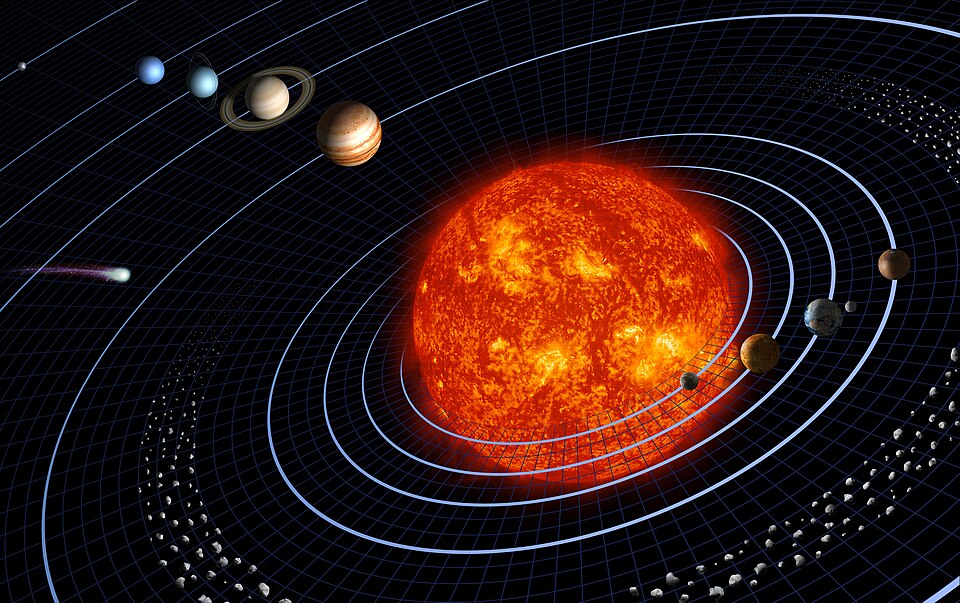
Pause and watch this image while you let the facts of the universe sink into your head...
That's it. These predetermined paths are the ether. Or not really, since they're not a substance and also constantly change. All objects in the universe affect the predetermined paths of other objects, and also get their own movements affected by other objects, which is just another way of saying "gravity". We usually see this gravitational movement - us falling down towards Earth, planets orbiting around the sun, stars travelling around the center of their galaxy - as a deviation from some empty and still vacuum, but that's just our dumb human way of thinking. This gravitational movement is the still thing itself, even if it doesn't look still to us.
And as soon as any of the other three fundamental forces - the electromagnetic force, the strong nuclear force and the weak nuclear force - have a finger in the game, they get objects to move out of their predetermined paths. This is acceleration. Acceleration makes objects move out of their predetermined path, creates the physical sensation of being "pushed back" by the acceleration, and then the objects continue a new predetermined gravity path from where they end up after the acceleration is done.
We feel acceleration as a physical reaction because it's a movement away from something, away from the predetermined paths of gravity, while not accelerating means we follow our predetermined gravitational paths which is the "normal" state and doesn't give us any specific physical reaction. (3)
Your predetermined path on Earth is to fall down to the Earth's core. The ground accelerates you upwards, which lets you stand on the ground. This is why free fall from the sky doesn't give any results on an accelerometer while standing on the ground shows "1g" on it. Because you're constantly accelerated up against the pretermined paths of gravity trying to get you to the Earth's core.
The thing preventing you from falling down through the ground is the electromagnetic force together with the strong and weak nuclear force, which create stable atoms that together form the solid materials in the ground. Every movement away from the predetermined paths of gravity originally comes from these three fundamental forces.
You could argue that this means gravity isn't a force, which general relativity sometimes imply, but you could also say that gravity is a force that creates the predetermined paths, the "normal" movement of the universe, while the other three fundamental forces create the acceleration, the movement away from the predetermined paths. That's just a matter of words. General relativity calls these paths "geodesics" and brings some complicated math to calculate how gravity bends four-dimensional spacetime. Other way less tested theories/hypotheses, like Henry Lindner's "flowing space", say that space itself is a substance that gets consumed by mass, which to me is a more practical description of what actually seems to happen. Not what happens in our abstract equations, but what happens before our eyes.
X. What is acceleration and what is gravity?
Yeah, after writing all of this I really wonder: What is even acceleration, and what is even gravity? And why do they and how they work go against our intuitions about them and against our intuitions about position, movement and speed?
And... What is mass and why does it "suck" things towards it? Why do the "normal" movements of gravity go towards centers of mass and not in a straight direction throughout the whole universe? Why is acceleration absolute when change of speed isn't, and how come we intuitively connect acceleration to speed change when we can't logically prove the connection? Can you ever reach zero acceleration or is there a smallest amount you can't go beneath, and if so, is there really a difference between constant speed and acceleration after all?
But I'll stop here for now.
Footnotes:
(c = the speed of light, ca 300 000 000 m/s)
(1) Knowing this, all weird things happening according to special relativity, where the universe doesn't seem to have a "real" shape but where each individual observerer experiences their own version of the world, starts to make a bit more sense. If we assume that all measurements take time and that everything constantly moves, it's impossible to know if the world is the same for another person at another time or another place as for you. You can't by definition talk about the world as a whole objective thing. The effects of relativity are therefore not illusions or distortions, they're your specific reality. The fact that light always travels in c compared to _you_ (a very weird concept), makes it seem like the world, or at least light, "knows" that individual frames of reference exist. There is no real version of the world, we all experience our own version of it.
(2) For this reason I think the way we talk about the speed of light is often misleading. We say the speed of light is absolute because it's always c compared to YOU. First, that's not really absolute in the way we usually think, it's a speed in relation to something - to yourself. And if we decide this is how we measure speeds generally, the thought experiments like "how would the world look if you travelled at 0.99c?" lose their meaning. If the speed of light is c compared to you, your speed compared to you is 0, always. So you're only travelling in 0.99c in the eyes of someone you're moving away from. They get the "distorted" version of you because of your fast speed, while you don't, because you're completely still. Everyone experiences their own version of the world, according to relativity, and you never experience a version where you travel in 0.99c.
(3) Some particles also radiate electromagnetic waves only when accelerating, another proof that acceleration is more than just change of speed.
 Subscribe to Golden emails
 by
by 
